
Story
The Scream by Munch: meaning, versions and a print
What Munch saw on a fjord road at sunset, why there are four Screams, the madman note he wrote himself, and how to choose a print.
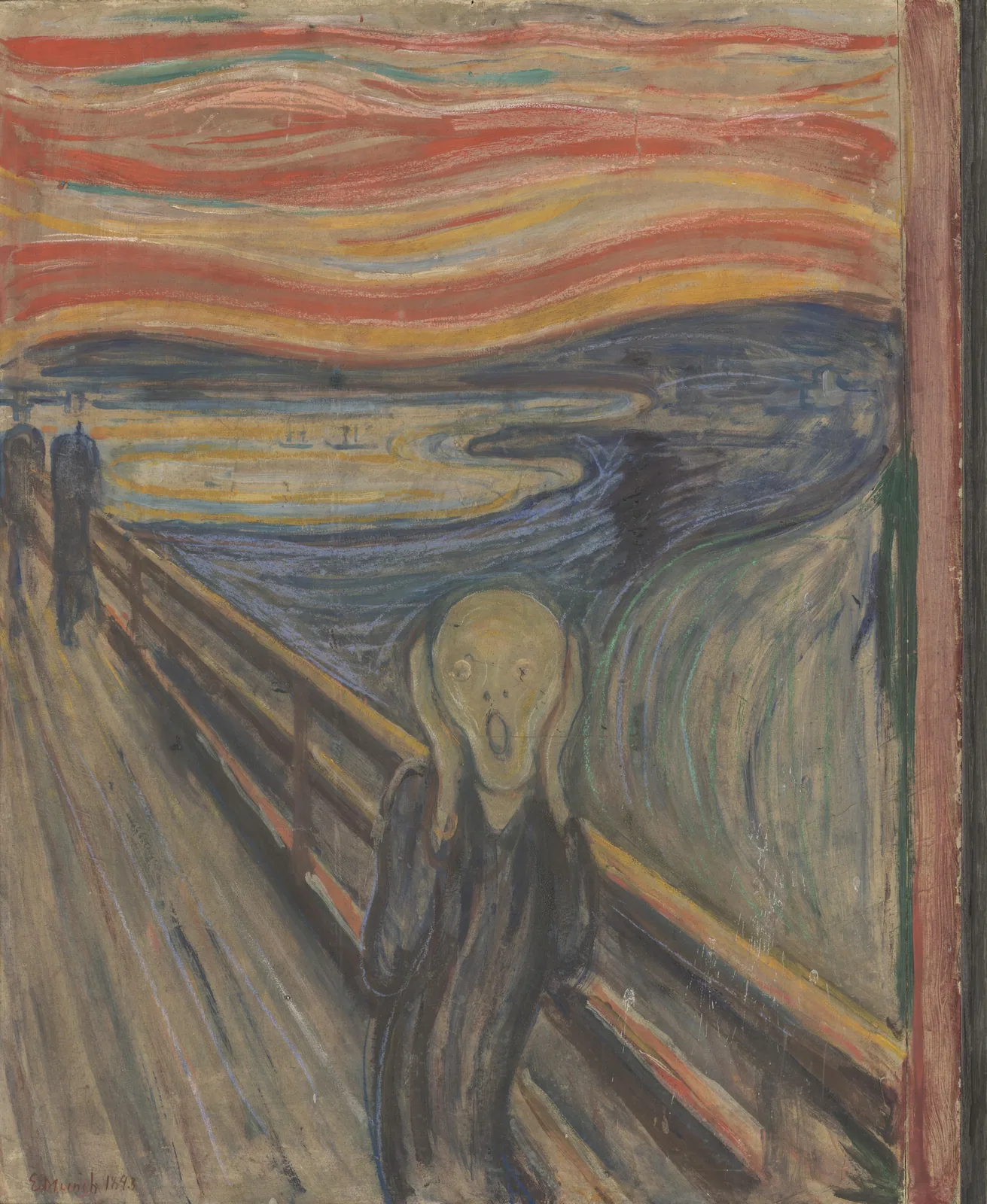
A figure on a road above a fjord presses its hands to its face. Behind it, the sky has turned to bands of red and orange, and two men walk on as if nothing were happening. Edvard Munch painted it in 1893, and it has become the picture everyone reaches for when they want to show dread. This is the first painted version, the one in the National Museum of Norway in Oslo, and it is the one we print.
What Munch saw
The picture began with a walk. In a diary entry headed “Nice 22 January 1892,” Munch remembered walking along a path with two friends as the sun set. The sky turned blood red, his friends walked on, and he stood still, shaking. He wrote that he sensed a scream passing through nature and seemed to hear it. In a later version of the same memory it became “an infinite scream passing through nature.”
The place is usually identified as the road up Ekeberg hill, looking out over the Oslofjord and the city, which was then called Kristiania. Munch’s sister Laura was a patient at an asylum at the foot of the hill when he painted it.
Is the figure screaming?
Not exactly. Munch’s own words describe hearing a scream, not making one: the figure covers its ears against a cry that comes from the landscape itself. That is why the first title it was shown under, in German, was Der Schrei der Natur, “The Scream of Nature.” In Norwegian it is simply Skrik. Many people still read the open mouth as a scream, and the picture works either way: the whole scene seems to be shaking with the same panic as the person in it.
The figure is barely a person at all. It has a head like a skull, no hair, no ears that you can see, and a body that bends like the water behind it. The art historian Robert Rosenblum suggested in 1978 that Munch had in mind a Peruvian mummy shown in Paris at the 1889 World’s Fair. Others have tried to explain the red sky as the after-effects of the 1883 Krakatoa eruption, or as the rare mother-of-pearl clouds that can form in the sky over Norway. None of these is proven, and Munch never said.
“Can only have been painted by a madman”
In the top left corner of the 1893 painting, over the paint, is a faint line in pencil: Kan kun være malet af en gal Mand, “Can only have been painted by a madman.” For a century it was taken for an insult scribbled by an angry visitor. In 2021 the National Museum of Norway studied it with infrared scans and compared it with Munch’s letters and notes. Its curator, Mai Britt Guleng, said the writing is “without a doubt Munch’s own.”
The museum links it to 1895, when the painting was first shown in Kristiania. At a discussion evening at the Students’ Association, a medical student, Johan Scharffenberg, questioned Munch’s mental health in public. The museum thinks Munch wrote the words himself, in 1895 or shortly after, in answer to the criticism.
How many versions of The Scream are there?
Munch made the image several times, in different materials:
- 1893, painted (oil, tempera and pastel on cardboard): National Museum of Norway. The one with the pencil note, and the one we print.
- 1893, crayon or pastel: Munch Museum, Oslo, possibly a first study.
- 1895, pastel: privately owned. It sold at Sotheby’s in New York in 2012 for nearly $120 million, then a record for any work of art at auction.
- 1910, painted: Munch Museum, Oslo.
- 1895, lithograph: a black-and-white print. About four dozen were pulled before the printer wiped the stone.
Stolen, twice
On 12 February 1994 two men broke into the National Gallery in Oslo and took this version, leaving a note that mocked the poor security. Police got it back undamaged on 7 May 1994. Ten years later, on 22 August 2004, masked gunmen took the 1910 version and Madonna from the Munch Museum. Police announced on 31 August 2006 that they had them back; The Scream had water damage in its lower left corner.
Where is The Scream now?
The 1893 painting hangs in the new National Museum of Norway in Oslo, which opened in 2022, in a room of Munch’s work with Madonna and The Dance of Life. The 1910 painting and the early pastel belong to the Munch Museum, also in Oslo.
Look closer
These details come from the scan we print from, 62,429 pixels on the long side. Pick a detail, or zoom in and drag to look around.
A skull-like head, hands pressed to the cheeks, mouth and eyes wide open. It has no hair, no ears and no age.
Choosing a print
Life size. The original is about 36 by 29 inches, and our largest framed print, 29 × 36 in, is almost exactly that. Over a sofa or a desk it has the same pull as the board in Oslo. Framed prints go up to 29 × 36 in, canvas up to 33 × 40 in and unframed art prints up to 39 × 48 in.
A smaller one. At 16 × 20 in it still reads from across a room, because the shapes are so simple. It is a strong picture to live with, so think about where you will see it: a study, a hallway or a reading corner suits it better than a bedroom.
Which material. Munch painted on cardboard, and the surface is dry and chalky, with no gloss. Smooth matte paper in a frame keeps that dry look and every stroke of crayon. Our canvas also has a matte finish and no glass, which suits a bright room; an unframed art print goes up to 39 × 48 in if you want it bigger than life. See our papers and canvas.
Frames. A slim black frame suits the hard graphic shapes and makes it look modern. Natural wood is softer and picks up the brown of the road and the board. A white mat gives the oranges room to breathe. See all our frames and mats.
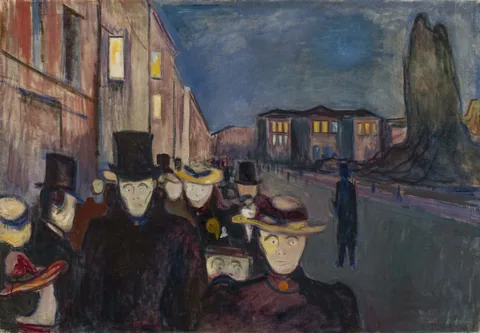
A pair. In 1894 Munch painted the same red sky over a fjord again, this time with a group of pale, staring figures, in Anxiety. Open the two as a set.
Questions
What does The Scream mean?
Munch said it came from a moment on a walk at sunset when he felt a scream passing through nature. It shows a person overwhelmed by fear or anxiety, with the landscape itself seeming to cry out.
Who painted The Scream, and when?
The Norwegian artist Edvard Munch, in 1893. He made other versions in 1893, 1895 and 1910.
Where is the original Scream?
The 1893 painting is in the National Museum of Norway in Oslo. The 1910 painting and a crayon version are in the Munch Museum, also in Oslo.
How big is The Scream?
The 1893 painting is 91 × 73.5 cm, about 36 × 29 in.
Who wrote “Can only have been painted by a madman” on it?
Munch himself, according to the National Museum of Norway’s 2021 study of the handwriting.
Can it be printed legally?
Yes. Munch died in 1944, and his work is now in the public domain. What public domain means.
More Munch
All Munch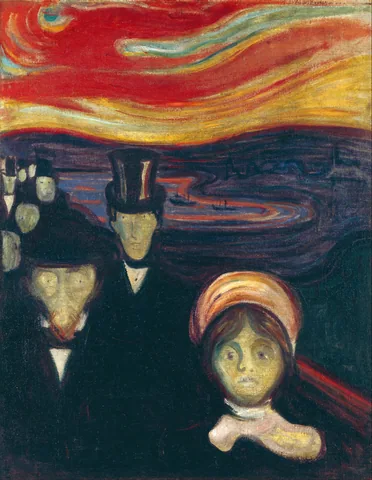
More moody pictures in Moody Landscapes.
Sources
More from the Journal
 Story · 7 min
Van Gogh’s Starry Night: the facts, and choosing a print
Painted in June 1889 at an asylum in Provence: the view from his window, plus a village he made up. What is real, what it means, and which print to choose. Story · 7 min
The Great Wave off Kanagawa: meaning, history and prints
A woodblock print, not a painting, and a storm wave, not a tsunami. What it shows, why no two impressions match, and how to choose a print. Story · 7 min
Klimt’s The Kiss: gold leaf, meaning and choosing a print
Real gold leaf on canvas, finished in 1909. The story of Klimt’s lovers, what a print can and can’t reproduce, and which size to choose. Story · 7 min