
Story
Rachel Ruysch’s Vase of Flowers: the story of a star painter
A bouquet that seems to spill out of the dark, by a painter paid more than Rembrandt. The story of Rachel Ruysch’s flowers, and a print.
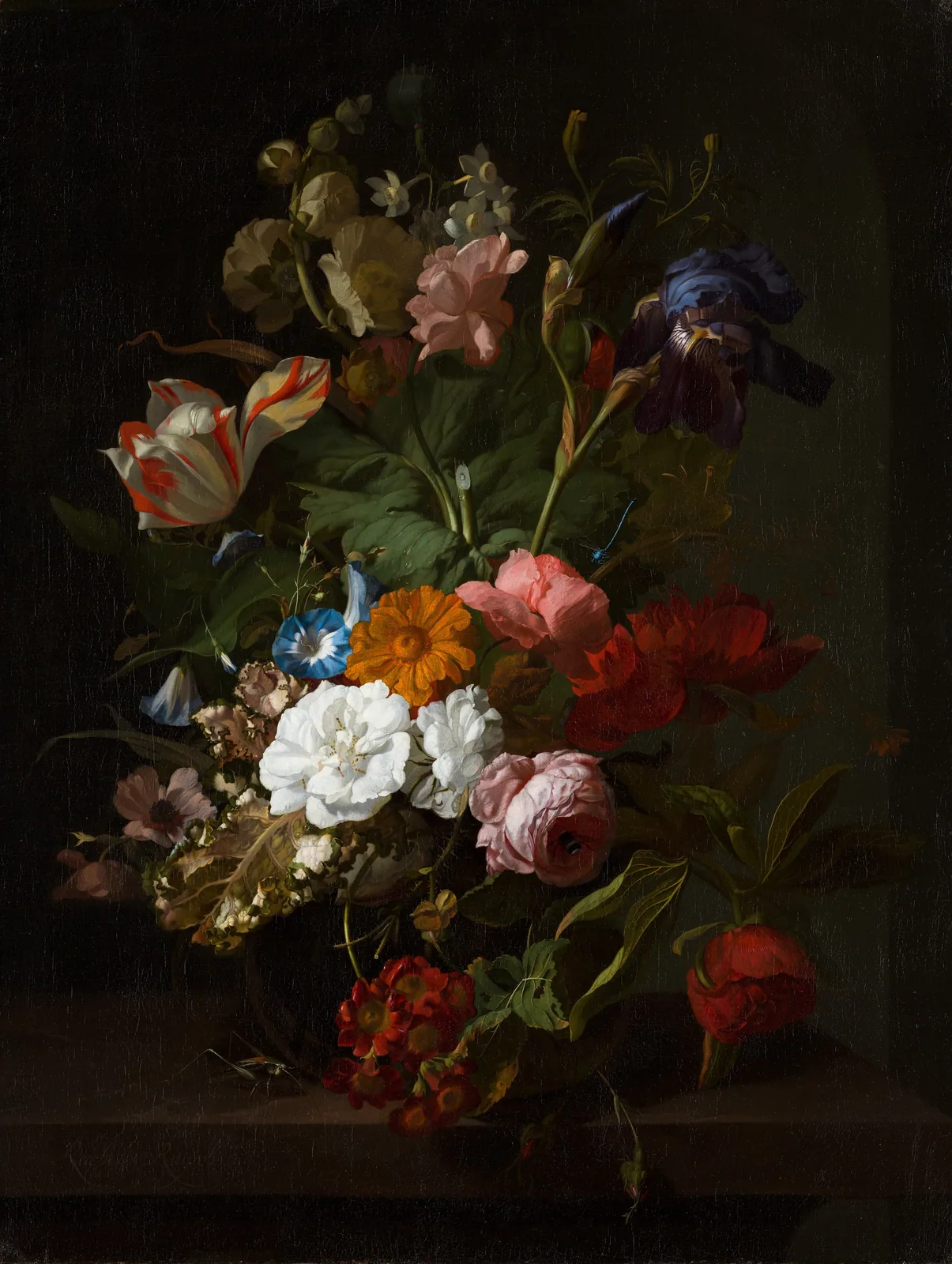
A bouquet rises out of the dark, crowded with flowers of many kinds, their stems and blooms overlapping. Rachel Ruysch painted it in 1700 and signed it at the lower left, “Rachel Ruysch F: 1700.” The F stands for fecit, Latin for “made it,” the way painters of her day signed their work. She was 36 when she painted it, well into a career that had begun more than twenty years before. It hangs in the Mauritshuis in The Hague. In her lifetime Ruysch was one of the most celebrated painters in the Netherlands, and one of the best paid.
A painter paid more than Rembrandt
Flower paintings could command high prices, and Ruysch was at the top of the field. Her paintings sold for 750 to 1,200 guilders. Rembrandt rarely received more than 500 guilders for a painting in his lifetime. She worked for more than six decades, from the age of 15 to about 83, and more than 250 works have been documented or attributed to her.
She had the honors to match. In 1701, the year after she painted this picture, she and her husband joined the painters’ guild in The Hague. She was offered membership in the Confrerie Pictura, the Hague artists’ society, as its first female member. And from 1708 until his death in 1716 she was court painter to Johann Wilhelm, the Elector Palatine, in Düsseldorf.
The anatomist’s daughter
Ruysch grew up surrounded by nature, in an unusual way. Her father, Frederik Ruysch, was a professor of anatomy and botany, and an amateur painter, with a large collection of specimens. She learned to draw by studying it. At fifteen, in 1679, she was apprenticed to the flower painter Willem van Aelst in Amsterdam, and she stayed with him until his death in 1683.
In 1693 she married the portrait painter Juriaen Pool. They had ten children, and she kept painting professionally the whole time. She often added her age to her signature, which has helped historians date her work.
A bouquet that moves
To see what was new about her flowers, it helps to know where the genre began. Around 1600, painters such as Jan Brueghel the Elder, Ambrosius Bosschaert and Roelandt Savery were among the first to make pictures of nothing but flowers. This was a time of new botanical gardens and a lively international trade in rare plants, and by the 1630s the prices of the most prized bulbs had soared, an episode remembered as tulip mania. The early flower pieces were flat, symmetrical arrangements, often of flowers that bloom in different seasons, set side by side like specimens.
Over the century, bouquets grew looser, with asymmetrical arrangements and overlapping blooms that suggest real depth. Ruysch made that freedom her own. Her bouquets are dynamic and asymmetrical, with drooping flowers, wild, twisting stems and lively diagonals, usually set against a dark background that makes the colors glow. The brushwork is painstaking: petals, leaves and the tiny creatures that often live among them are painted with a scientist’s care. The result is a bouquet that seems to be growing and moving, not posed.
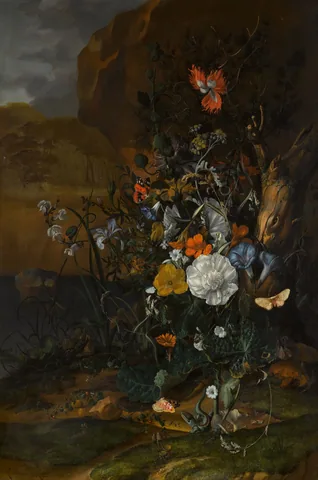
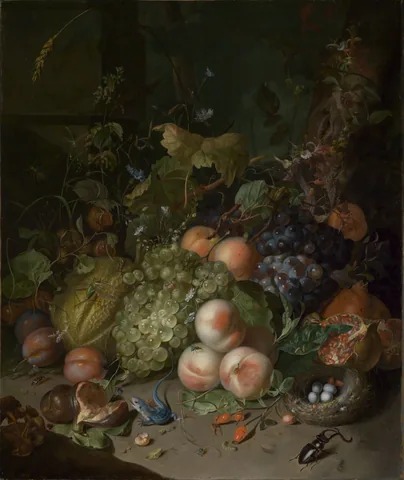
Her early work also includes “forest floor” pictures, with small animals and fungi among the plants. The store has one of her later woodland scenes, Fruit, a Nest, a Lizard and Insects in a Wood, and her large Roses, Convolvulus, Poppies and Other Flowers in an Urn.
More than decoration
Dutch flower pieces were never only pretty pictures. The National Gallery’s director, Gabriele Finaldi, has described them as often rich in symbolism and historic interest. They spoke of wealth, since rare flowers were costly, and of science, since they were painted in an age of new botanical gardens and careful study of plants. A bouquet that included the finest flowers of the season was a display of knowledge as much as of taste.
Ruysch was perfectly placed for both. She had grown up among her father’s scientific specimens and trained with a leading flower painter, and her pictures combine the eye of a naturalist with the sense of movement of an artist. That combination is a large part of why collectors, and a prince, paid so much for them.
How to look at it
Give it time. Start where the light is strongest, on the biggest blooms near the center, then follow a stem as it curls out to the edge and turns back. Find the flowers that hang down, heavy and open, and the buds that have not opened yet. Look for the small things, the leaves turned over to show their undersides, and any insects that have settled on the petals. A painting like this was made to be studied up close, slowly, the way you might look at a real bouquet on a table.
Rediscovered
Today her reputation is rising again. In 2021 the Rijksmuseum in Amsterdam added her work to its Gallery of Honour, making her one of the first women included. In 2024 and 2025 a major exhibition, Rachel Ruysch: Nature into Art, was organized by the Alte Pinakothek in Munich, the Toledo Museum of Art and the Museum of Fine Arts, Boston, and its catalogue won the 2024 George Wittenborn Memorial Book Award.
Choosing a print
Size. The original is about 31 by 24 inches. Our scan is 6,000 pixels on its long side, enough for a print the size of the painting or larger: up to 27 × 36 in framed, or 30 × 40 in on canvas. Framed prints go up to 27 × 36 in, canvas up to 30 × 40 in and unframed art prints up to 30 × 40 in. At 18 × 24 in it suits a dining room or a hallway.
Paper or canvas. The dark background and the glowing petals are richest on smooth paper behind glazing. Canvas gives a painted surface and no reflections, which helps against a dark ground. See our papers and canvas.
Frames and walls. A gold or dark wood frame is the traditional match for a Dutch flower piece. It looks wonderful on a deep green, navy or warm white wall, and in a dining room or a bedroom. See our frames.
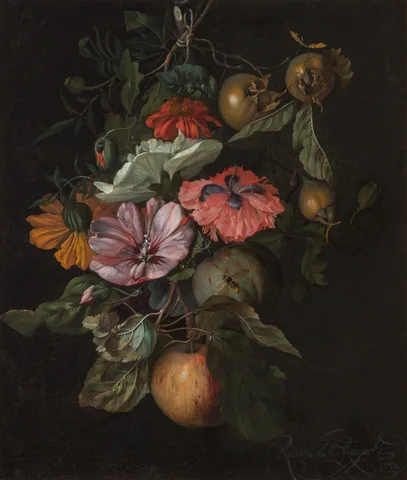
Pairing. Two flower pieces hung side by side make a classic pair. Try it with her Roses, Convolvulus, Poppies and Other Flowers in an Urn, or with one of her woodland scenes for contrast. For more ideas, see our guide to botanical prints.
Questions
Who was Rachel Ruysch?
A Dutch flower painter, trained by Willem van Aelst, who worked for more than sixty years and was court painter to the Elector Palatine in Düsseldorf. Her paintings sold for more than Rembrandt’s.
Where is Vase of Flowers?
In the Mauritshuis, The Hague. It is signed and dated 1700, and measures 79.5 × 60.2 cm.
What makes her flower paintings special?
Loose, asymmetrical bouquets with twisting stems and drooping blooms on a dark ground, painted with great precision.
How do we know when she painted each picture?
She signed and dated many of them, and often added her age to the signature, which helps historians date her work.
Can it be printed legally?
Yes. Ruysch died in 1750, and the painting is in the public domain. What public domain means.
More Rachel Ruysch
All Rachel Ruysch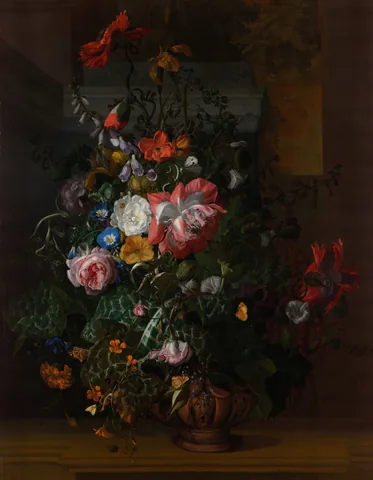
More in Botanical and Flowers.
Sources
More from the Journal
 Story · 7 min
Van Gogh’s Starry Night: the facts, and choosing a print
Painted in June 1889 at an asylum in Provence: the view from his window, plus a village he made up. What is real, what it means, and which print to choose. Story · 7 min
The Great Wave off Kanagawa: meaning, history and prints
A woodblock print, not a painting, and a storm wave, not a tsunami. What it shows, why no two impressions match, and how to choose a print. Story · 7 min
Klimt’s The Kiss: gold leaf, meaning and choosing a print
Real gold leaf on canvas, finished in 1909. The story of Klimt’s lovers, what a print can and can’t reproduce, and which size to choose. Story · 7 min