
Story
Rembrandt’s The Jewish Bride: who they are, and a print
One of the great pictures of love, with paint you could almost touch. Who the couple may be, where the name came from, and how to choose a print.
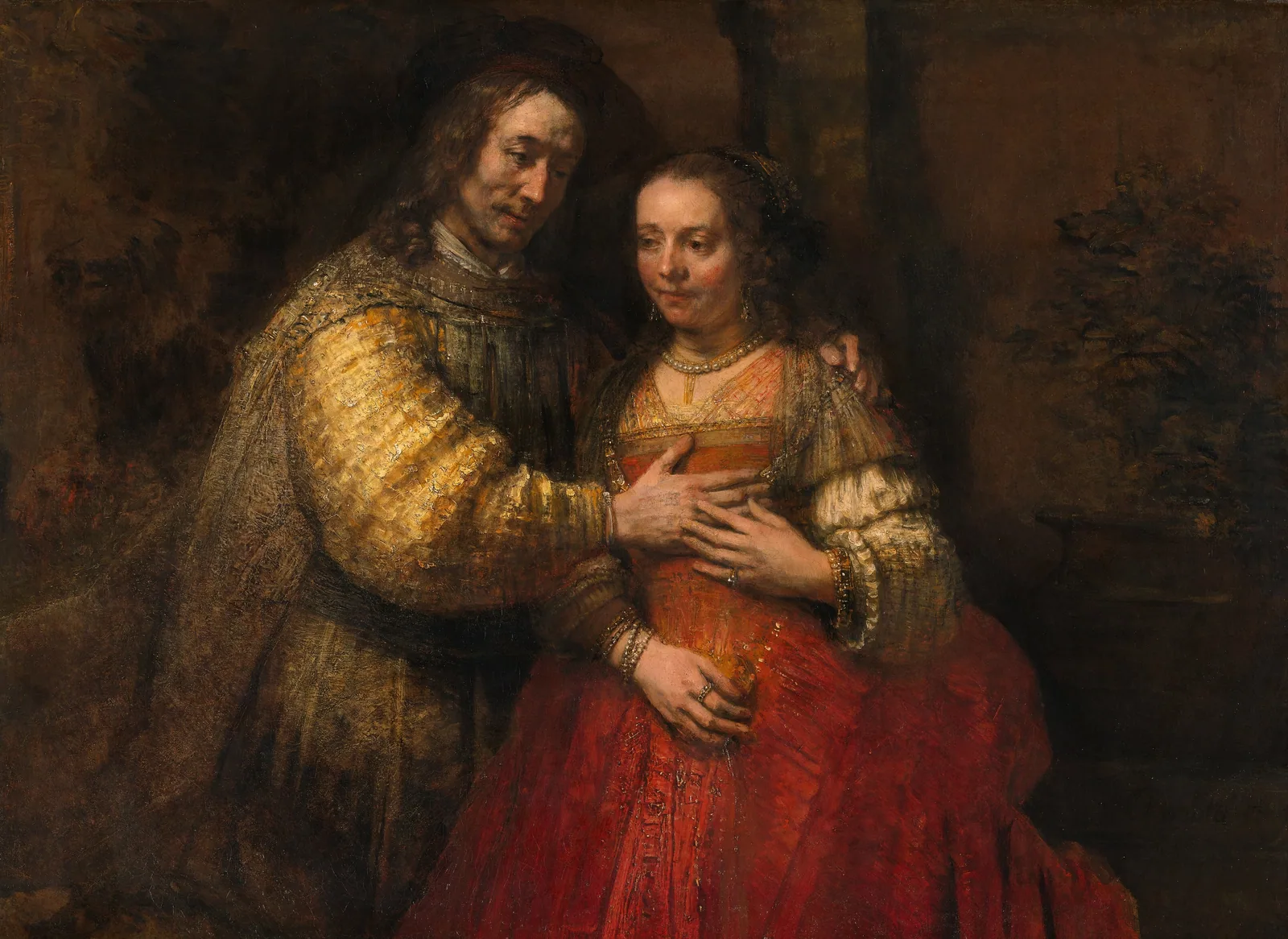
A man puts his arm around a woman and rests his hand on her chest. She lays her fingers lightly on his. He looks down at her; she looks away, thinking. Nothing else happens, and nothing else needs to. Rembrandt painted it late in his life, between about 1665 and 1669, and the Rijksmuseum calls it one of the most famous embraces in the art of painting. The biographer Christopher White called it “one of the greatest expressions of the tender fusion of spiritual and physical love in the history of painting.”
Who are the couple?
Nobody knows for certain. The Rijksmuseum’s title is Isaac and Rebecca, after the couple in the Book of Genesis. In the Bible story, Isaac hid his love for Rebecca by pretending that they were brother and sister, until the king saw them embracing. A drawing Rembrandt made a few years earlier, around 1662, shows Isaac and Rebecca in a similar pose, which supports the idea. The museum adds that they may be other Old Testament figures.
Others have suggested real people dressed in biblical costume: Rembrandt’s son Titus and his bride, or the poet Miguel de Barrios and his wife. It may well be both, a portrait of a real couple presented as a story from scripture.
Why is it called The Jewish Bride?
The nickname is a mistake that stuck. In the early 1800s an Amsterdam art collector decided that the picture showed a Jewish father giving his daughter a necklace on her wedding day. That reading is no longer accepted, but the name has stayed with the painting for two centuries.
Paint you can almost touch
Up close, the painting is astonishing. In the museum’s words, Rembrandt “applies the paint thickly, and scratches into it with the butt end of his paintbrush.” The man’s gold sleeve is built up so heavily that it rises from the canvas like a crust, catching the light along its ridges. The woman’s red dress is laid on in layers and dragged across. The museum points to the contrast between the quiet, tender mood and this bold handling of the clothes.
The picture was not always meant to look like this. Technical study suggests Rembrandt first planned a larger, busier composition and simplified it as he worked, down to two people and their hands. His signature at the lower left shows the canvas is close to the size he finished it.
Where is The Jewish Bride now?
In the Rijksmuseum in Amsterdam, in the Gallery of Honour, the same museum as The Night Watch. It belongs to the City of Amsterdam, part of a bequest by the collector A. van der Hoop, and is on loan to the museum. The canvas is about 48 by 65½ inches.
Look closer
These details come from the scan we print from, 5,486 pixels on the long side. A print is flat, so the ridges of paint become light and shadow, but you can still see every scratch. Pick a detail, or zoom in and drag to look around.
His hand rests gently on her chest; her fingers touch his. The heart of the picture.
Choosing a print
Size. The original is big, about 48 by 65½ inches. Our largest framed print is 36 × 26 in. Framed prints, canvas and unframed art prints all go up to 36 × 26 in. The wide shape suits the wall over a bed, a sofa or a sideboard. At 24 × 17 in it fits a narrower wall.
Where it works. A bedroom is the natural home for a painting about love, and it is one of the best wedding and anniversary gifts in art. See what to hang over a bed and our gift guide.
Mind the dark. The background is deep brown. Behind clear acrylic, dark areas reflect a facing window, so hang a framed print with side light, or choose canvas, which has a matte finish and no cover and suits this most painterly of pictures. See canvas and our papers.
Frames. A wide gold frame like our Gold Plein Air echoes the gold sleeve; black wood makes the red glow. See all our frames.
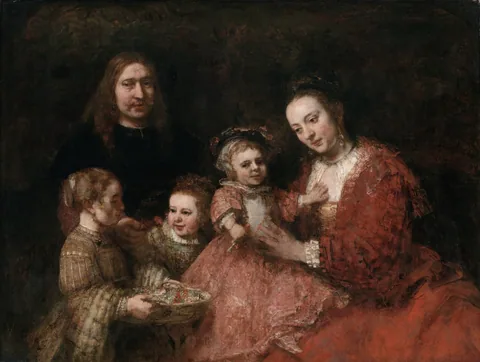
A pair from the same years. Rembrandt’s late Portrait of a Family (1668) is painted in the same warm reds. Open the two as a set.
Questions
Who is in The Jewish Bride?
Probably Isaac and Rebecca from the Book of Genesis, perhaps modeled on a real couple. The museum titles it Isaac and Rebecca.
Why is it called The Jewish Bride?
An early 19th-century collector thought it showed a Jewish father giving his daughter a necklace on her wedding day. The idea has been dropped, but the name stuck.
Where is The Jewish Bride?
In the Rijksmuseum in Amsterdam, on loan from the City of Amsterdam.
How big is it?
121.5 × 166.5 cm, about 48 × 65½ in.
Can it be printed legally?
Yes. It is more than 350 years old and in the public domain. What public domain means.
More Rembrandt
All Rembrandt
More in Dutch and Flemish Masters and Old Masters.
Sources
More from the Journal
 Story · 7 min
Van Gogh’s Starry Night: the facts, and choosing a print
Painted in June 1889 at an asylum in Provence: the view from his window, plus a village he made up. What is real, what it means, and which print to choose. Story · 7 min
The Great Wave off Kanagawa: meaning, history and prints
A woodblock print, not a painting, and a storm wave, not a tsunami. What it shows, why no two impressions match, and how to choose a print. Story · 7 min
Klimt’s The Kiss: gold leaf, meaning and choosing a print
Real gold leaf on canvas, finished in 1909. The story of Klimt’s lovers, what a print can and can’t reproduce, and which size to choose. Story · 7 min