
Story
Renoir’s The Umbrellas: two styles in one painting
A Paris street in a sudden shower, begun around 1881 and finished years later in a new style. What the X-rays show, and choosing a print.
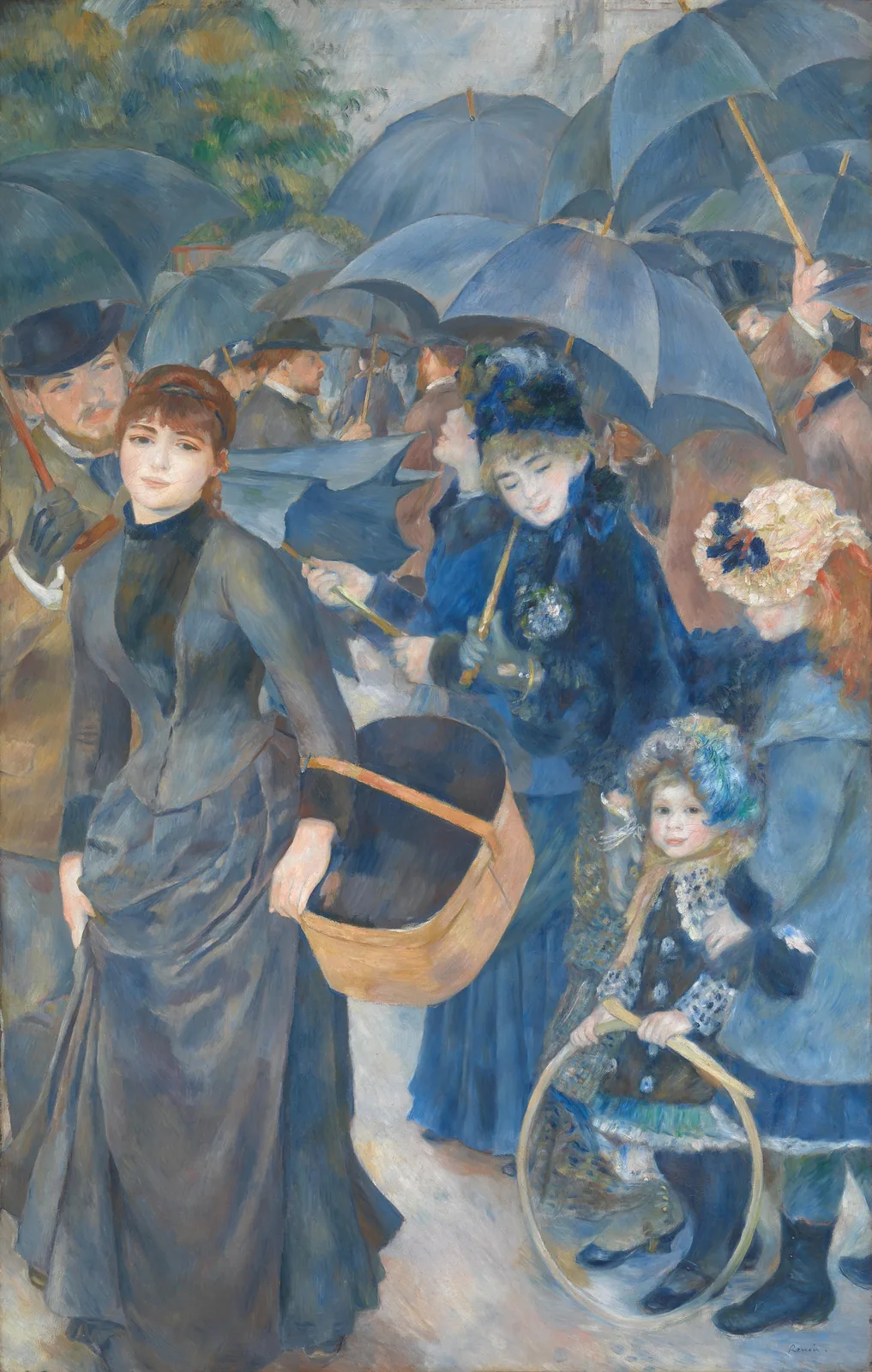
A shower has caught a crowd on a Paris street, and the umbrellas go up. On the left a young woman with a hatbox has no umbrella at all; a bearded young man behind her seems about to offer his. On the right a mother looks down at her two little girls, one holding a hoop. Pierre-Auguste Renoir began the painting around 1881 and came back to it years later, and you can see both visits in the finished picture.
Two styles in one painting
Renoir painted the first version around 1880 to 1881 in his Impressionist manner: loose brushwork, dark and bright tones. Around 1885 he returned to it. By then he had turned away from Impressionism, drawing on the classical art he had seen in Italy and on the painters Ingres and Cézanne. He repainted the woman on the left in a crisp, linear style with muted colors, and added the background and the umbrellas.
Compare the two sides. The mother and her daughters on the right are soft and feathery; the young woman on the left is firmly drawn, her gray-blue dress smooth and plain.
What the X-rays show
X-rays reveal that the woman on the left first wore a hat and a dress with horizontal frills and white lace at the collar and cuffs, the clothes of a middle-class woman. In the repainting she lost them. Her simple dress, bare head and hatbox now make her a working milliner’s assistant. Her model was Suzanne Valadon.
Fashion helps date the work too. The little girls wear the afternoon styles of 1881, and the changes in clothing help date the second stage. Analysis of the paint confirms two stages, with layers dated to 1881 and 1886.
Rain starting, or stopping?
A woman in the center, half hidden by the mother, is raising or lowering her umbrella, so we cannot tell whether the rain is starting or stopping. The composition is unusual: the focus is off center, and many figures are cut off by the edges, like a snapshot. Among the angles of the umbrellas, the round hatbox and hoop stand out.
Where is The Umbrellas?
Renoir kept it for years, perhaps unsure how the public would take its mix of styles, and sold it to the dealer Paul Durand-Ruel in 1892. Durand-Ruel sold it to the collector Sir Hugh Lane, who died in the sinking of the Lusitania in 1915. A long dispute over his will followed. Today the painting belongs to the National Gallery in London, and under a 1959 agreement it is shown in turns in London and at the Hugh Lane gallery in Dublin.
Look closer
These details come from the scan we print from, 4,226 pixels on the long side. Pick a detail, or zoom in and drag to compare the two styles.
No hat, no umbrella, looking straight at us. The model was the young Suzanne Valadon.
Choosing a print
Tall and narrow. The canvas is almost six feet tall. Our scan prints sharply up to 15 × 24 in, well under life size, and we don’t sell it bigger than that. Framed prints, canvas and unframed art prints all go up to 15 × 24 in.
Where it works. The tall shape suits a narrow wall: beside a door, in a hallway or an entryway, where umbrellas belong. At 15 × 24 in it fits between two windows. See how high to hang art.
Which material. The blues and grays suit smooth cotton paper in a frame, or canvas, with its matte finish and no cover. See our papers and canvas.
Frames. Slim black echoes the dark coats and hats; white wood brightens the grays. See all our frames.
Rain in Paris. Pair it with Caillebotte’s Paris Street; Rainy Day. Open the two as a set.
Questions
Why does The Umbrellas look like two different paintings?
Renoir painted it in two stages, around 1881 and around 1885, and changed his style in between.
Who is the woman with the hatbox?
A milliner’s assistant. The model was Suzanne Valadon.
Where is The Umbrellas?
It belongs to the National Gallery in London and is shown in turns in London and at the Hugh Lane in Dublin.
How big is it?
180.3 × 114.9 cm, about 71 × 45 in.
Can it be printed legally?
Yes. Renoir died in 1919, and his paintings are in the public domain. What public domain means.
More Renoir and Paris
All Renoir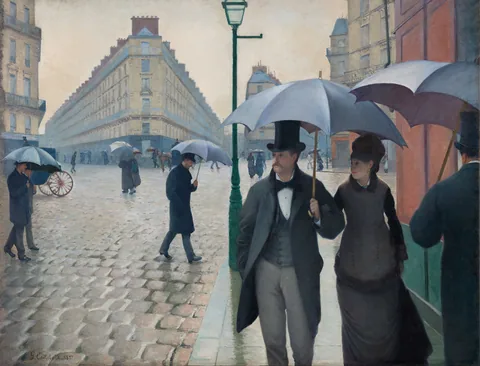
More in Impressionists and Cityscapes.
Sources
More from the Journal
 Story · 7 min
Van Gogh’s Starry Night: the facts, and choosing a print
Painted in June 1889 at an asylum in Provence: the view from his window, plus a village he made up. What is real, what it means, and which print to choose.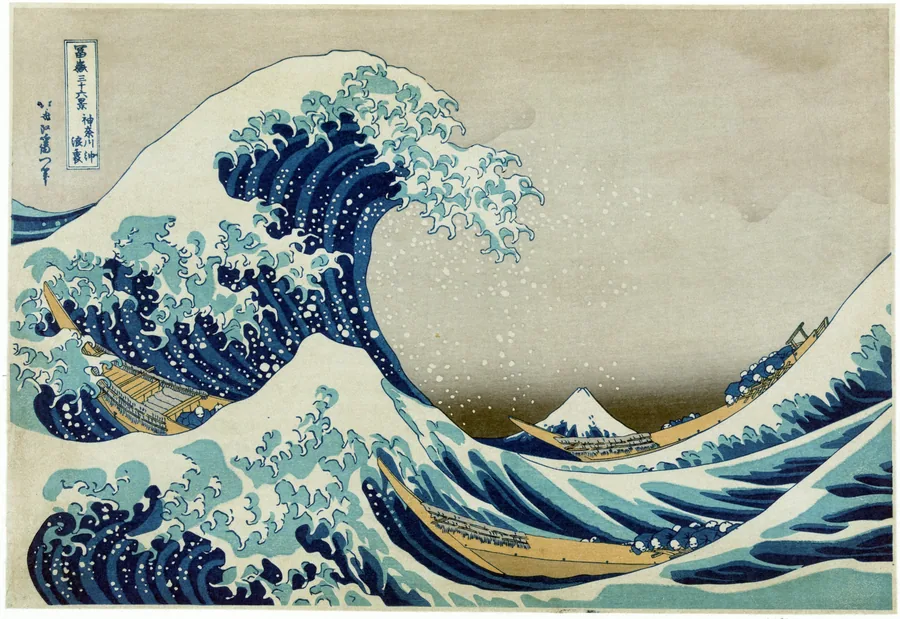 Story · 7 min
The Great Wave off Kanagawa: meaning, history and prints
A woodblock print, not a painting, and a storm wave, not a tsunami. What it shows, why no two impressions match, and how to choose a print.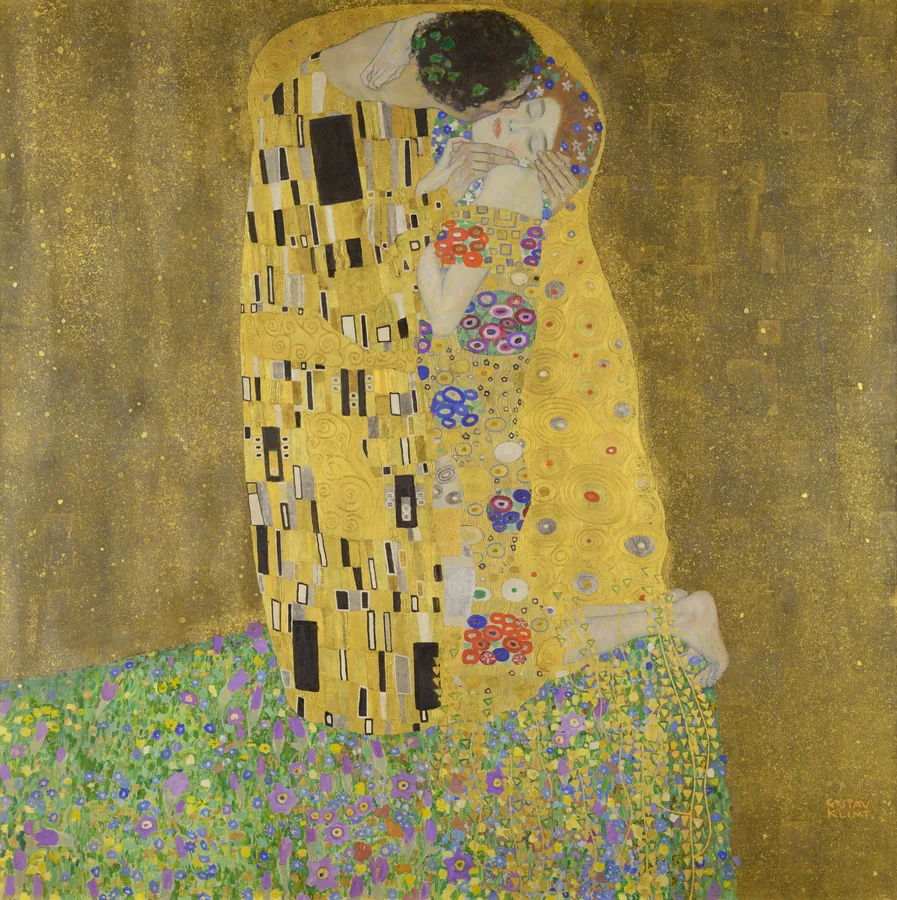 Story · 7 min
Klimt’s The Kiss: gold leaf, meaning and choosing a print
Real gold leaf on canvas, finished in 1909. The story of Klimt’s lovers, what a print can and can’t reproduce, and which size to choose. Story · 7 min