
Story
Rousseau’s Tiger in a Tropical Storm: story and meaning
A tiger in a storm-lashed jungle, by a painter who never left France. What the tiger is doing, how Rousseau made it, and choosing a print.
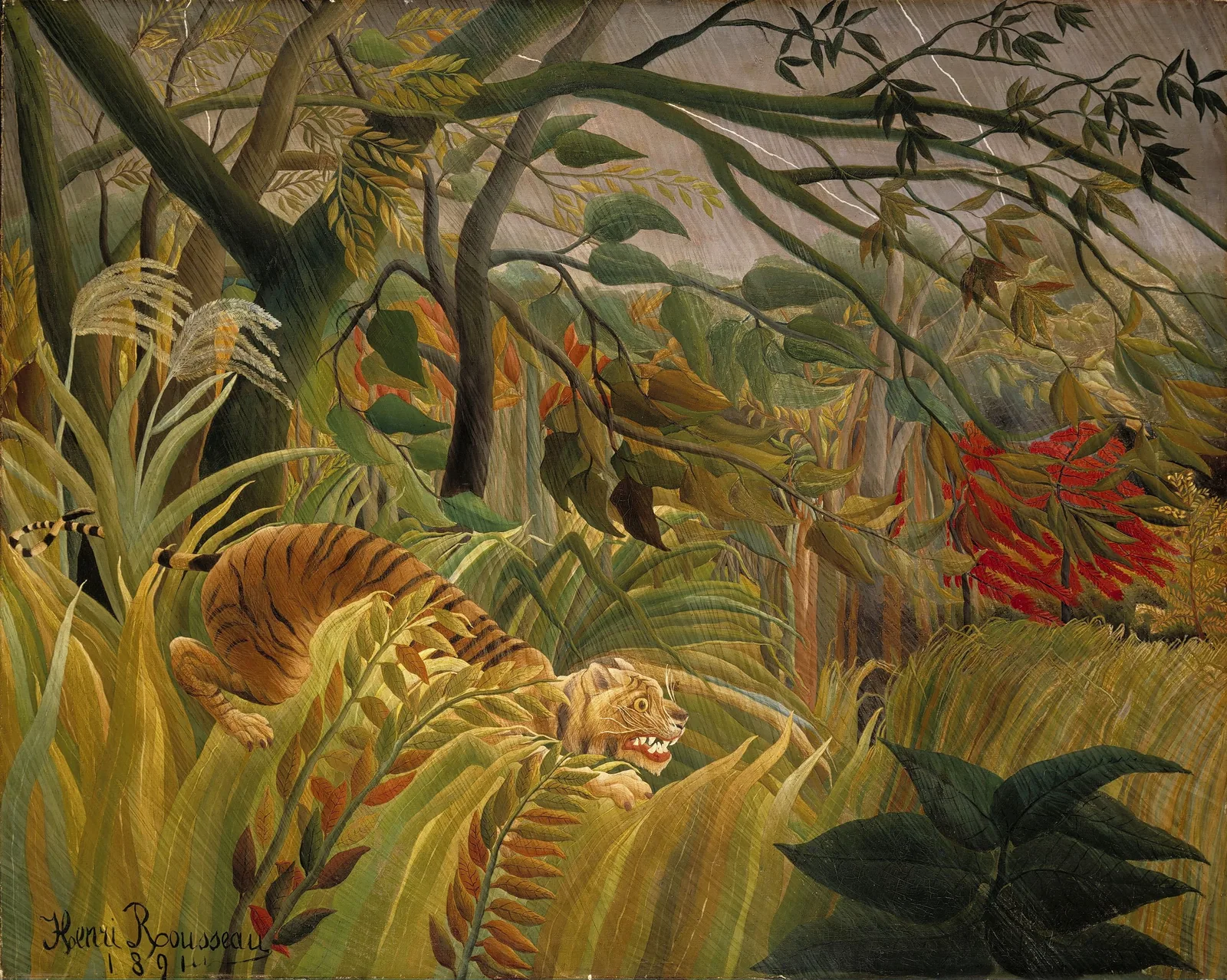
A tiger crouches low in thick jungle, its back arched and its teeth bared, while a storm breaks over it. Rain slants across the whole picture, and a flash of lightning lights up the tiger’s stripes. Henri Rousseau painted it in 1891, and it was the first of the jungle pictures that would make him famous. When he first showed it, he called it Surprised, or Surpris in French, and the National Gallery in London, which owns it, still uses that name.
What is the tiger doing?
That is the question the painting leaves open, and part of why people keep coming back to it. The National Gallery notes that it is unclear whether the tiger is cowering from the lightning or stalking its prey. One reading is that it is about to pounce on something just outside the frame, so you have to imagine what comes next. Rousseau himself, years later, said the tiger was about to attack a group of explorers. But nothing in the picture shows them, and the bared teeth can be read as fright as easily as menace. Is the tiger surprising its prey, or has the storm surprised the tiger? The title works both ways.
The pose has a history of its own. The frightened, crouching tiger comes from a motif in the work of Eugène Delacroix, the great French Romantic painter. Rousseau took that idea and set it in a jungle of his own invention.
A jungle he never saw
A story grew up that Rousseau had seen real jungles in Mexico. It is not true. He never left France, and his jungles were made in Paris. He went to the Jardin des Plantes, the city’s botanical garden, to study the tropical plants, and he looked at stuffed animals, prints and illustrated books. The National Gallery suggests the jungle is built from house plants he saw at the botanical gardens, and that the tiger may be put together from stuffed specimens, illustrations and an ordinary domestic cat.
That is why the jungle looks the way it does. It is not a record of a real forest but an imagined wall of leaves, each one carefully shaped. The effect is less like a window onto a faraway place than like a dream of one, and that dreamlike quality is what later artists would prize in him.
How he painted the storm
Rousseau built the jungle up in layers, using many different shades of green, so that the leaves seem to stack one behind another into the depth of the picture. Then he added the weather. The rain is not suggested by a blur or a haze; it is painted as fine strands of silver drawn diagonally across the canvas, one by one. That smooth, careful finish has been linked to the satin-smooth surfaces of William-Adolphe Bouguereau, one of the most admired academic painters of the day.
It was an odd combination: the polish of the academy and the flat, patterned look of a picture made by someone with no training at all. Critics at the time saw mostly the second. Today it is the mix of the two that makes his jungles feel so strange and so memorable. The original is big, about 130 by 162 cm, a little over four feet tall and five feet wide.
The customs officer who taught himself
Rousseau had no training as an artist. For years he worked as a toll and tax collector for the city of Paris, which is why he is known as Le Douanier, the customs officer, a nickname that began as a joke about his job. His first known picture dates from when he was 35, and he began painting seriously in his early forties. He retired from his job in 1893 to paint full time. He liked to say he had no teacher other than nature.
The jury of the official Salon had turned his work down, so he showed at the Salon des Indépendants, an exhibition with no jury, open to any artist. That is where the tiger first appeared in 1891. Most critics laughed at it and called it childish. One who did not was the painter Félix Vallotton, who wrote that the tiger surprising its prey was a must-see.
The jungles that followed
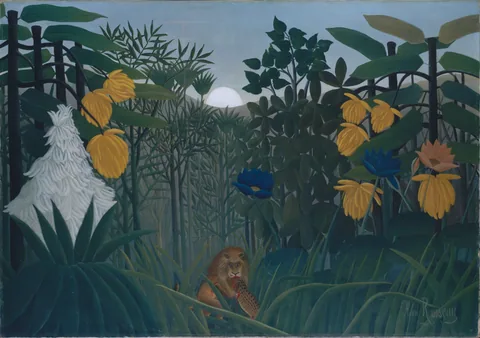
Rousseau did not paint another jungle for about seven years. In 1898 he showed Struggle for Life, now lost, and from then on the jungle became one of his great subjects, with more tigers in Tiger Hunt, Scouts Attacked by a Tiger of 1904, and two pictures of a tiger fighting a buffalo in 1908. In between came other dream pictures, among them The Sleeping Gypsy of 1897, now at the Barnes Foundation, and at the very end The Dream, shown in March 1910. The shop has two of his later jungle pictures, Tropical Forest with Monkeys and The Repast of the Lion, and you can see the same thick wall of leaves running through them.
His reputation changed slowly. The dealer Ambroise Vollard bought the tiger around 1908 for 190 francs. That same year Pablo Picasso held a half-serious banquet in Rousseau’s honor at the Bateau-Lavoir, the Montmartre building where Picasso had his studio. Ridiculed by critics for most of his life, Rousseau came to be seen as a self-taught original, and his dreamlike jungles influenced the Surrealists. The National Gallery bought the tiger in 1972, with funds given in part by Walter Annenberg.
Choosing a print
Size. Our scan of this painting is 3,000 pixels on its long side, which prints sharply only up to a medium size, so we keep it there: framed up to 20 × 16 in, canvas up to 20 × 16 in. That is plenty for a desk wall, a hallway or a child’s room, anywhere you will see the tiger up close.
Paper or canvas. The silver rain and the many greens are sharpest on smooth paper behind glazing. Canvas suits the painted surface and has nothing to reflect the light, which helps in a bright room. See our papers and canvas.
Frames and walls. A black frame sharpens the dark jungle; a gold one warms the tiger’s orange. It looks good on a deep green or a warm white wall. See our frames.
Pairing. Hung beside one of his later jungles, such as Tropical Forest with Monkeys, it makes a pair that shows how the same imagined forest grew over nearly twenty years, from a single crouching tiger to a whole world of leaves.
Questions
Is Tiger in a Tropical Storm the same as Surprised?
Yes. Rousseau first showed it in 1891 as Surpris, Surprised, and the National Gallery still uses that title.
What is the tiger doing?
Either stalking prey outside the picture or shrinking from the lightning; nobody can say for sure. Rousseau later said it was about to attack explorers.
Did Rousseau ever see a jungle?
No. He never left France. He studied the plants and stuffed animals at the Jardin des Plantes in Paris, and pictures in books.
Where is it?
In the National Gallery, London, since 1972. It is about 130 × 162 cm.
Can it be printed legally?
Yes. Rousseau died in 1910, and the painting is in the public domain. What public domain means.
More Henri Rousseau
All Henri Rousseau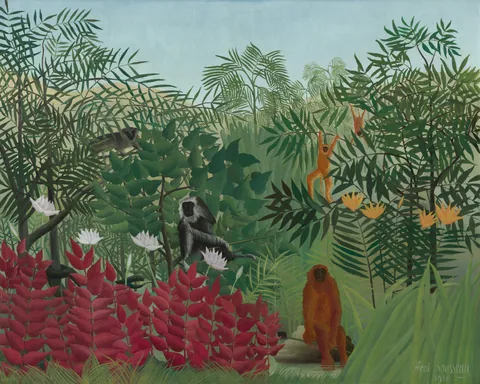
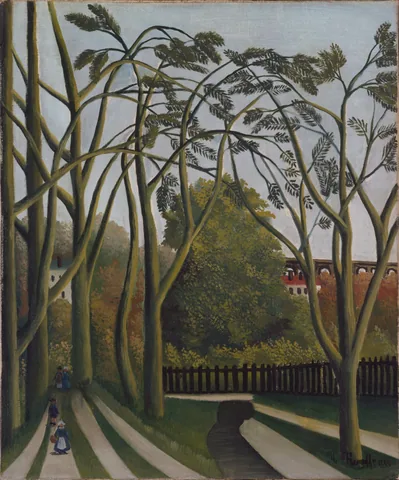
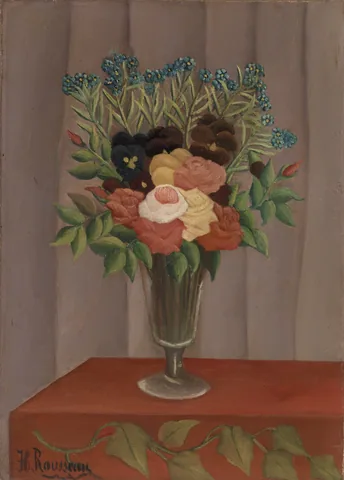
More in Birds and Animals.
Sources
More from the Journal
 Story · 7 min
Van Gogh’s Starry Night: the facts, and choosing a print
Painted in June 1889 at an asylum in Provence: the view from his window, plus a village he made up. What is real, what it means, and which print to choose. Story · 7 min
The Great Wave off Kanagawa: meaning, history and prints
A woodblock print, not a painting, and a storm wave, not a tsunami. What it shows, why no two impressions match, and how to choose a print. Story · 7 min
Klimt’s The Kiss: gold leaf, meaning and choosing a print
Real gold leaf on canvas, finished in 1909. The story of Klimt’s lovers, what a print can and can’t reproduce, and which size to choose. Story · 7 min