
Story
The Church at Auvers: Van Gogh’s violet church
A village church, violet against pure cobalt, painted in Auvers in June 1890. What Van Gogh wrote about it, what it may mean, and choosing a print.
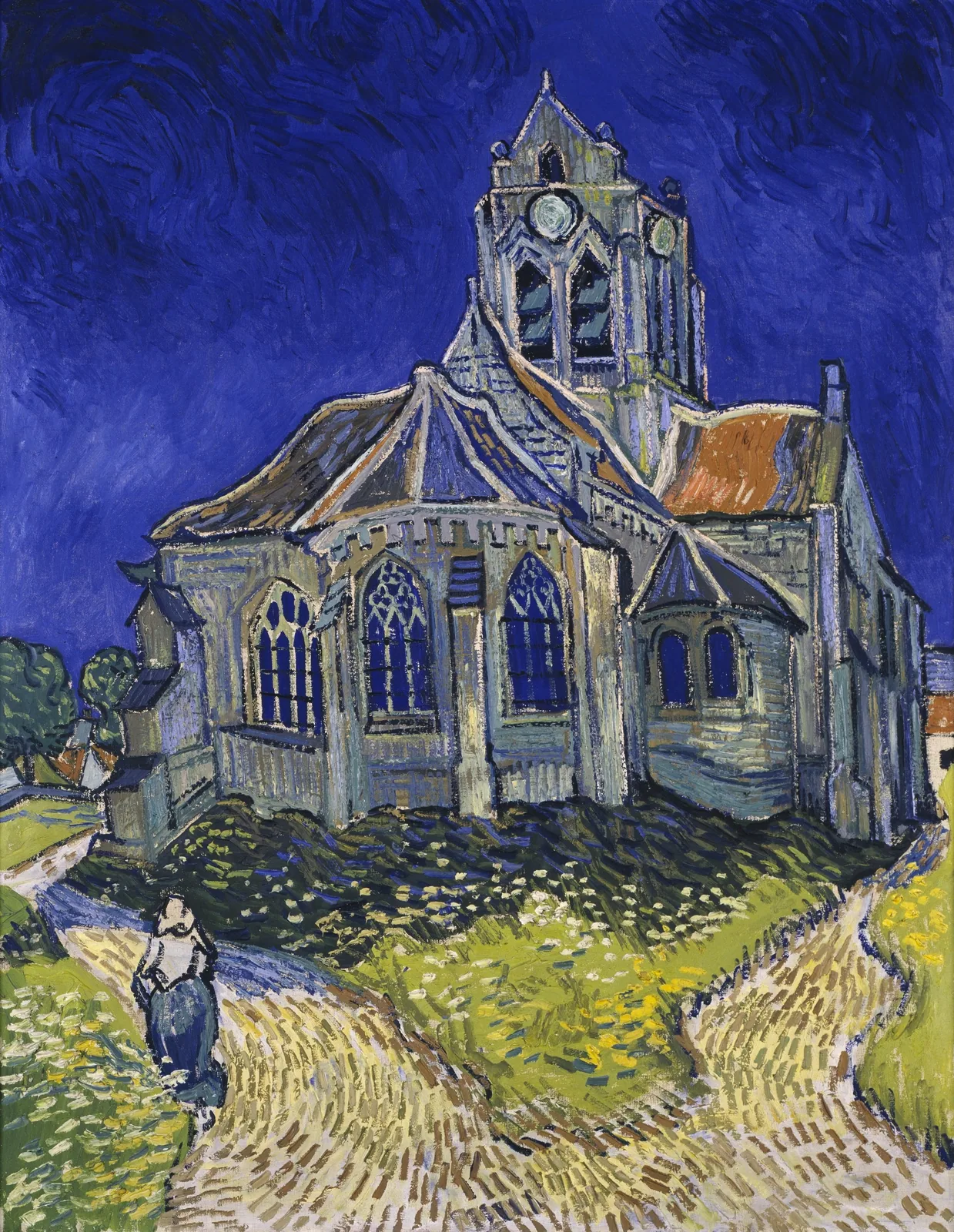
A village church looms against a sky of deep, almost black blue. Its walls bend and sway, its windows are filled with the same blue as the sky, and in front the sunlit path splits in two around it while a woman walks away. Vincent van Gogh painted it in Auvers-sur-Oise in June 1890, in the last weeks of his life, and it is one of the most haunting pictures he made there.
The church
It is the Église Notre-Dame-de-l’Assomption, the parish church of Auvers-sur-Oise, a village about 27 km northwest of Paris. Van Gogh moved there in 1890, after his stay at the asylum in Saint-Rémy, to be near the doctor Paul Gachet; see the story of his portrait. He painted the church a few weeks after arriving, at the same time as the portrait.
In his own words
On 5 June 1890 he described it in a letter to his sister Wilhelmina. In this painting, he wrote, “the building appears to be violet-hued against a sky of simple deep blue colour, pure cobalt.” He added that it was “nearly the same thing as the studies I did in Nuenen of the old tower and the cemetery,” studies he had painted years before in the Dutch village of Nuenen.
What does it mean?
Look at where the light falls. The path and the grass in front are bright with sun, but the church sits in its own shadow. It neither reflects nor gives off any light of its own, and its windows show only blue. Some writers connect this with things Van Gogh wrote ten years earlier, when he described empty, uninspiring preaching by quoting Shakespeare’s Falstaff on “the inside of a church.”
The rest is up to you. The path forks, and neither branch leads into the church. The woman walks away from it. Read it as a picture of doubt, or simply as a very beautiful picture of an old building under a summer sky.
On screen
The church has a famous cameo in the 2010 Doctor Who episode “Vincent and the Doctor.” The church scenes were filmed at Llandaff Cathedral in Wales.
Where is The Church at Auvers now?
In the Musée d’Orsay in Paris. The canvas is about 37 inches tall and 29 wide.
Look closer
These details come from the scan we print from, 4,433 pixels on the long side. Pick a detail, or zoom in and drag to look around.
The bell tower with its clock, drawn in wobbling dark outlines against the cobalt sky.
Choosing a print
Size. Our scan of this painting prints sharply up to 19 × 24 in, smaller than the 37 by 29 inch original, and we don’t sell it bigger than the file can print well. Framed prints, canvas and unframed art prints all go up to 19 × 24 in. It is a tall picture, so it suits a narrow wall, a stair wall or the space beside a bookcase. At 12 × 16 in it fits a desk wall or a shelf.
Which material. The cobalt sky is the heart of it. Smooth matte paper in a frame keeps the blue deep and the outlines crisp; canvas suits the thick strokes and has no cover to reflect light. See our papers and canvas.
Frames. Black wood deepens the night-dark sky; natural oak picks up the sunlit path. See all our frames.
Auvers, June 1890. Pair it with the Portrait of Dr. Gachet, painted the same month. Open the two as a set.
Questions
Which church is in The Church at Auvers?
The Église Notre-Dame-de-l’Assomption in Auvers-sur-Oise, north of Paris.
When was it painted?
In June 1890, a few weeks before Van Gogh’s death in July.
Where is The Church at Auvers?
In the Musée d’Orsay in Paris.
What does the painting mean?
Van Gogh described the colors, violet against cobalt, rather than a meaning. Some read the dark church, lit by no light of its own while the path glows, as a sign of his doubts about the church.
Can it be printed legally?
Yes. Van Gogh died in 1890, and his paintings are in the public domain. What public domain means.
More Van Gogh
All Van Gogh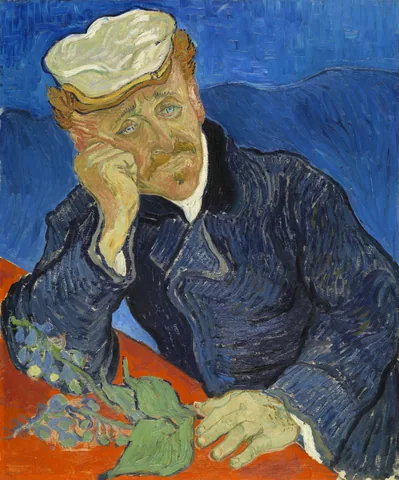
More in Landscapes and Impressionists.
Sources
More from the Journal
 Story · 7 min
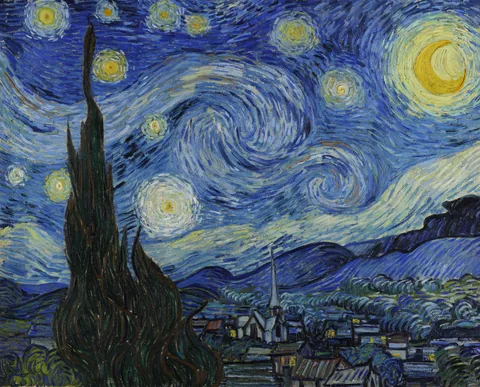
Van Gogh’s Starry Night: the facts, and choosing a print
Painted in June 1889 at an asylum in Provence: the view from his window, plus a village he made up. What is real, what it means, and which print to choose.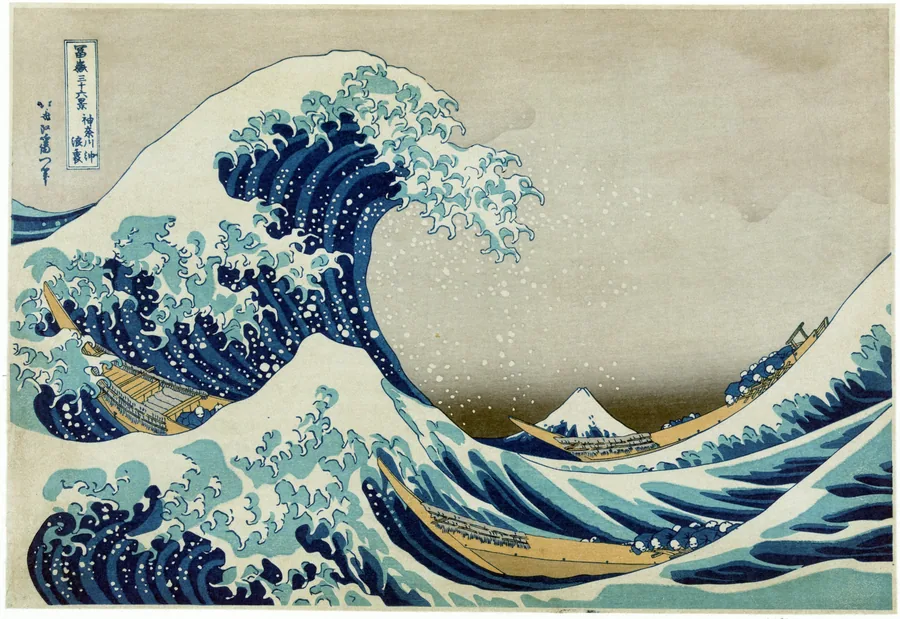 Story · 7 min
The Great Wave off Kanagawa: meaning, history and prints
A woodblock print, not a painting, and a storm wave, not a tsunami. What it shows, why no two impressions match, and how to choose a print. Story · 7 min
Klimt’s The Kiss: gold leaf, meaning and choosing a print
Real gold leaf on canvas, finished in 1909. The story of Klimt’s lovers, what a print can and can’t reproduce, and which size to choose. Story · 7 min