
Story
The Yellow House: Van Gogh’s home in Arles, and a print
Van Gogh’s home in Arles, where Gauguin stayed nine weeks and the Sunflowers hung. What is in the picture, what became of it, and choosing a print.
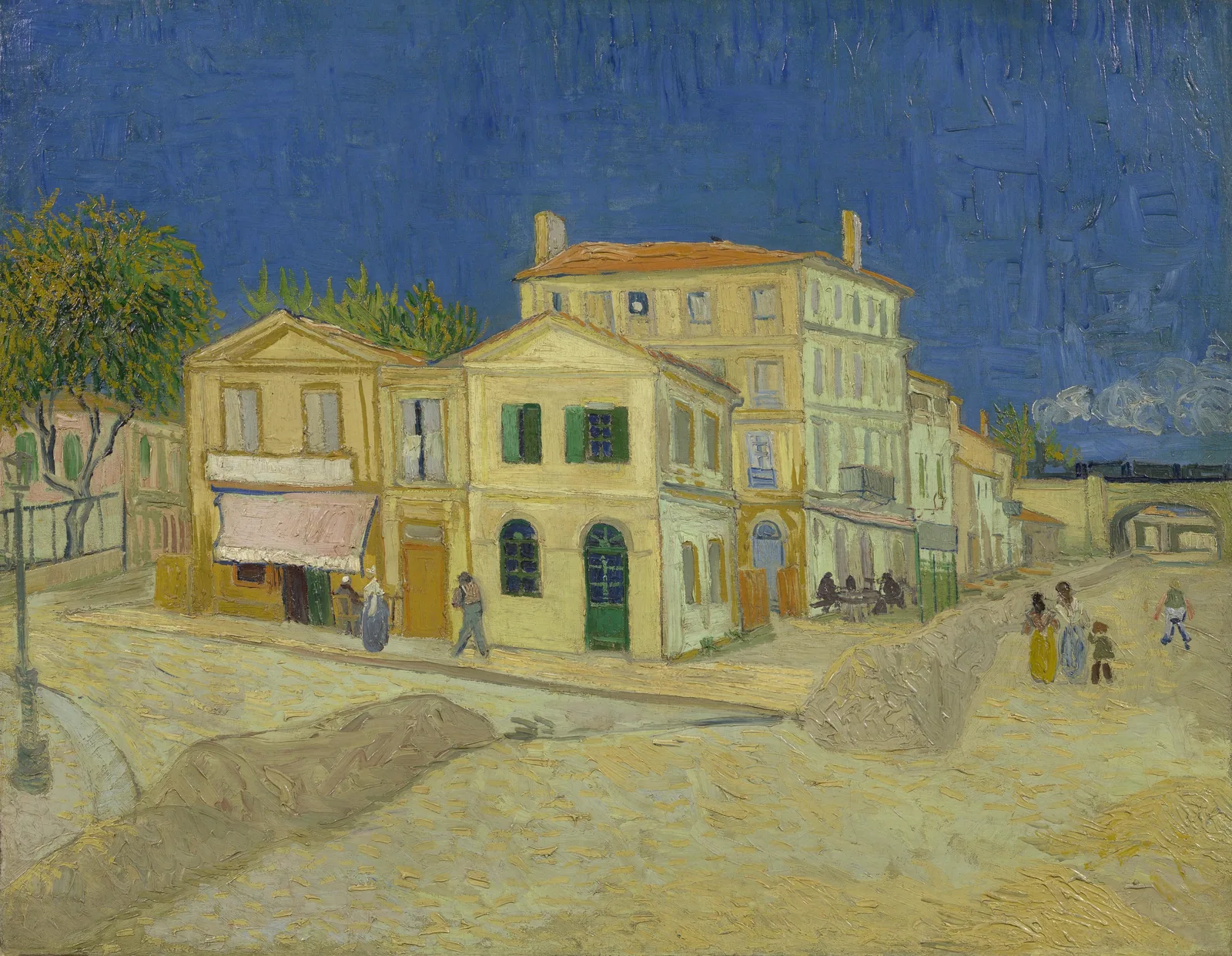
A yellow corner house with green shutters stands in the sun on a square in Arles, under a sky of thick, dark blue. People stroll in the street, a train crosses a bridge in the distance, and the earth of the square is dug up for a pipe. Vincent van Gogh painted his own home in September 1888. For a few months it was the center of his hopes.
Van Gogh’s house in Arles
On 1 May 1888 Van Gogh rented four rooms in the right wing of 2 Place Lamartine, in Arles: two large rooms on the ground floor, a studio and a kitchen, and two smaller rooms upstairs. That is the house with the green shutters at the center of the picture. His bedroom was upstairs, behind the window next to the corner; he painted it too, in the famous pictures of his bedroom.
He hoped to share it as a studio with Paul Gauguin, and Gauguin did come: he lived in the guest room for nine weeks from late October 1888. Van Gogh painted his Sunflowers to decorate that room before Gauguin arrived.
The whole neighborhood
Van Gogh first called the picture The House and its Surroundings, then settled on The Street, and it really is a portrait of a neighborhood:
- The restaurant. The building with the awning, to the left, is where he ate. It was run by the widow Venissac, who was also his landlady.
- The railway. To the right, the Avenue Montmajour runs to two railway bridges, and a train is puffing across one of them.
- The ditch. The mounds in the square mark a trench for a gas pipe along the avenue. Thanks to that pipe, he later got gas light in his studio.
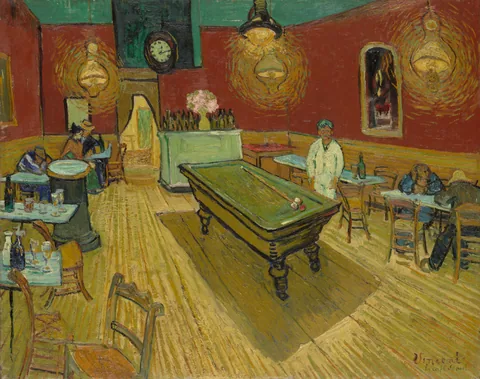
- The night café. It is not in the picture: Van Gogh noted that it was just to the left of the restaurant. He painted it from inside in The Night Café.
“A sulphur sun under a pure cobalt sky”
He sent his brother Theo a sketch of the painting and summed it up in a few words: the house and its surroundings under “a sulphur sun under a pure cobalt sky.” Here yellow and blue meet head on: a yellow house, yellow ground, and a sky so dark a blue it is nearly night.
What happened to the Yellow House?
It no longer exists. The house was badly damaged in an Allied bombing raid on 25 June 1944 and later pulled down. A sign marks the spot on the Place Lamartine. The painting is all that is left of it, along with Van Gogh’s letters and the pictures he made inside.
The painting belongs to the Vincent van Gogh Foundation and has been on permanent loan to the Van Gogh Museum in Amsterdam since 1962.
Look closer
These details come from the scan we print from, 6,917 pixels on the long side. Pick a detail, or zoom in and drag to look around.
The corner house with green shutters and doors: the right wing of 2 Place Lamartine, where Van Gogh rented four rooms.
Choosing a print
Life size. The canvas is about 28 by 36 inches, and our 36 × 28 in framed print is almost exactly that. Canvas goes to 40 × 31 in. Framed prints go up to 36 × 28 in, canvas up to 40 × 31 in and unframed art prints up to 40 × 31 in.
Where it works. A picture of a home makes a natural housewarming gift and a good entryway picture. Its sunny yellow and deep blue brighten a dull hallway or a north-facing room. At 24 × 19 in it fits over a console table. See our gift guide.
Which material. The sky is thick, heavy paint, and canvas suits it, with a matte finish and no cover. A framed print on smooth paper keeps the small figures and windows crisp. See canvas and our papers.
Frames. A white frame keeps it bright and fresh; natural oak warms the yellow. See all our frames.
The house and its flowers. Hang it with the Sunflowers that hung inside. Open the two as a set.
Questions
Where was the Yellow House?
At 2 Place Lamartine in Arles, in the south of France. Van Gogh rented four rooms in its right wing from May 1888.
Does the Yellow House still exist?
No. It was badly damaged by bombing in June 1944 and later demolished. A sign marks the site.
Did Gauguin live in the Yellow House?
Yes, for nine weeks from late October 1888, in the guest room.
Where is the painting?
In the Van Gogh Museum in Amsterdam, on permanent loan from the Vincent van Gogh Foundation.
Can it be printed legally?
Yes. Van Gogh died in 1890, and his paintings are in the public domain. What public domain means.
More Van Gogh
All Van Gogh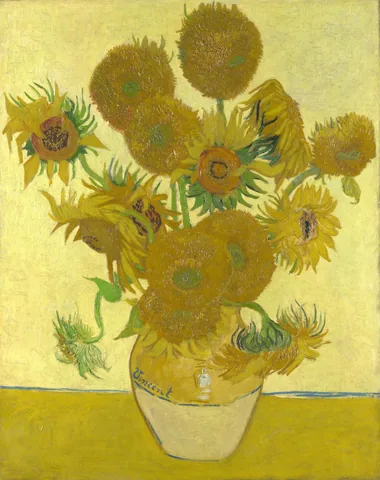
More in Cityscapes and Impressionists.
Sources
More from the Journal
 Story · 7 min
Van Gogh’s Starry Night: the facts, and choosing a print
Painted in June 1889 at an asylum in Provence: the view from his window, plus a village he made up. What is real, what it means, and which print to choose. Story · 7 min
The Great Wave off Kanagawa: meaning, history and prints
A woodblock print, not a painting, and a storm wave, not a tsunami. What it shows, why no two impressions match, and how to choose a print. Story · 7 min
Klimt’s The Kiss: gold leaf, meaning and choosing a print
Real gold leaf on canvas, finished in 1909. The story of Klimt’s lovers, what a print can and can’t reproduce, and which size to choose. Story · 7 min