
Story
Van Gogh’s Wheat Field with Cypresses: story and a print
Painted at the Saint-Rémy asylum in 1889: cypresses “like an Egyptian obelisk”, wheat in the mistral, and three versions. How to choose a print.
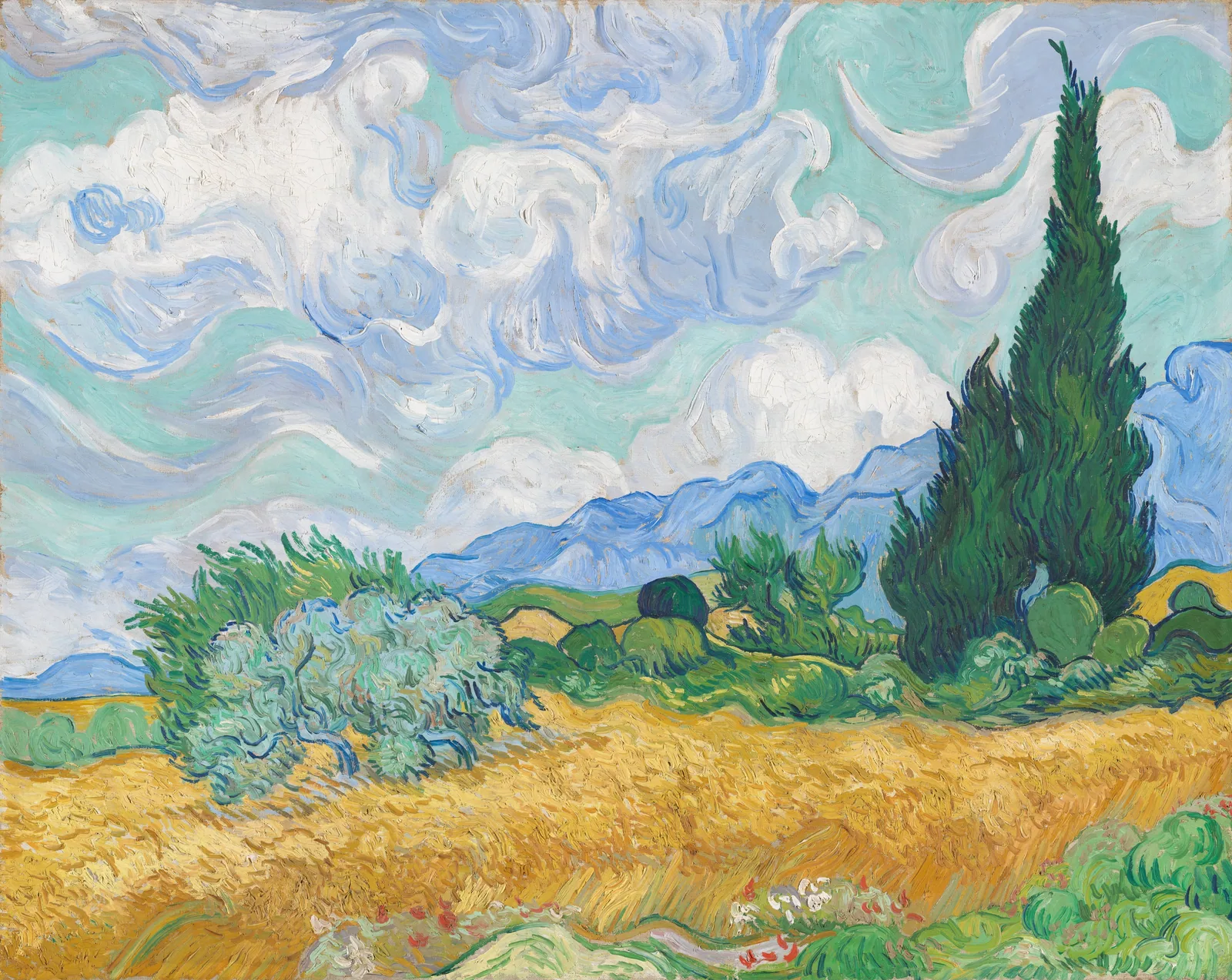
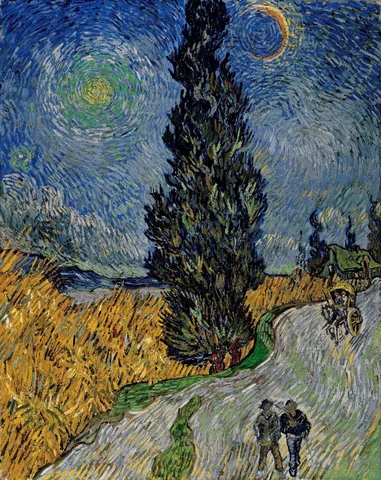
Ripe wheat bends in the wind, an olive bush tosses silver leaves, and on the right two tall cypresses rise like dark green flames against a sky full of swirling clouds. Blue hills sit low on the horizon. Vincent van Gogh painted this version in September 1889, while he was confined to his room at the asylum of Saint-Paul de Mausole in Saint-Rémy, in the south of France.
Why cypresses?
That summer Van Gogh could not stop thinking about them. On 25 June 1889 he wrote to his brother Theo: “The cypresses still preoccupy me.” He found them “beautiful as regards lines and proportions like an Egyptian obelisk,” and said that “the green has such a distinguished quality.” In a landscape full of sun, the cypress is, in his words, “the dark patch in a sun-drenched landscape.” Here they are the anchor of the picture, a dark vertical against all that moving gold and blue.
The wind
Everything in the painting moves. The cause is the mistral, the strong, cold wind of southern France, and Van Gogh lets it run through the whole picture: the wheat bends, the olive bush tosses, the cypresses sway, the clouds curl, even the distant hills seem to roll. The hills are the Alpilles, the low range near Saint-Rémy.
How many versions are there?
Three, and they are easy to mix up:
- The first, painted on the spot in late June 1889, when he was allowed out with a guardian. He thought of it as a preliminary study. It is in the Metropolitan Museum of Art in New York.
- This one, the finished version, painted in September 1889 at the same size, while he was confined to his room. It is in the National Gallery in London, and it is the one we print.
- A smaller copy he made for his mother and sister, now in a private collection.
Where is it now?
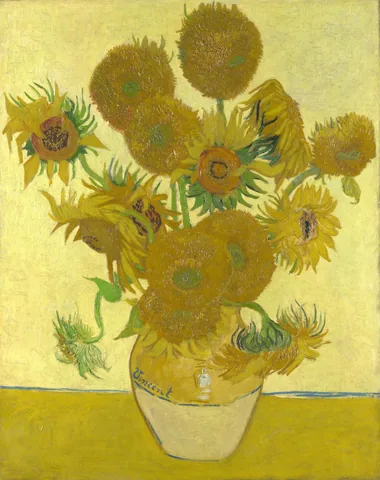
In the National Gallery in London, in room 43, in a 17th-century Italian frame. It was bought in 1923 with the Courtauld Fund. It shares room 43 with his Sunflowers, which the gallery also owns.
Look closer
These details come from the scan we print from, 10,882 pixels on the long side. Pick a detail, or zoom in and drag to look around.
Two tall cypresses like a dark green flame, “the dark patch in a sun-drenched landscape.”
Choosing a print
Life size. The canvas is about 28½ by 36 inches, and our largest framed print, 36 × 29 in, is almost exactly that. Unframed art prints go up to 48 × 38 in. Framed prints go up to 36 × 29 in, canvas up to 40 × 32 in and unframed art prints up to 48 × 38 in.
Where it works. Its fresh turquoise, gold and green brighten any room: a living room, a kitchen, a sunny bedroom. It is one of the most cheerful Van Goghs, and it suits a sofa wall or a wall over a bed. See what size art over a sofa. At 24 × 19 in it fits over a desk.
Which material. The paint is thick and swirling, and canvas suits it, with a matte finish and no cover. A framed print on smooth paper keeps every stroke crisp. See canvas and our papers.
Frames. A white frame keeps the sky light; natural oak warms the wheat. See all our frames.
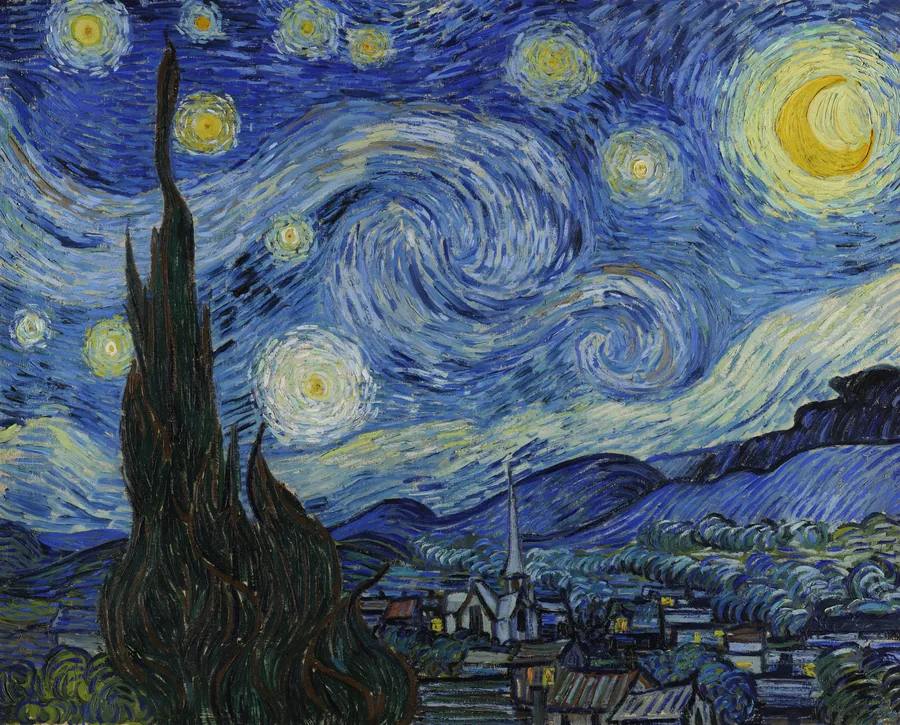
Saint-Rémy, 1889. Pair it with The Starry Night, with its own great cypress, painted at the same asylum that June. Open the two as a set. Read its story too.
Questions
How many versions of Wheat Field with Cypresses are there?
Three: the first study (Metropolitan Museum, New York), this finished version (National Gallery, London) and a smaller copy in a private collection.
Where was it painted?
At the Saint-Paul de Mausole asylum in Saint-Rémy, in the south of France, in 1889.
What are the mountains?
The Alpilles, the low hills near Saint-Rémy.
How big is it?
72.1 × 90.9 cm, about 28½ × 36 in.
Can it be printed legally?
Yes. Van Gogh died in 1890, and his paintings are in the public domain. What public domain means.
More Van Gogh
All Van Gogh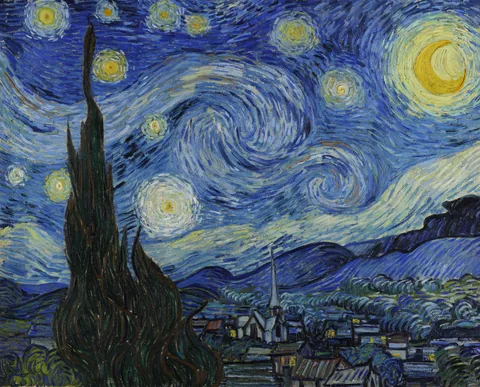
More in Landscapes and Impressionists.
Sources
More from the Journal
 Story · 7 min
Van Gogh’s Starry Night: the facts, and choosing a print
Painted in June 1889 at an asylum in Provence: the view from his window, plus a village he made up. What is real, what it means, and which print to choose. Story · 7 min
The Great Wave off Kanagawa: meaning, history and prints
A woodblock print, not a painting, and a storm wave, not a tsunami. What it shows, why no two impressions match, and how to choose a print. Story · 7 min
Klimt’s The Kiss: gold leaf, meaning and choosing a print
Real gold leaf on canvas, finished in 1909. The story of Klimt’s lovers, what a print can and can’t reproduce, and which size to choose. Story · 7 min