
Story
Vermeer’s A Girl Asleep: the man he painted out
A young woman dozing at a table, wine and fruit beside her, and a man and a dog hidden under the paint. The story, and choosing a print.
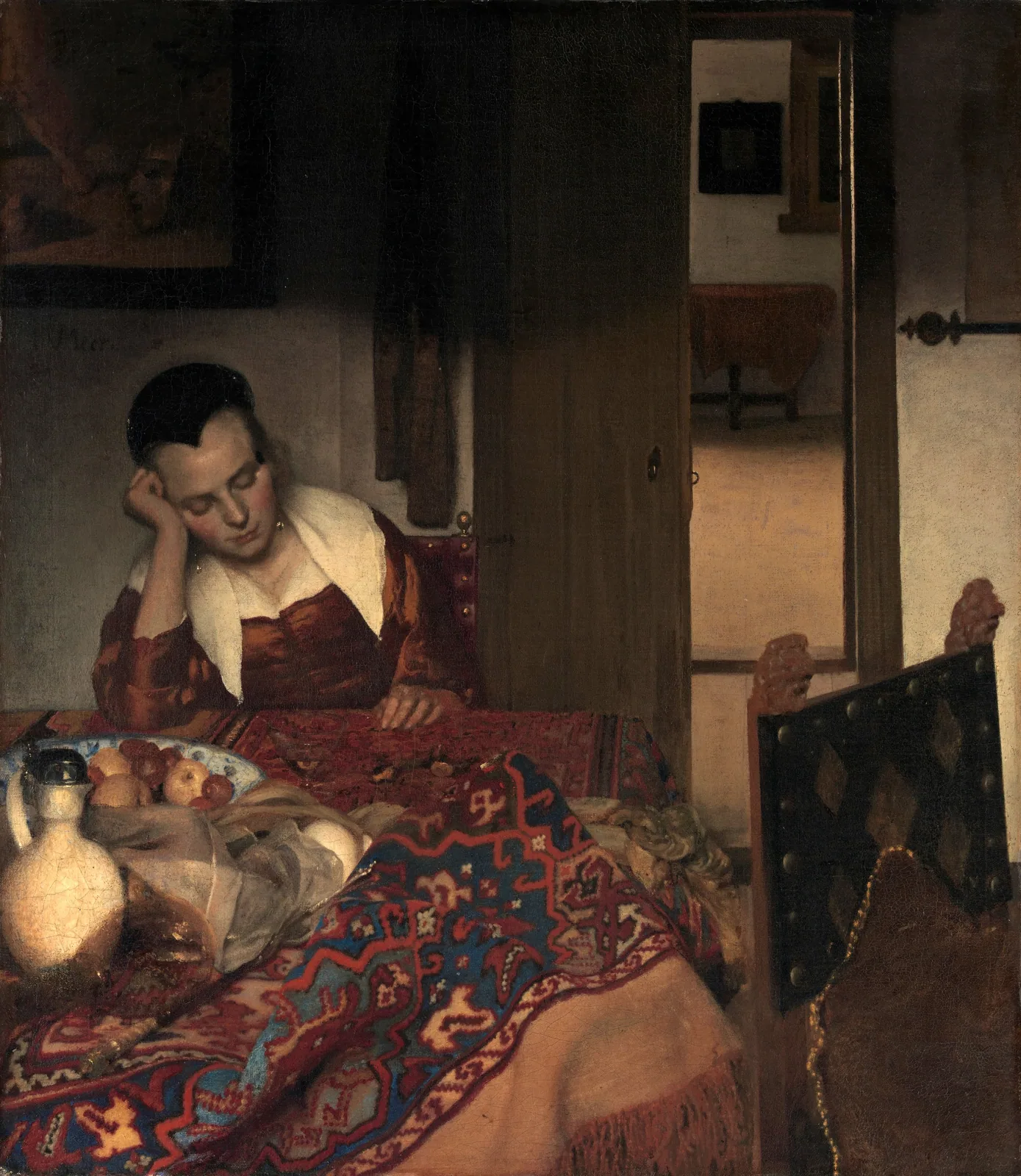
A young woman in a red dress has dozed off at a table, her head propped on her hand. In front of her, a heavy rug is pushed up over the table, with a bowl of fruit and a white wine pitcher. A door stands open onto another room, and a chair is set at an angle, as if someone has just left. Johannes Vermeer painted it around 1657.
The man he painted out
X-rays show that Vermeer first told a fuller story. In the room beyond the door stood a man, and a dog was looking at him. Vermeer painted them both out, putting a mirror on the far wall and a chair with a cushion in their place. What was left is quieter and more mysterious: we are left to guess who was here.
What does it mean?
The clues are still there. According to the scholar Walter Liedtke, the wine, a glass on its side and what may be a knife and fork suggest she was recently with someone. The empty chair with its cushion hints at recent company, and at idleness. The bowl of fruit, a Chinese porcelain dish, was a symbol of temptation, and a mirror suggests how quickly pleasures pass. The painting has had many titles, among them A Woman Asleep at Table and A Maid Asleep.
Where is A Girl Asleep?
In the Metropolitan Museum of Art in New York. It was sold on 16 May 1696 with the estate of Jacob Dissius, and it probably came from Vermeer’s major patron, Pieter van Ruijven. Benjamin Altman bought it in 1908 and left it to the museum in 1913. His bequest forbids it from ever being lent, so New York is the only place to see it.
Look closer
These details come from the scan we print from, 3,759 pixels on the long side. Pick a detail, or zoom in and drag to look around.
Her head propped on her hand, eyes closed, at a table in a quiet house.
Choosing a print
Size. The canvas is about 34½ by 30 inches. Our scan prints sharply up to 21 × 24 in, smaller than the original, and we don’t sell it bigger than that. At 17 × 20 in it suits a smaller wall. Framed prints, canvas and unframed art prints all go up to 21 × 24 in.
Where it works. A bedroom, a reading corner or a quiet den: a picture about rest, after all. It suits warm, dark walls. See what to hang over a bed.
Which material. Much of the picture is dark. Behind clear acrylic, dark areas reflect a facing window, so hang a framed print with side light, or choose canvas, with its matte finish and no cover. See our papers and canvas.
Frames. Black wood is the classic Dutch look; a wide gold frame picks up the red dress and the rug. See all our frames.
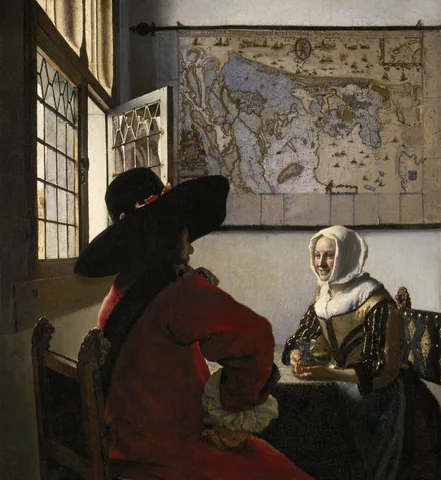
Early Vermeer. Pair it with Officer and Laughing Girl, painted around the same time. Open the two as a set. Read its story too.
Questions
What is hidden in A Girl Asleep?
X-rays show a man in the next room and a dog looking at him, which Vermeer painted over.
Where is it?
In the Metropolitan Museum of Art in New York. Its donor’s bequest forbids lending it.
When was it painted?
Around 1657.
How big is it?
87.6 × 76.5 cm, about 34½ × 30 in.
Can it be printed legally?
Yes. It is more than 350 years old and in the public domain. What public domain means.
More Vermeer
All Vermeer
More in Dutch and Flemish Masters and Interiors and Portraits.
Sources
More from the Journal
 Story · 7 min
Van Gogh’s Starry Night: the facts, and choosing a print
Painted in June 1889 at an asylum in Provence: the view from his window, plus a village he made up. What is real, what it means, and which print to choose. Story · 7 min
The Great Wave off Kanagawa: meaning, history and prints
A woodblock print, not a painting, and a storm wave, not a tsunami. What it shows, why no two impressions match, and how to choose a print. Story · 7 min
Klimt’s The Kiss: gold leaf, meaning and choosing a print
Real gold leaf on canvas, finished in 1909. The story of Klimt’s lovers, what a print can and can’t reproduce, and which size to choose. Story · 7 min