
Story
Vermeer’s Officer and Laughing Girl: the story
A soldier in a giant hat, a young woman laughing over a glass of wine, and a real map on the wall. What is going on, and how to choose a print.
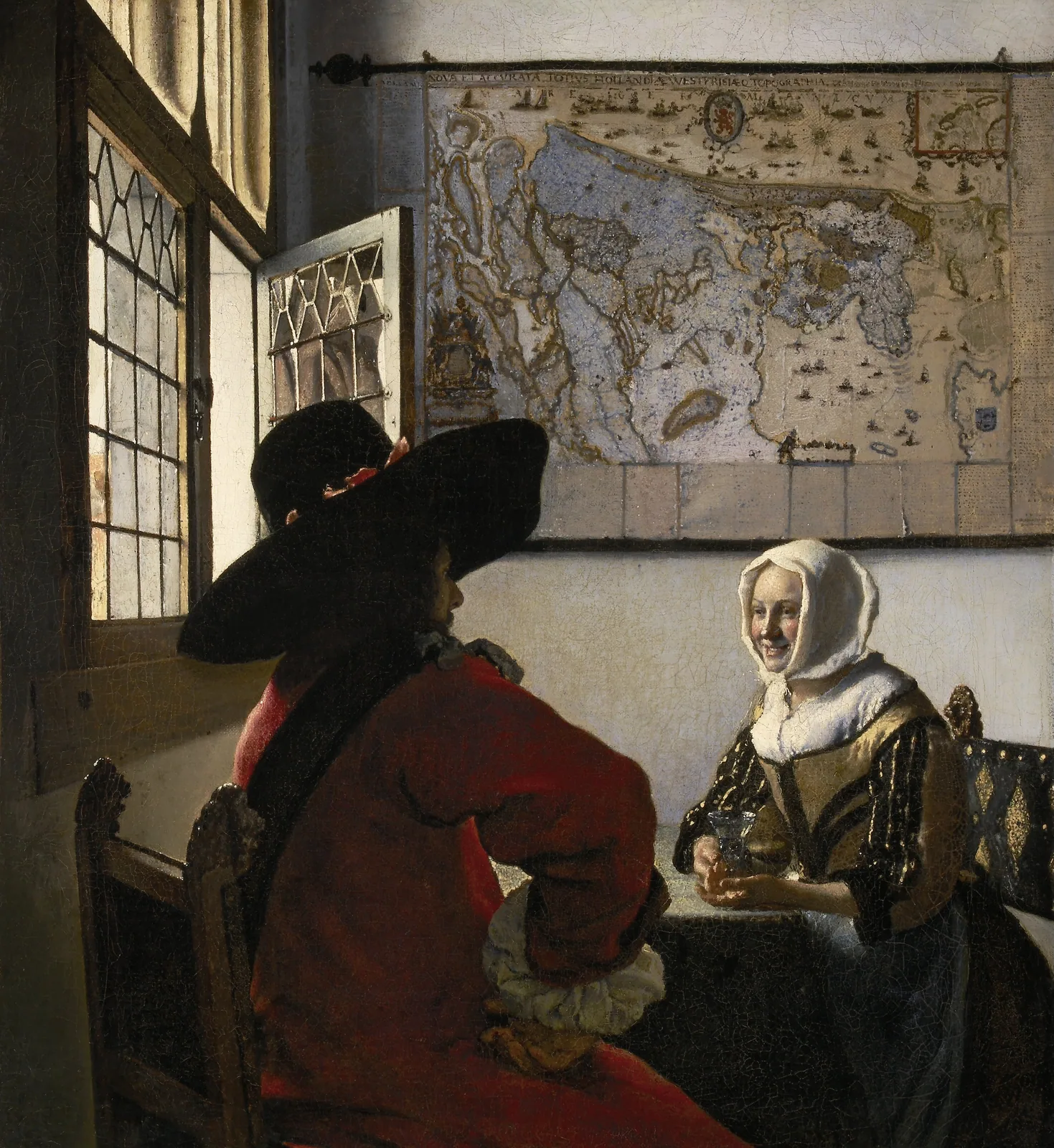
A soldier in a red coat and an enormous black hat sits with his back to us. Across the table a young woman laughs, holding a glass of wine in both hands, her face lit by an open window. Above them hangs a big map of Holland. Johannes Vermeer painted it around 1657.
What is happening?
A man and a woman are talking over wine, and she is enjoying it. Most historians see an innocent, honorable courtship: a young man calling on a young woman at home. Others read her open hand and her smile as a hint that she might welcome more. Another idea is that the soldier has surprised her in the middle of her morning chores. Vermeer leaves it open, which is part of the fun.
The pair are dressed to impress. He wears a red coat, a black sash that shows his rank and a wide-brimmed hat of costly beaver felt; the pelts were probably from New Netherland, the Dutch colony in North America. She wears a yellow bodice and a blue apron. The glass of wine matters too: wine cost more than beer, so it marks a well-off household.
Why is the officer so big?
He is close to us and she is a few feet farther away, but the difference in size is dramatic, almost like a photograph taken with a wide lens. That is one reason some writers think Vermeer used a camera obscura, a darkened box with a lens that projects an image. There is no historical evidence that he did, but effects in his paintings like this sharp change of scale, soft focus and color fringes have kept the theory alive.
A real map
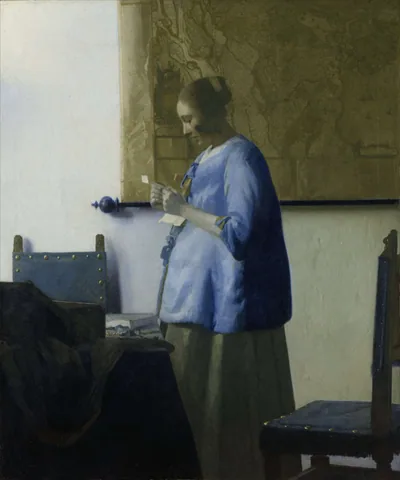
The map on the wall is real and identifiable. It is a map of Holland and West Friesland by Balthasar Florisz. van Berckenrode, in the edition published by Willem Blaeu in 1621. The map historian Peter van der Krogt said Vermeer’s gift for realism shows in the fact that the map can be identified at all. The same map appears in Woman in Blue Reading a Letter.
Changes of mind
X-rays show that Vermeer first planned a large white collar that would have hidden much of her yellow dress, and that he later extended her cap to cover her hair. The woman may have been modeled on his wife, Catharina Bolnes; she resembles her.
Where is Officer and Laughing Girl?
In the Frick Collection in New York, which also owns two more Vermeers, Girl Interrupted at Her Music and Mistress and Maid. It is small, about 20 by 18 inches.
Look closer
These details come from the scan we print from, 5,213 pixels on the long side. Pick a detail, or zoom in and drag to read the map.
An open, laughing face under a white cap, lit by the window. She seems delighted, or amused.
Choosing a print
Life size, or a little more. The canvas is about 20 by 18 inches. Our 18 × 20 in framed print is about life size, and framed prints go up to 28 × 30 in. Framed prints, canvas and unframed art prints all go up to 28 × 30 in.
Where it works. A dining room, a kitchen with a table, a bar area: a picture of two people enjoying a drink and a conversation. It suits anyone who loves maps or Dutch interiors.
Which material. The officer is a large dark shape. Behind clear acrylic, dark areas reflect a facing window, so hang a framed print with side light, or choose canvas, with its matte finish and no cover. Smooth cotton paper keeps the map’s fine lines crisp. See our papers and canvas.
Frames. Black wood is the classic Dutch look; a wide gold frame like our Gold Plein Air picks up the map’s warm tones. See all our frames.
Two couples. Pair it with The Music Lesson. Open the two as a set. Read its story too.
Questions
Where is Officer and Laughing Girl?
In the Frick Collection in New York.
What is the map on the wall?
A map of Holland and West Friesland by Balthasar Florisz. van Berckenrode, in Willem Blaeu’s 1621 edition.
Why is the officer so large?
He is much closer to us. The dramatic change of scale is one reason some think Vermeer used a camera obscura, though there is no proof.
How big is it?
50.5 × 46 cm, about 20 × 18 in.
Can it be printed legally?
Yes. It is more than 350 years old and in the public domain. What public domain means.
More Vermeer
All Vermeer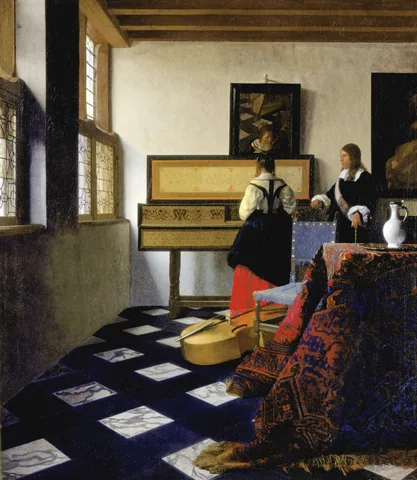
More in Dutch and Flemish Masters and Interiors and Portraits.
Sources
More from the Journal
 Story · 7 min
Van Gogh’s Starry Night: the facts, and choosing a print
Painted in June 1889 at an asylum in Provence: the view from his window, plus a village he made up. What is real, what it means, and which print to choose. Story · 7 min
The Great Wave off Kanagawa: meaning, history and prints
A woodblock print, not a painting, and a storm wave, not a tsunami. What it shows, why no two impressions match, and how to choose a print. Story · 7 min
Klimt’s The Kiss: gold leaf, meaning and choosing a print
Real gold leaf on canvas, finished in 1909. The story of Klimt’s lovers, what a print can and can’t reproduce, and which size to choose. Story · 7 min