
Story
Vermeer’s Woman in Blue Reading a Letter: the story
A woman in a blue jacket reads a letter in the morning light, under a map of Holland. What the details may mean, and how to choose a print.
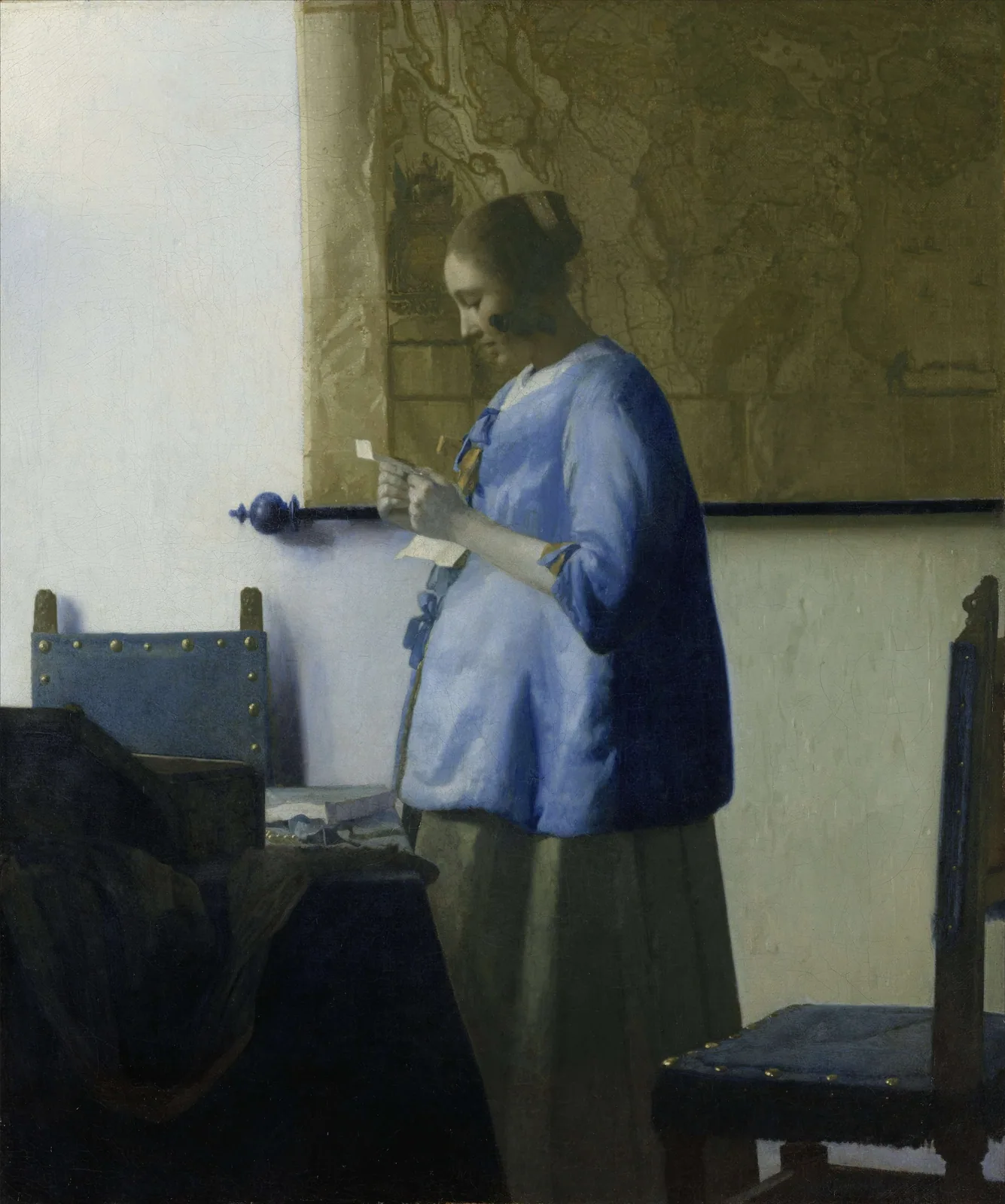
A young woman stands in a quiet room, holding a letter close and reading it, her lips slightly parted. The light comes from a window we cannot see. Behind her hangs a big map; on either side stand blue chairs. In the Rijksmuseum’s words, she is enjoying a quiet, private moment, absorbed in reading a letter in the morning light. Johannes Vermeer painted it around 1663. Very little happens, and that is its power.
The blue jacket
The museum notes that she is still wearing her blue night jacket, so this is early in the day; she has not finished dressing. That jacket is the heart of the picture. It glows in many shades of blue against the pale wall and the dark map, and the blue is picked up again in the chairs and the cloth on the table. That is why the painting is so often called Woman in Blue Reading a Letter.
What does the letter say?
We never find out. Its contents are hidden from us, which is the point: we are outside her thoughts, looking in. But Vermeer leaves clues.
The map. The map on the wall shows the County of Holland and West Friesland. It was made by Balthasar Florisz. van Berckenrode, published in 1620 and reprinted by Willem Blaeu in 1621; Vermeer shows it as a print in a single color. A copy survives today in the Westfries Museum in Hoorn. Some have read the map as a hint that the letter comes from a husband who is traveling.
The pearls. On the table, barely visible, is a box of pearls. Pearls could stand for vanity, and some take them as a hint of a lover. Others see nothing more than the things on a Delft table.
Is she pregnant?
She looks it, and people have asked the question for a long time. But many scholars argue that her rounded shape is simply the fashion of the day. Pregnancy was rarely shown in paintings of the period. As with the letter, Vermeer leaves it open.
Where is Woman in Blue Reading a Letter?
In the Rijksmuseum in Amsterdam. It belongs to the City of Amsterdam, which received it in 1854 in the bequest of the collector A. van der Hoop, and it has been in the Rijksmuseum since the museum opened in 1885. It was the first Vermeer the museum had. It is small, about 18½ by 15½ inches.
Look closer
These details come from the scan we print from, 5,341 pixels on the long side. Pick a detail, or zoom in and drag to look around.
She holds the letter close in both hands. We never see what it says.
Choosing a print
Life size, or a little more. The canvas is small. Our 17 × 20 in framed print is close to life size, and framed prints go up to 25 × 30 in. Framed prints, canvas and unframed art prints all go up to 25 × 30 in.
Where it works. A bedroom, a quiet study or beside a writing desk. Its blues and soft whites are calm and suit a blue, gray or white room. Hang the center at eye level; see how high to hang art.
Which material. The lower part of the picture is dark. Behind clear acrylic, dark areas reflect a facing window, so hang a framed print with side light, or choose canvas, with its matte finish and no cover. Smooth cotton paper keeps the blues clean. See our papers and canvas.
Frames. Black wood is the classic Dutch choice; a white frame brings out the pale wall and the blue. See all our frames.
Two letters. Pair it with Girl Reading a Letter at an Open Window. Open the two as a set. Read its story, with the hidden Cupid.
Questions
Is the woman in blue pregnant?
She may be, but many scholars think her shape reflects the fashion of the time. Pregnancy was rarely painted then.
What is the map on the wall?
A map of Holland and West Friesland by Balthasar Florisz. van Berckenrode, first published in 1620.
Where is the painting?
In the Rijksmuseum in Amsterdam, on loan from the City of Amsterdam.
How big is it?
46.5 × 39 cm, about 18½ × 15½ in.
Can it be printed legally?
Yes. It is more than 350 years old and in the public domain. What public domain means.
More Vermeer
All Vermeer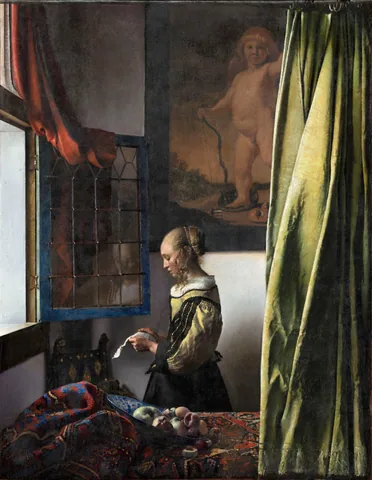
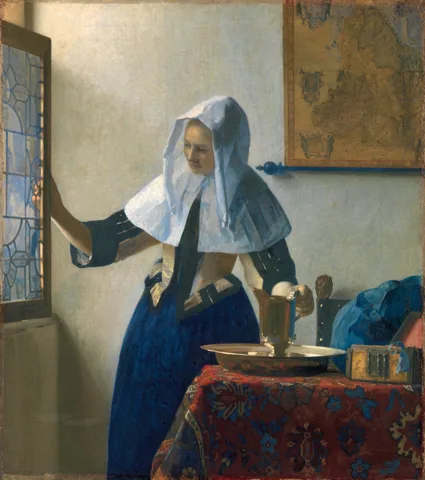
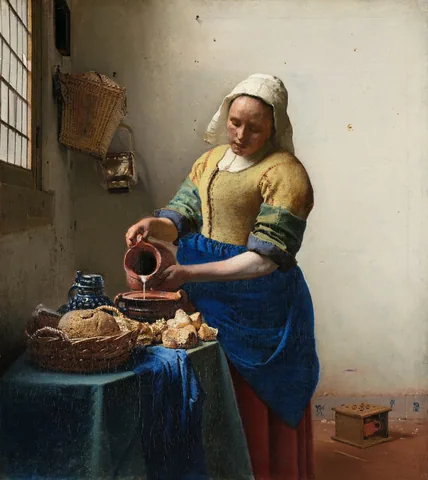
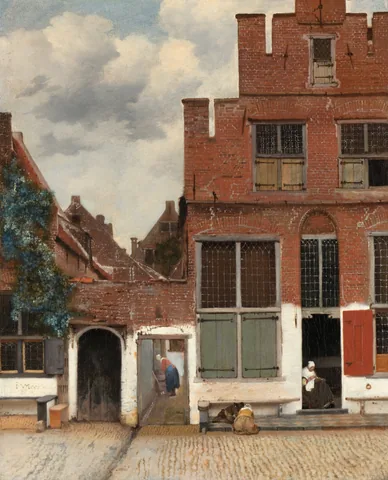
More in Dutch and Flemish Masters and Interiors and Portraits.
Sources
More from the Journal
 Story · 7 min
Van Gogh’s Starry Night: the facts, and choosing a print
Painted in June 1889 at an asylum in Provence: the view from his window, plus a village he made up. What is real, what it means, and which print to choose.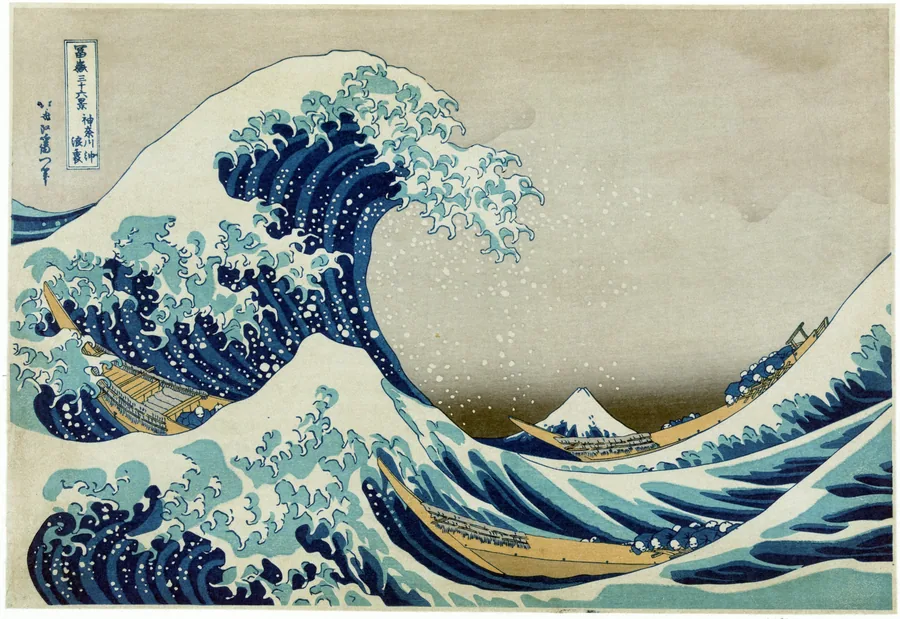 Story · 7 min
The Great Wave off Kanagawa: meaning, history and prints
A woodblock print, not a painting, and a storm wave, not a tsunami. What it shows, why no two impressions match, and how to choose a print.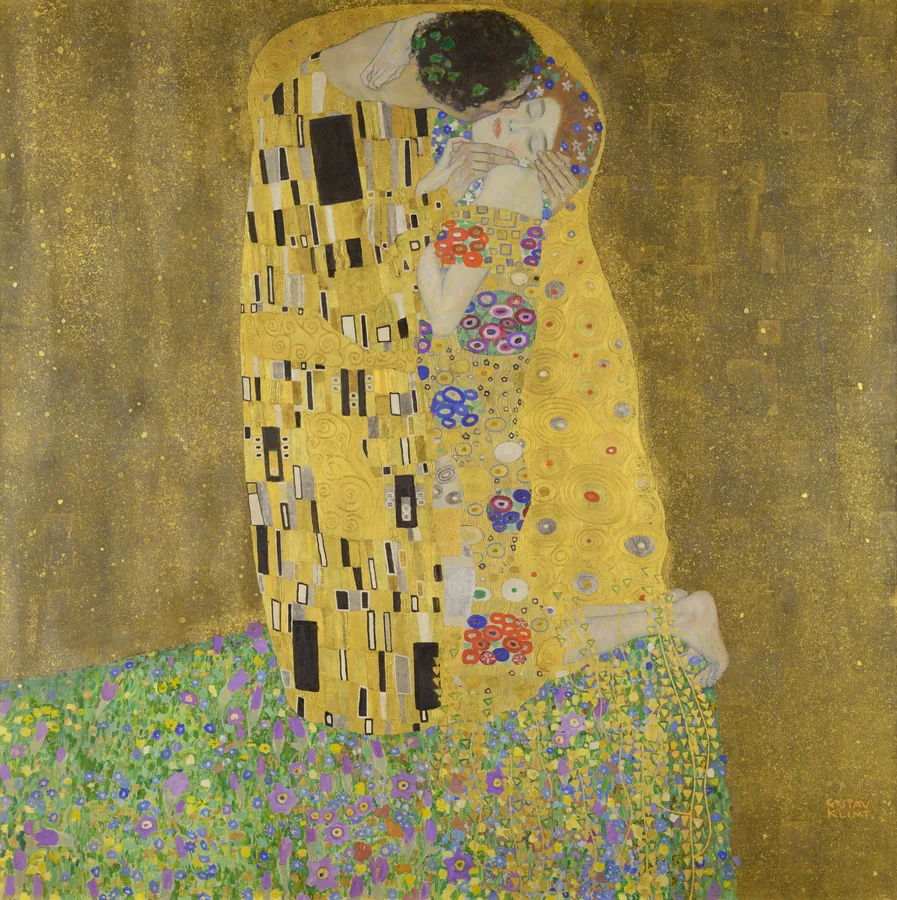 Story · 7 min
Klimt’s The Kiss: gold leaf, meaning and choosing a print
Real gold leaf on canvas, finished in 1909. The story of Klimt’s lovers, what a print can and can’t reproduce, and which size to choose. Story · 7 min