
Story
Vermeer’s The Art of Painting: meaning and a print
A painter, a model dressed as the muse of history, a creased map. What Vermeer’s studio picture means, how Hitler bought it, and choosing a print.
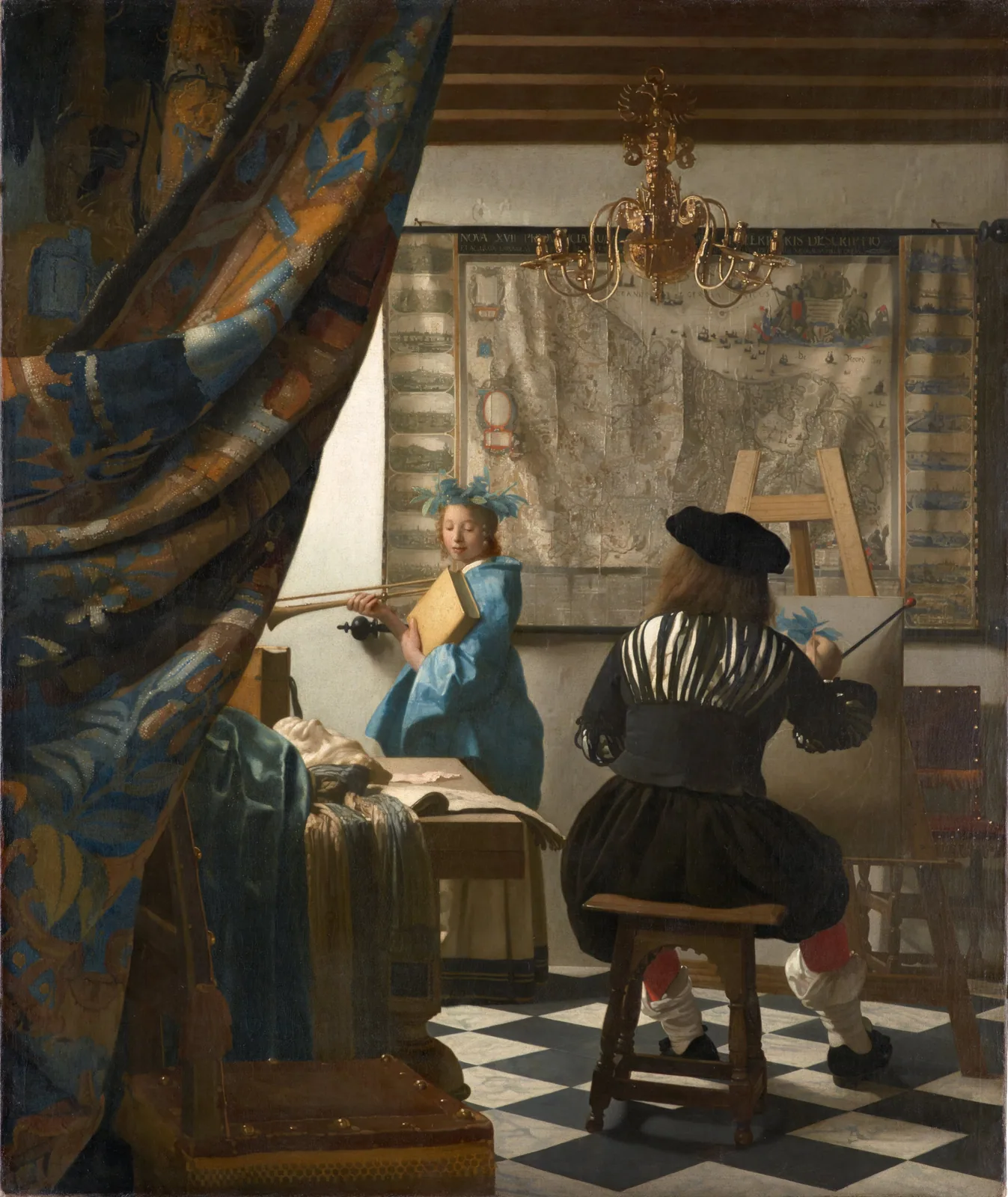
A heavy curtain is pulled back, and we look into a painter’s studio. The painter sits with his back to us at his easel. In front of him, by the window, a young woman poses in blue, holding a trumpet and a book, a wreath of laurel in her hair. Behind them hangs a huge map. Johannes Vermeer painted The Art of Painting around 1667, a picture about his own craft. He never sold it.
What does The Art of Painting mean?
It is an allegory, a picture in which people and things stand for ideas. That is why it is also called The Allegory of Painting. It is not a scene from Vermeer’s working day so much as a statement about what painting is and why it matters.
The model is Clio. Her laurel wreath and trumpet match the attributes of Clio, the muse of history, and the book she holds may be by one of the great Greek historians, Herodotus or Thucydides. (Some read her as Fame, or as Painting itself.) If she is History, the painter is turning history into art: painting is how the past is remembered.
The painter. He wears an elegant black outfit with slashes in the sleeves and back. Look at his canvas and you see he has just started, with a few blue laurel leaves of the wreath.
The mask. On the table lies a plaster mask, perhaps a nod to the old argument, called the paragone, over whether painting or sculpture was the greater art.
The map and the eagle
The great map on the wall shows the Seventeen Provinces of the Low Countries, published by Claes Janszoon Visscher in 1636. A deep crease runs across it, dividing north from south. Some historians read that crease as a reminder of the split between the independent Dutch Republic in the north and the southern provinces still ruled by the Habsburgs. The brass chandelier above may be crowned with a double-headed eagle, the Habsburg emblem.
Kept from the creditors
Vermeer kept the painting all his life. After he died, his widow, Catharina, was deep in debt, and in 1676 she transferred it to her mother, Maria Thins, to keep it out of the creditors’ hands. The executor of the estate, the Delft scientist Antonie van Leeuwenhoek, ruled that the transfer was illegal.
Bought by Hitler
Centuries later the painting belonged to the Czernin family in Vienna. On 20 November 1940 Adolf Hitler bought it through his agent Hans Posse, for 1.82 million Reichsmarks, for the museum he planned in Linz. At the end of the war it was hidden with other looted and bought art in the salt mine at Altaussee in Austria, and in 1945 it was rescued from there. It went to the Kunsthistorisches Museum in Vienna. The Czernin family has argued that the 1940 sale was forced; in 2011 the Austrian government again rejected their claim.
Where is The Art of Painting now?
In the Kunsthistorisches Museum in Vienna. It is about 47 by 39 inches.
Look closer
These details come from the scan we print from, 7,377 pixels on the long side. Pick a detail, or zoom in and drag to look around.
A young woman in blue with a laurel wreath, a trumpet and a book: dressed as Clio, the muse of history.
Choosing a print
Big, to step into. The painting is built like a stage set you look into, and size helps. Our largest framed print is 25 × 30 in, and unframed art prints go to 40 × 48 in. Framed prints go up to 25 × 30 in, canvas up to 34 × 40 in and unframed art prints up to 40 × 48 in.
Where it works. A studio, a study or a creative workspace: it is a painting about making art. It is a fine gift for a painter, a photographer or a historian. At 20 × 24 in it fits over a desk.
Which material. The curtain and the shadows are dark, so behind clear acrylic hang it with side light, or choose canvas, with a matte finish and no cover. Smooth cotton paper keeps the map’s fine lines crisp. See our papers and canvas.
Frames. A wide gold frame like our Gold Plein Air picks up the brass chandelier; black wood echoes the floor tiles and the painter’s clothes. See all our frames.
A pair. The Astronomer is Vermeer’s other great picture of a man at work. Open the two as a set. Read its story too.
Questions
Who is the woman in The Art of Painting?
A model posing as Clio, the muse of history, with a laurel wreath, a trumpet and a book.
Is the painter Vermeer?
We see only his back, so nobody can say.
What is the map?
The Seventeen Provinces of the Low Countries, published by Claes Janszoon Visscher in 1636.
Where is The Art of Painting?
In the Kunsthistorisches Museum in Vienna. It is 120 × 100 cm, about 47 × 39 in.
Can it be printed legally?
Yes. It is more than 350 years old and in the public domain. What public domain means.
More Vermeer
All Vermeer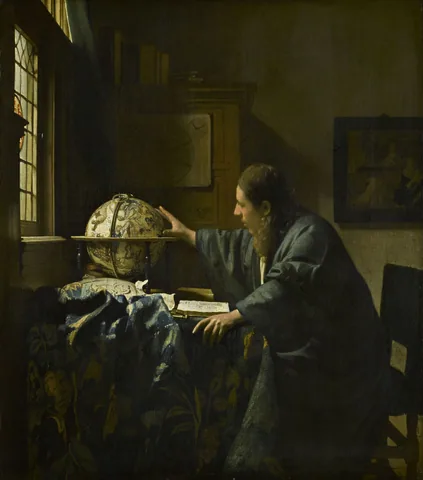
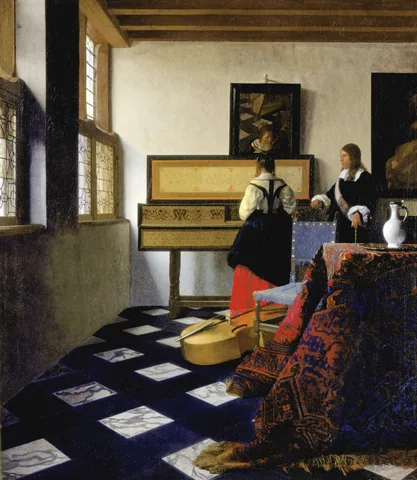
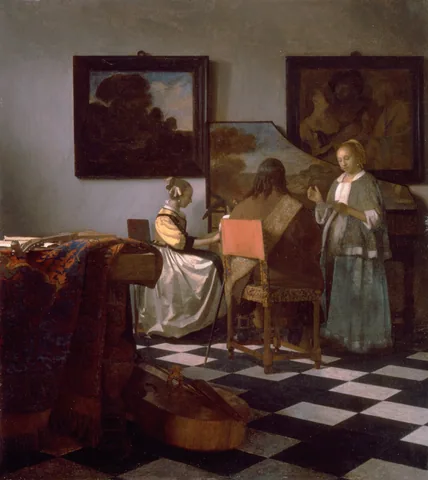
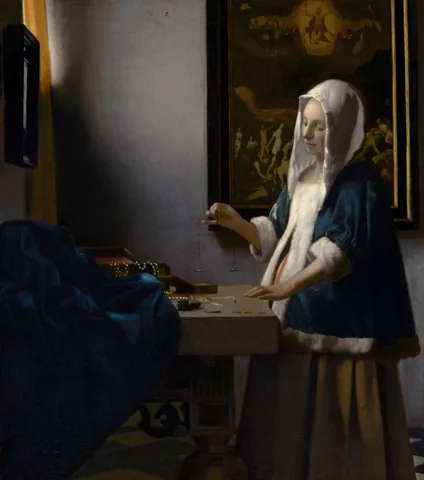
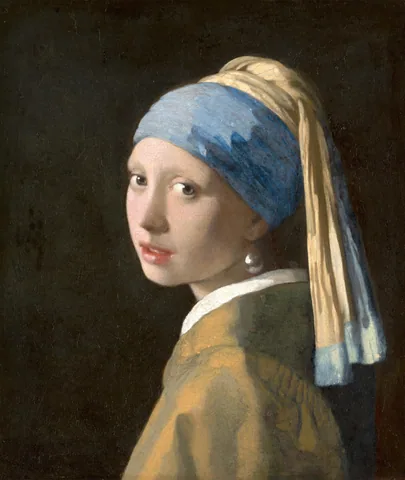
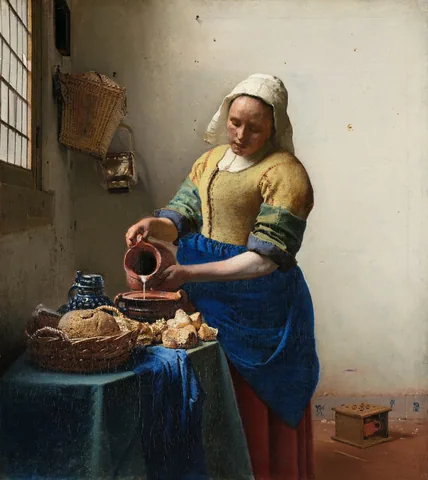
More in Dutch and Flemish Masters and Interiors and Portraits.
Sources
More from the Journal
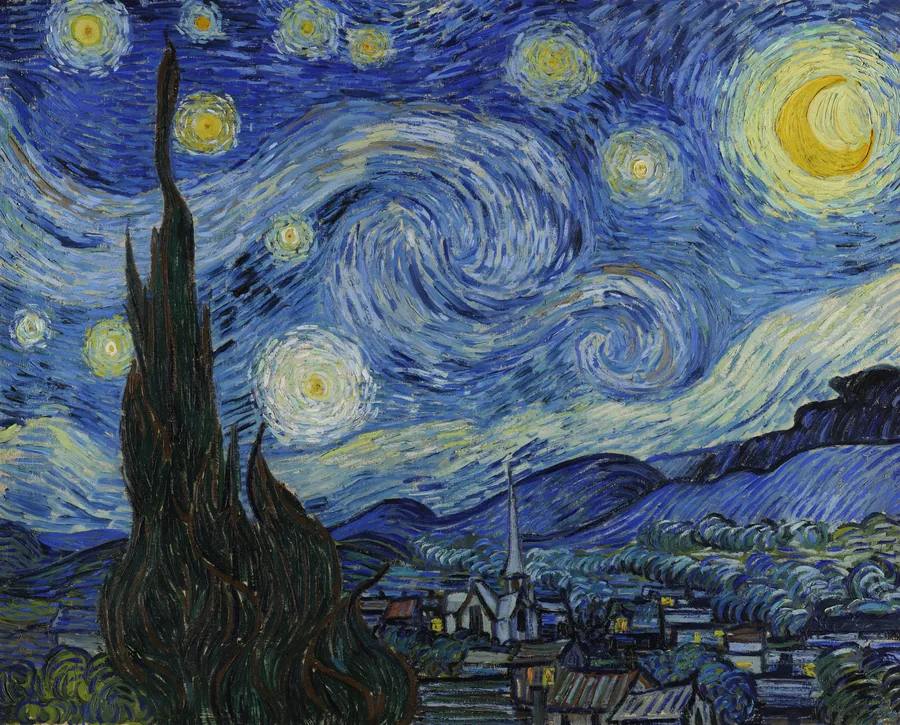 Story · 7 min
Van Gogh’s Starry Night: the facts, and choosing a print
Painted in June 1889 at an asylum in Provence: the view from his window, plus a village he made up. What is real, what it means, and which print to choose. Story · 7 min
The Great Wave off Kanagawa: meaning, history and prints
A woodblock print, not a painting, and a storm wave, not a tsunami. What it shows, why no two impressions match, and how to choose a print. Story · 7 min
Klimt’s The Kiss: gold leaf, meaning and choosing a print
Real gold leaf on canvas, finished in 1909. The story of Klimt’s lovers, what a print can and can’t reproduce, and which size to choose. Story · 7 min