
Story
Vermeer’s The Milkmaid: meaning, details and a print
What she is making, the hidden basket and map, the foot warmer and Cupid tile, why the bread sparkles, and how to choose a print.
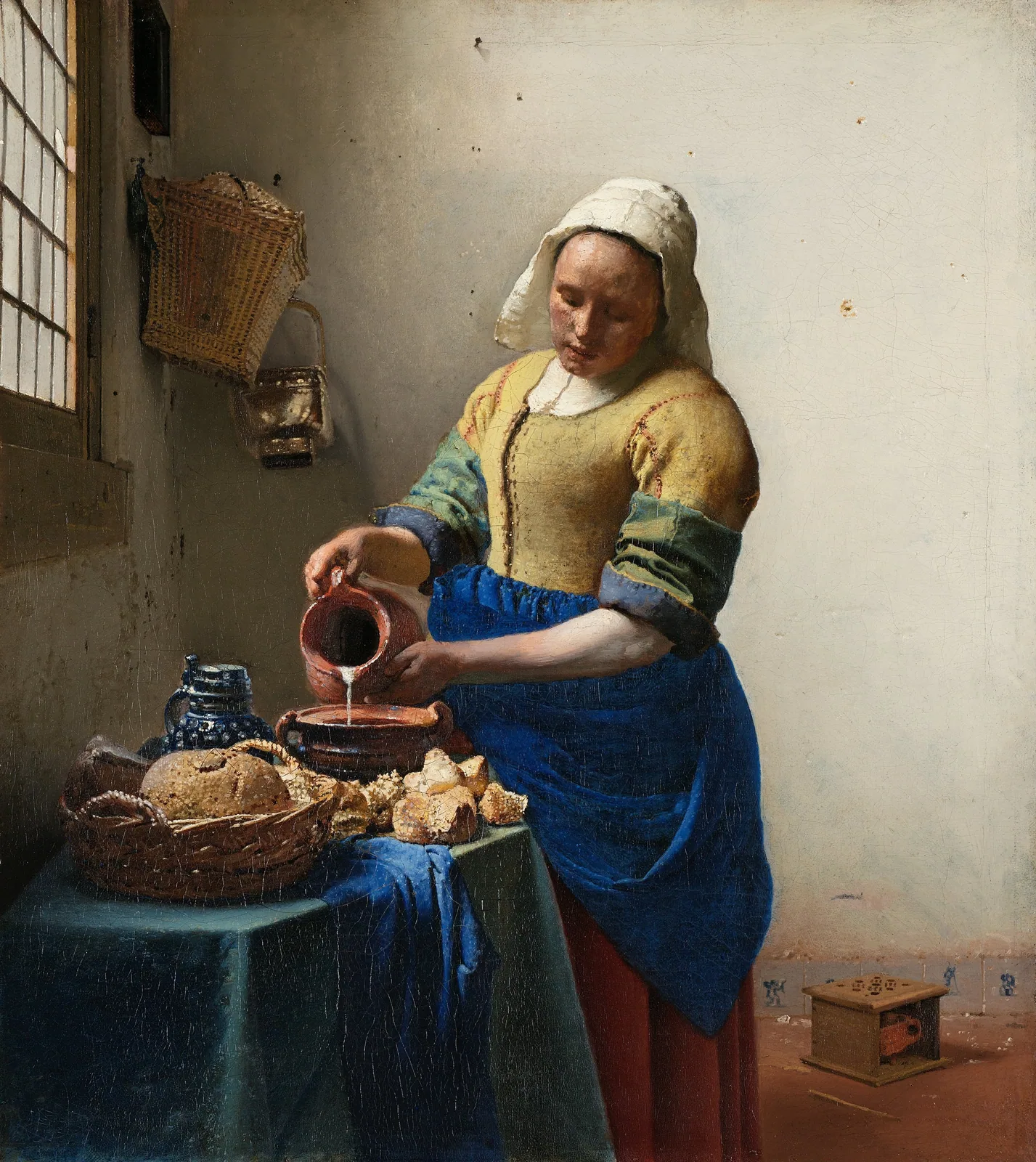
A kitchen maid pours milk into a bowl. That is all that happens. “Except for the stream of milk,” the Rijksmuseum writes, “everything else is still.” Johannes Vermeer painted it in Delft around 1658, and he turned one of the plainest jobs in a Dutch house into one of his most famous pictures.
What is the milkmaid doing?
She is not a dairymaid; she is a kitchen maid, and the milk is for cooking. She pours it slowly into a low earthenware bowl, next to a basket and a pile of broken bread. The art historian Harry Rand has suggested she is making bread pudding, with the milk poured over stale bread. It fits what is on the table.
The museum describes her as standing “like a statue in the brightly lit room,” and that is the feeling of the picture. She is solid and strong, with bare forearms and a plain working dress: a yellow bodice, rolled green sleeves, a red skirt and a deep blue apron. She is entirely absorbed in what she is doing, and that is why we can look at her for so long.
Why the bread seems to sparkle
Look at the bread, the basket handles and the rim of the jug and you see little raised dots of pale paint. Art historians call them pointillé. Vermeer used them to show light glinting off rough and shiny surfaces, and the museum notes how he caught the play of light through hundreds of small colored dots. From a step back they read as crust and gleam; up close they are pure paint.
He spent on materials. The blue of the apron and the tablecloth is natural ultramarine, made from ground lapis lazuli, much more costly than the cheaper blue, azurite, that many painters used. The yellow is lead-tin yellow. Even the white wall is a mix of lead white, umber and charcoal black, which is why it looks lived in rather than blank.
The basket and the map he painted out
The bare wall was not always bare. Vermeer first painted a large map hanging behind her and a basket on the floor, and then painted them out. X-rays have shown the basket; the Rijksmuseum calls it a sewing basket. Taking them away left the woman alone against a pale wall, and that empty space is a large part of why she seems so calm and so monumental.
The foot warmer and the Cupid tile
On the floor at the right stands a wooden box with holes in the lid: a foot warmer, which held a pot of hot coals. Behind it, a row of Delft tiles runs along the bottom of the wall. One of them shows Cupid, and another a figure carrying a pole.
Some art historians read these as a hidden joke. In Dutch paintings of the time, a foot warmer could hint at a woman’s desire, Cupid is the god of love, and the Dutch word for milking could also mean to lure someone. On that reading, she may be thinking about a man. Others point out that a foot warmer was simply useful in a cold kitchen, and a sign of a woman who works hard. The painting leaves both readings open.
A painting the Dutch fought to keep
In 1696, when a group of Vermeer paintings from the estate of Jacob Dissius was auctioned, The Milkmaid sold for 175 guilders, the second-highest price of the sale, after the View of Delft. It later belonged to the Six family. When their collection was sold in 1908, buying it for the nation became a public argument that reached the Dutch parliament. In the end the Rijksmuseum bought it with help from the government and the Rembrandt Society.
Where is The Milkmaid now?
In the Rijksmuseum in Amsterdam, in the Gallery of Honour. In 2009 it was lent to the Metropolitan Museum of Art in New York for a show of its own. It is small, about 18 by 16 inches.
Look closer
These details come from the scan we print from, 4,485 pixels on the long side. Pick a detail, or zoom in and drag to look around: try the bread.
A thin white stream from the jug into the bowl: the only thing moving in the picture.
Choosing a print
Life size, or a little more. The canvas is about 18 by 16 inches. Our 18 × 20 in framed print is close to life size, and 21 × 24 in is a little larger. Framed prints, canvas and unframed art prints all go up to 21 × 24 in. It is almost square, which suits a narrow wall in a kitchen, a breakfast nook or a dining room.
In a kitchen. It is the classic kitchen painting, but kitchens are hard on art. Hang it away from the stove and the sink, and choose canvas if the room gets steamy or bright: it has no cover to fog or reflect, and a matte finish. A framed print on smooth cotton paper keeps the most detail, down to the dots on the bread. See canvas and our papers.
Frames. Natural oak suits the plain kitchen and the bread basket. Black wood makes the blue and yellow glow. See all our frames.
A pair. Vermeer’s Woman with a Water Jug is another woman at a window, still and absorbed, in the same light. Open the two as a set. And read the story of his most famous face, Girl with a Pearl Earring.
Questions
What is the milkmaid making?
Probably bread pudding: she pours milk over bread in a cooking bowl, as the art historian Harry Rand has suggested.
What is the box on the floor?
A foot warmer, a wooden box that held a pot of hot coals.
Is there a hidden meaning?
Some see one: a Cupid tile, the foot warmer and a Dutch pun on milking hint at love. Others read it as a simple, respectful picture of work. Both readings are argued.
Where is The Milkmaid?
In the Rijksmuseum in Amsterdam, in the Gallery of Honour.
How big is it?
45.5 × 41 cm, about 18 × 16 in.
Can it be printed legally?
Yes. It is more than 350 years old and in the public domain. What public domain means.
More Vermeer
All Vermeer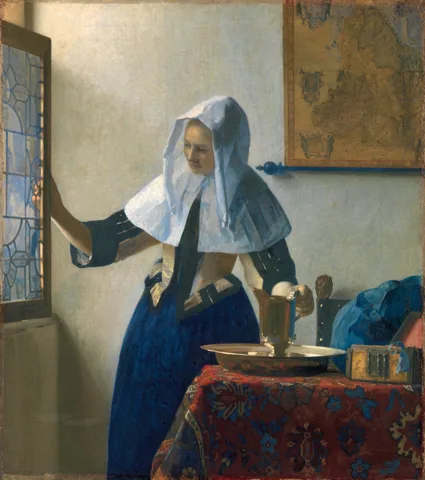
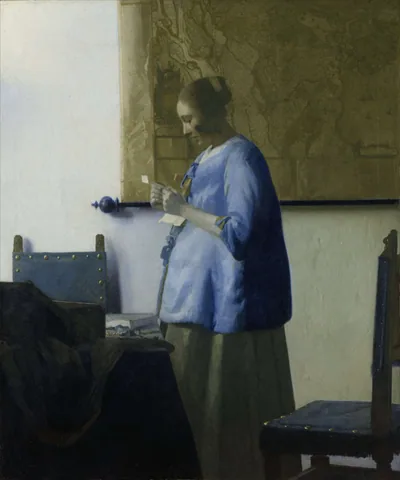
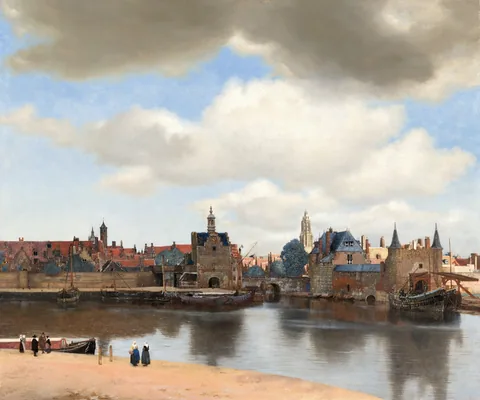
More in Dutch and Flemish Masters and Interiors and Portraits.
Sources
More from the Journal
 Story · 7 min
Van Gogh’s Starry Night: the facts, and choosing a print
Painted in June 1889 at an asylum in Provence: the view from his window, plus a village he made up. What is real, what it means, and which print to choose. Story · 7 min
The Great Wave off Kanagawa: meaning, history and prints
A woodblock print, not a painting, and a storm wave, not a tsunami. What it shows, why no two impressions match, and how to choose a print. Story · 7 min
Klimt’s The Kiss: gold leaf, meaning and choosing a print
Real gold leaf on canvas, finished in 1909. The story of Klimt’s lovers, what a print can and can’t reproduce, and which size to choose. Story · 7 min