
Story
Vermeer’s The Procuress: his first scene of everyday life
A soldier, a young woman, a coin and a grinning man who may be Vermeer himself. The story of his first genre painting, and choosing a print.
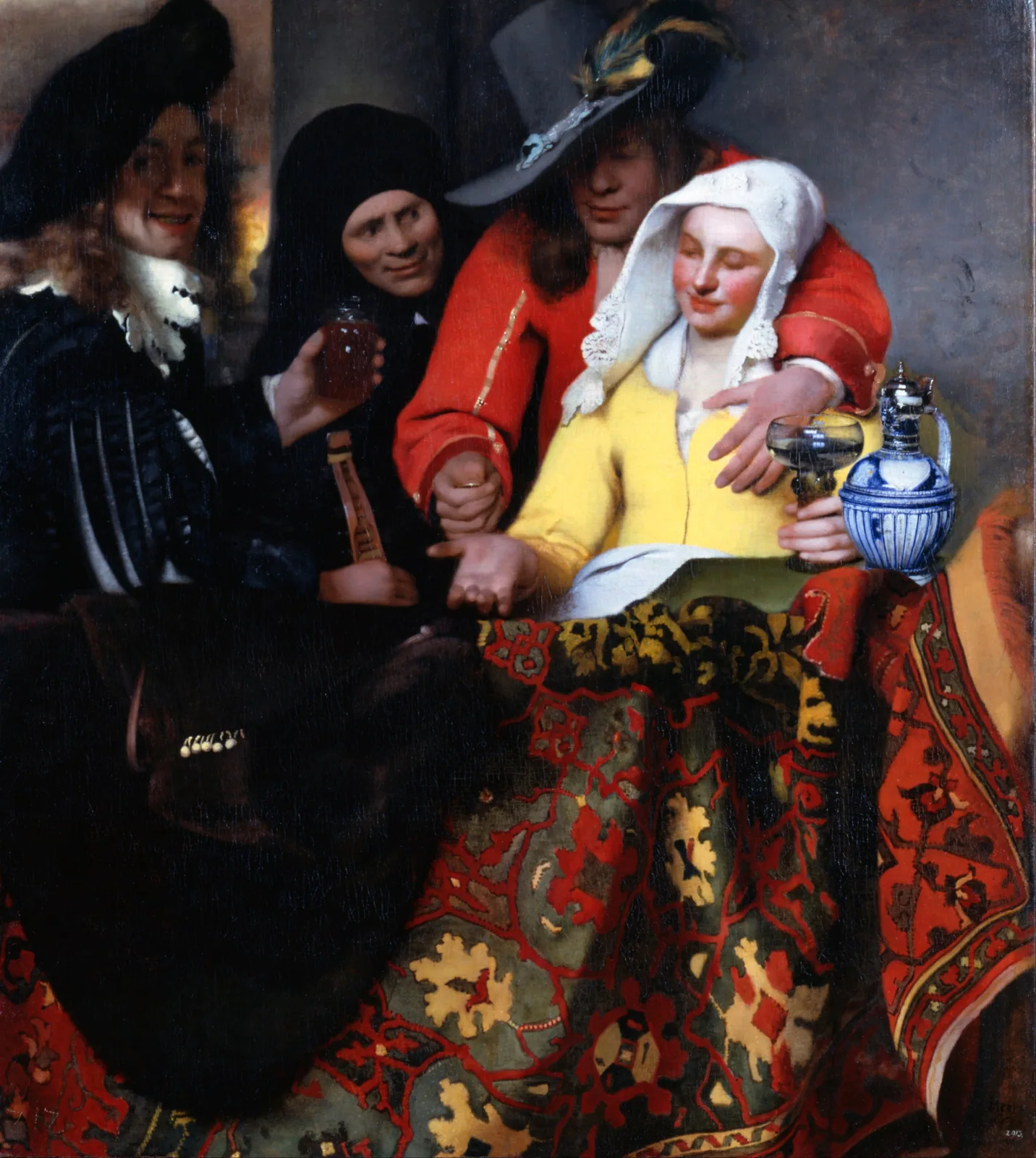
A soldier in a red jacket puts his arm around a young woman in yellow and drops a coin into her open hand. Beside them an old woman in black watches greedily, and on the left a man in a black beret grins out at us, glass in hand. Johannes Vermeer painted it in 1656, when he was 24. It is a long way from the quiet women in sunlit rooms he became famous for, and it is where that story begins.
What is happening?
A deal is being struck, perhaps in a brothel. The title names the woman in black: the procuress, who arranges the meeting and takes her share. The soldier pays; the young woman, glass of wine in hand, accepts. Vermeer shows it plainly, with no scolding.
Vermeer’s first scene of everyday life
Before this, Vermeer painted stories from the Bible and from mythology. The Procuress is his first genre painting, a scene of contemporary life, and the start of the work that made his name. It is also one of only three paintings he both signed and dated, which is why we know the year for certain.
He learned from others. The painter Gerard ter Borch influenced him, and so did Dirck van Baburen’s own Procuress of about 1622. That painting belonged to Vermeer’s mother-in-law, Maria Thins, and Vermeer liked it enough to paint it as a picture on the wall in two of his later works.
Is that Vermeer on the left?
Possibly. The man in the black beret and doublet, looking out at us with a grin, has been identified as a possible self-portrait. The art historian Benjamin Binstock goes further: he reads the whole picture as a portrait of Vermeer’s family, perhaps with his wife Catharina as the procuress and her brother Willem as the soldier. It is a bold theory, not a fact.
The objects
A heavy rug thrown over a balustrade fills about a third of the canvas, so the figures seem to lean over it toward us. On it stands a blue and white Westerwald stoneware jug. The man on the left holds what is probably a cittern, a stringed instrument. These rich things, the rug, the jug, the wine glasses, become regular props in Vermeer’s later rooms.
Where is The Procuress now?
In the Gemäldegalerie Alte Meister in Dresden. It was bought in 1741 for Augustus III, Elector of Saxony and King of Poland, from the Waldstein collection.
Look closer
These details come from the scan we print from, 4,278 pixels on the long side. Pick a detail, or zoom in and drag to look around.
Grinning out at us in a black beret and doublet, a glass in his hand: possibly Vermeer himself.
Choosing a print
Size. The original is big, about 56 by 51 inches. Our scan prints sharply up to 21 × 24 in, and we don’t sell it bigger than that. Framed prints, canvas and unframed art prints all go up to 21 × 24 in.
Where it works. A bar, a den or a dining room with dark walls, where its reds, yellows and the rich rug glow. It is a lively, adult picture, better suited to a sitting room than a child’s room.
Which material. The background and the man on the left are dark. Behind clear acrylic, dark areas reflect a facing window, so hang a framed print with side light, or choose canvas, with its matte finish and no cover. See our papers and canvas.
Frames. A wide gold frame picks up the yellow jacket and the rug; black wood keeps it sober. See all our frames.
Another soldier. Pair it with Officer and Laughing Girl, painted a year later. Open the two as a set. Read its story too.
Questions
What is a procuress?
A woman who arranges paid meetings between men and women. In the painting she is the old woman in black.
Is Vermeer in The Procuress?
Possibly. The grinning man in the black beret on the left has been identified as a possible self-portrait.
Where is The Procuress?
In the Gemäldegalerie Alte Meister in Dresden, since 1741.
How big is it?
143 × 130 cm, about 56 × 51 in.
Can it be printed legally?
Yes. It is more than 350 years old and in the public domain. What public domain means.
More Vermeer
All Vermeer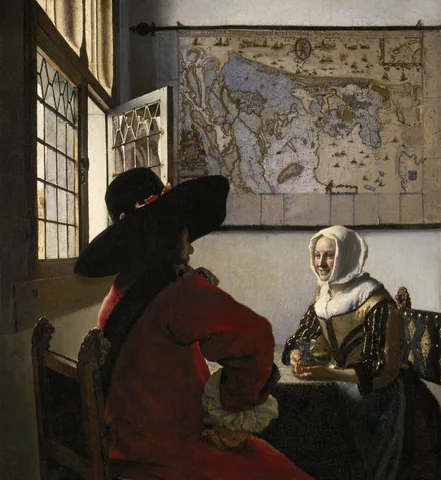
More in Dutch and Flemish Masters and Interiors and Portraits.
Sources
More from the Journal
 Story · 7 min
Van Gogh’s Starry Night: the facts, and choosing a print
Painted in June 1889 at an asylum in Provence: the view from his window, plus a village he made up. What is real, what it means, and which print to choose. Story · 7 min
The Great Wave off Kanagawa: meaning, history and prints
A woodblock print, not a painting, and a storm wave, not a tsunami. What it shows, why no two impressions match, and how to choose a print.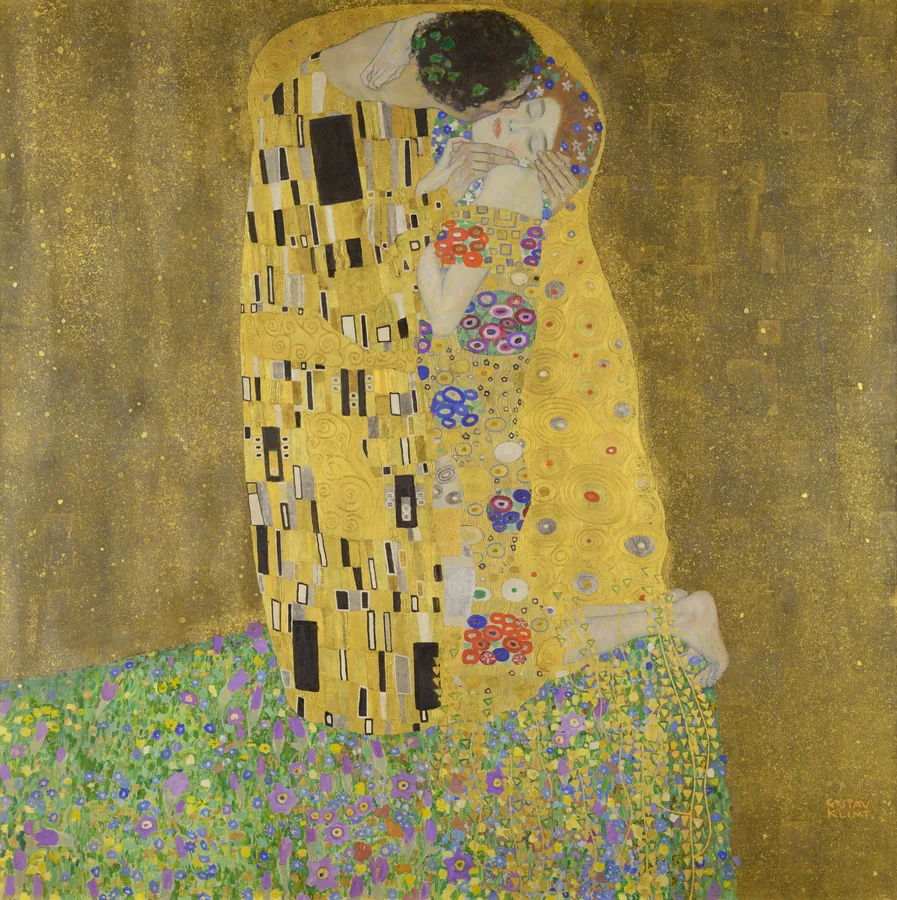 Story · 7 min
Klimt’s The Kiss: gold leaf, meaning and choosing a print
Real gold leaf on canvas, finished in 1909. The story of Klimt’s lovers, what a print can and can’t reproduce, and which size to choose. Story · 7 min