
Story
Vermeer’s Woman Holding a Balance: meaning and a print
She holds an empty balance before a painting of the Last Judgment. What Vermeer’s quiet picture may mean, and how to choose a print.
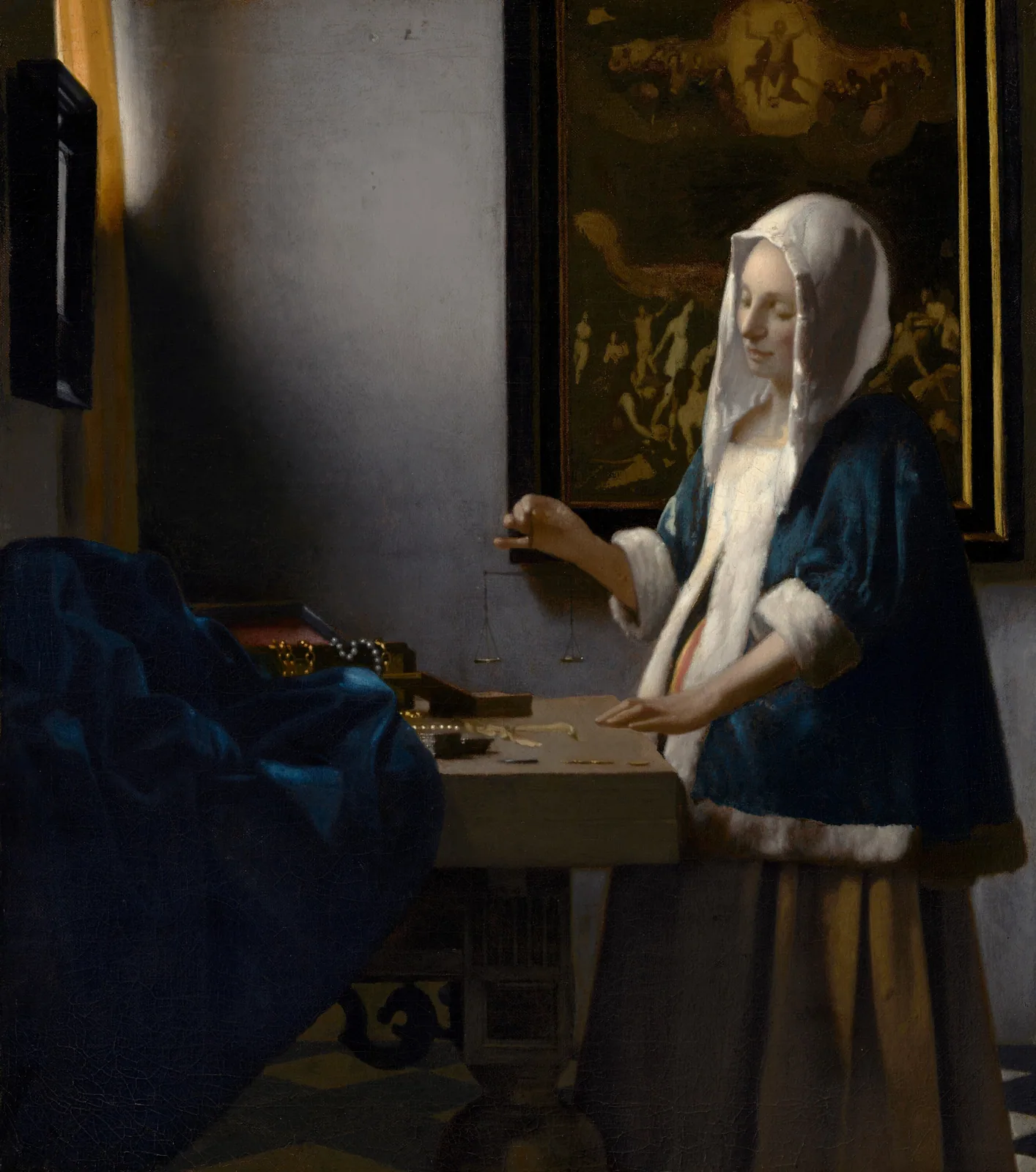
A young woman stands at a table by a window, holding a small balance perfectly level between her finger and thumb. In front of her, pearls and gold spill from an open box. Behind her, on the wall, hangs a dark painting of the Last Judgment. Johannes Vermeer painted this tiny, silent picture around 1662 or 1663. It is one of his most quietly loaded.
What is she weighing?
Nothing. The painting used to be called Woman Weighing Gold, but microscopic study has confirmed that the pans of her balance are empty. She is not counting her wealth. She is waiting for the scale to settle, with the jewels lying ignored beside her.
The Last Judgment behind her
That is where the meaning comes in. The painting on the wall shows the Last Judgment, with Christ at the top, his hands raised and outstretched, deciding the fate of souls. In Christian belief, at the end of time every soul is weighed. So a woman weighing nothing, in front of a picture of souls being judged, with earthly treasure at her elbow, invites us to think about what really counts.
What does it mean?
Writers have offered several readings, and they overlap:
- A vanitas. A reminder that worldly riches, the pearls and gold, mean nothing in the end.
- Justice and truth. The balance as a symbol of fair judgment and divine truth.
- A meditation. A picture to help the viewer reflect, like a quiet prayer.
- Mary. The scholar John Michael Montias saw her as symbolically weighing unborn souls, and as a figure of the Virgin Mary.
The mirror on the wall, facing her, has been read as a sign of self-knowledge. She seems to be expecting a child, too, which adds to the sense of a life in the balance.
How Vermeer paints it
The light comes from a window on the left, hidden except for its golden curtain, and falls on her face, her hands, the white fur of her jacket and the pearls. Everything else is in soft shadow. The balance is the stillest point in a still room; her whole body is arranged around that small act of holding steady.
Where is Woman Holding a Balance?
In the National Gallery of Art in Washington, part of the Widener Collection. In 1696 it was sold at auction in Amsterdam from the estate of Jacob Dissius, with other Vermeers, for 155 guilders. It is small, about 16½ by 15 inches.
Look closer
These details come from the scan we print from, made by the National Gallery of Art, 26,343 pixels on the long side. Pick a detail, or zoom in on the balance to see that it is empty.
A small balance held perfectly level between finger and thumb. Its pans are empty.
Choosing a print
Life size, or a little more. The painting is small. At 14 × 16 in it is about life size; at 18 × 20 in it is a little larger and easier to read across a room. Framed prints go up to 27 × 30 in. Framed prints go up to 27 × 30 in, canvas up to 35 × 40 in and unframed art prints up to 42 × 48 in.
Where it works. A bedroom, a dressing room or a quiet study. A small, still picture wants a place where you can stand close to it. Hang the center at eye level; see how high to hang art.
Mind the dark. Much of the picture is shadow. Behind clear acrylic, dark areas reflect a facing window, so hang a framed print with side light, or choose canvas, with its matte finish and no cover. Smooth cotton paper keeps the tiny balance and pearls sharp. See our papers and canvas.
Frames. Black wood is the classic Dutch look; a wide gold frame like our Gold Plein Air makes the small picture feel precious. See all our frames.
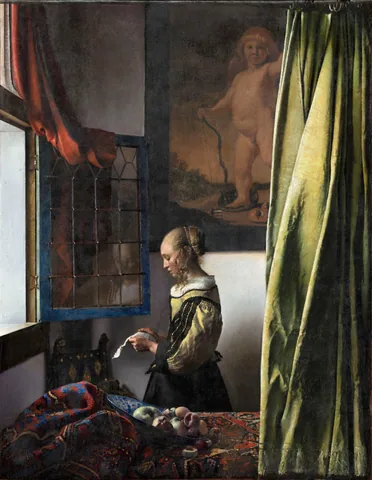
A pair in blue. Woman in Blue Reading a Letter shows another woman alone in a quiet room, in the same blue. Open the two as a set.
Questions
What is the woman weighing?
Nothing. Microscopic study confirmed that the pans of her balance are empty.
What is the painting behind her?
A painting of the Last Judgment, with Christ judging the souls of the dead.
What does it mean?
Readings include a vanitas about the emptiness of riches, a picture of justice and truth, and an aid to meditation.
Where is it?
In the National Gallery of Art in Washington. It is 42.5 × 38 cm, about 16½ × 15 in.
Can it be printed legally?
Yes. It is more than 350 years old and in the public domain, and the National Gallery of Art shares its image freely. What public domain means.
More Vermeer
All Vermeer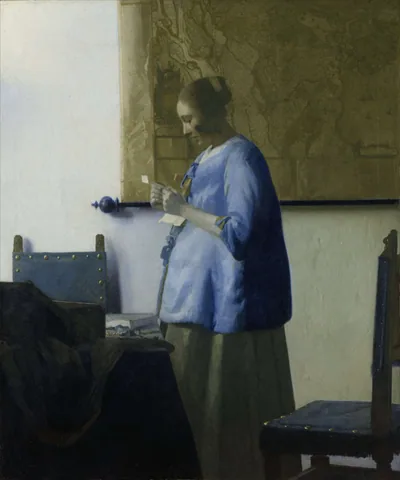
More in Dutch and Flemish Masters and Interiors and Portraits.
Sources
More from the Journal
 Story · 7 min
Van Gogh’s Starry Night: the facts, and choosing a print
Painted in June 1889 at an asylum in Provence: the view from his window, plus a village he made up. What is real, what it means, and which print to choose. Story · 7 min
The Great Wave off Kanagawa: meaning, history and prints
A woodblock print, not a painting, and a storm wave, not a tsunami. What it shows, why no two impressions match, and how to choose a print. Story · 7 min
Klimt’s The Kiss: gold leaf, meaning and choosing a print
Real gold leaf on canvas, finished in 1909. The story of Klimt’s lovers, what a print can and can’t reproduce, and which size to choose. Story · 7 min