
Story
The Cosmic Cliffs: Webb’s famous Carina Nebula image
Glowing mountains of gas where stars are born, from the Webb telescope’s first images. What the Cosmic Cliffs are, and choosing a print.
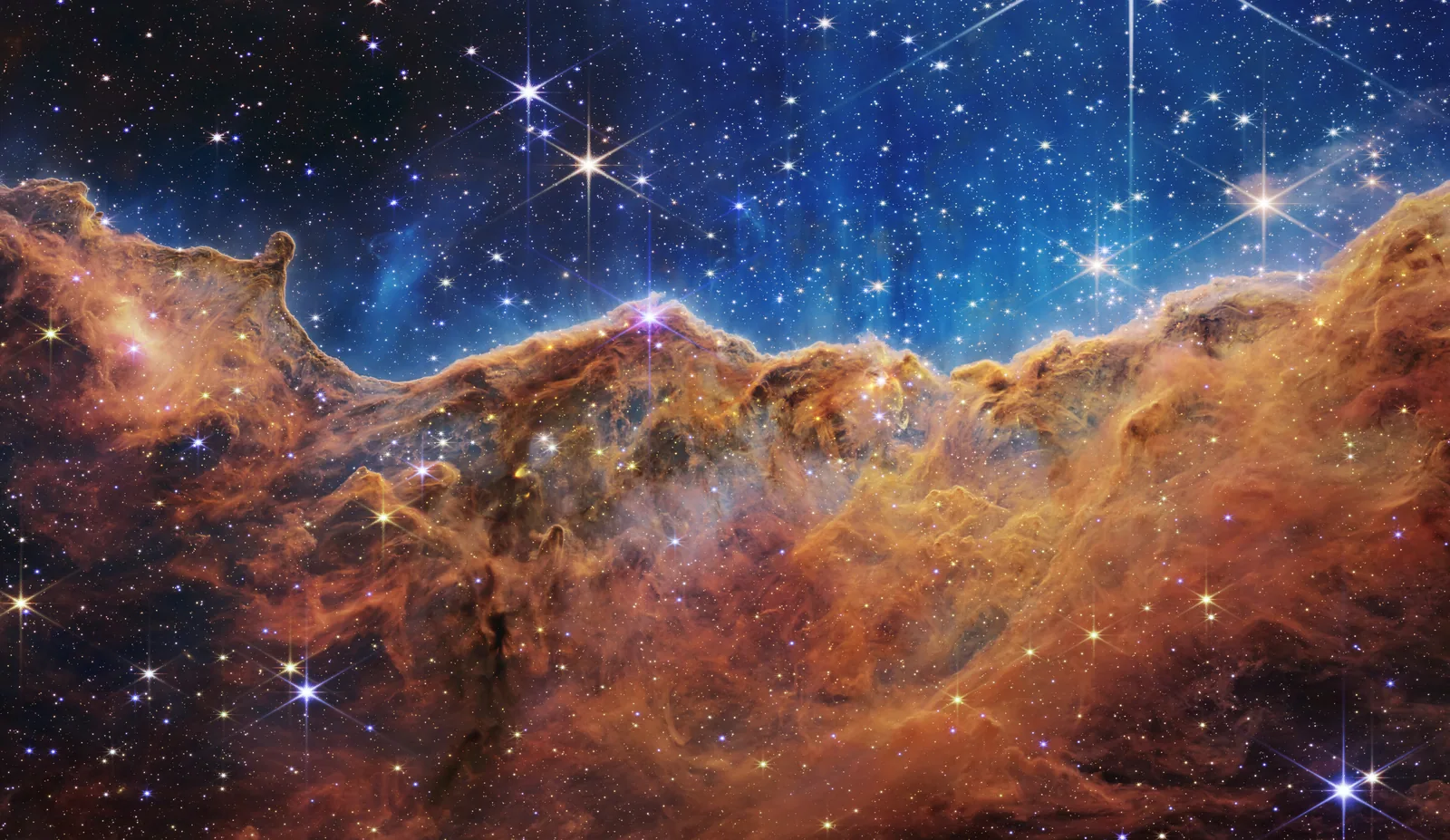
It looks like a landscape: a jagged range of mountains glowing orange and brown at sunset, with a deep blue sky above, scattered with stars. But there is no ground and no sunset. This is a wall of gas and dust in the Carina Nebula, thousands of light-years away, seen in infrared light by the James Webb Space Telescope. Released on July 12, 2022, as one of Webb’s first full-color science images, it showed the world what the new telescope could do.
What are the Cosmic Cliffs?
The Carina Nebula is a huge cloud of gas and dust in the southern sky, with a radius of about 230 light-years. The French astronomer Nicolas-Louis de Lacaille discovered it from the Cape of Good Hope in 1752. It is also home to Eta Carinae, a hypergiant star estimated at 100 to 150 times the mass of the Sun and about four million times as bright.
The Cosmic Cliffs are at the edge of a young star-forming region within it called NGC 3324, about 7,600 light-years away by ESA/Webb’s figure. What looks like a mountainside is really the wall of an enormous cavity in the gas. Massive, hot, young stars have carved the cavity out with their ultraviolet radiation and stellar winds, and they are slowly eroding its wall. The “mountains” are the parts of the wall still standing.
Reading the picture
Once you know what you are looking at, the details start to make sense. The wisps that rise from the cliffs like steam or smoke are hot, ionized gas and hot dust streaming away from the nebula under that intense ultraviolet light. Here and there, pillars of denser material resist the radiation and stand up out of the wall, the way the Pillars of Creation do in the Eagle Nebula.
Inside the cliffs, stars are being born. Webb’s infrared eyes can see through dust that would hide them in visible light, and the image shows jets and outflows, picked out in gold, coming from newly forming stars still wrapped in dust. ESA/Webb points out a “blow-out” near the top center of the ridge, where gas and dust spew outward, and an unusual arch shaped like a bent cylinder. The early stage of a star’s life captured here is short by cosmic standards, lasting about 50,000 to 100,000 years for each star.
Look beyond the cliffs, too. The field is full of stars that were hidden from earlier telescopes, and in the background are galaxies far beyond our own.
A landscape that is not a landscape
Part of the image’s appeal is how familiar it feels. The eye reads the bottom half as land and the top half as sky, the bright edge of the ridge as a sunlit cliff and the rising gas as mist in a valley. You may find faces, animals or coastlines in it too. None of that is really there, of course, but it is a useful way in: it lets you grasp, at a glance, a scene so large that light takes years to cross it.
And it is a scene that changes. The wall of the cavity is being worn away all the time, and the stars forming inside it will one day clear out their own surroundings in turn. The picture catches one moment in a process that runs for hundreds of thousands of years.
Why it looks the way it does
Webb sees mainly in infrared light, which our eyes cannot see. To make a picture, astronomers take images through separate filters, each recording a different wavelength, and assign each a visible color, from blue for the shortest to red and yellow for the longest. In this image, one filter traces molecular hydrogen, another traces complex carbon-based molecules in the dust, and the rest record starlight and glowing gas. The colors are a translation, but the structures are real.
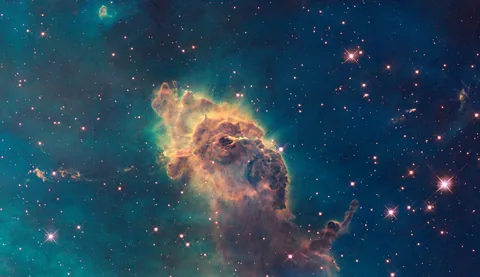
Infrared matters for three reasons. Light from very distant objects is stretched into the infrared on its way to us. Infrared light passes through dust clouds more easily than visible light. And cooler objects, like dusty young stars, glow most strongly in the infrared. For a stellar nursery like the Cosmic Cliffs, the second and third reasons are everything: Webb sees into the dust where stars are forming. Compare the Hubble view of part of the Carina Nebula in visible light to see the difference.
The telescope
The James Webb Space Telescope launched on December 25, 2021, on an Ariane 5 rocket from French Guiana. It orbits around a point in space called L2, about 1.5 million kilometers from Earth. Its main mirror is 6.5 meters across, made of 18 hexagonal segments of gold-coated beryllium, with about six times the collecting area of Hubble’s. A five-layer sunshield, each layer about a tenth of a millimeter thick, keeps it cold enough to see faint infrared light.
It is a partnership of NASA, the European Space Agency and the Canadian Space Agency, and is named after James E. Webb, who ran NASA from 1961 to 1968. The first image was released to the public on July 11, 2022, and the Cosmic Cliffs followed the next day, with the Carina Nebula among the five targets of that first set of science images. Webb has since gone on to make many more famous pictures, among them its view of the Pillars of Creation. For that story, read Pillars of Creation: the story of Hubble’s famous image.
Choosing a print
Size. This is one of the largest files in the shop, 14,575 pixels on its long side, and the image is wide, a little under twice as wide as it is tall. It prints sharply even very large: up to 40 × 23 in framed, or 48 × 28 in on canvas. Framed prints go up to 40 × 23 in, canvas up to 48 × 28 in and unframed art prints up to 48 × 28 in. The wide shape suits the wall over a sofa, a bed or a desk. At 36 × 21 in it makes a strong piece for a home office.
Paper or canvas. Smooth paper keeps the tiny stars and fine wisps of gas crisp. Canvas, with no glass, suits a bright room and gives the image the feel of a painted landscape. See our papers and canvas.
Frames and rooms. A thin black frame lets the colors glow. It suits an office, a study, a teenager’s room or a family room, and makes a good gift for anyone who followed the Webb launch. See our frames.
Pairing. Hang it beside Webb’s Pillars of Creation for two views of stars being born, or beside Hubble’s visible-light image of Carina to show how differently the two telescopes see the same nebula.
Questions
What are the Cosmic Cliffs?
The edge of a giant cavity in the gas of NGC 3324, a young star-forming region in the Carina Nebula, carved out by the radiation and winds of hot young stars.
When was the image released?
On July 12, 2022, as one of the James Webb Space Telescope’s first full-color science images.
Are the colors real?
The image was made in infrared, which we cannot see. Each filter is given a visible color, so the colors are translated, but the shapes are real.
How far away is it?
About 7,600 light-years, according to ESA/Webb. The Carina Nebula as a whole is usually given as about 8,500 light-years away.
Can it be printed legally?
Yes. ESA/Webb releases this image under a CC BY 4.0 license, which allows reuse with credit. The credit line is NASA, ESA, CSA, and STScI.
More from Webb and Hubble
All space prints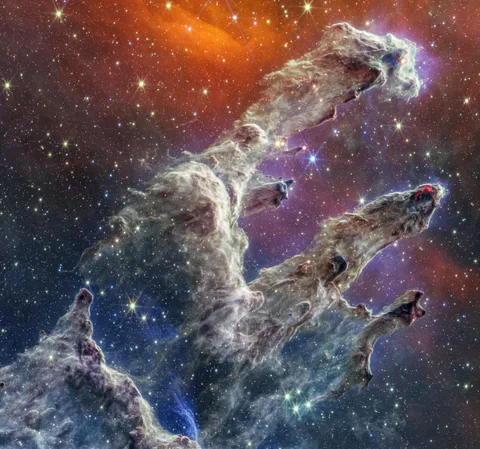
Sources
More from the Journal
 Story · 7 min
Van Gogh’s Starry Night: the facts, and choosing a print
Painted in June 1889 at an asylum in Provence: the view from his window, plus a village he made up. What is real, what it means, and which print to choose. Story · 7 min
The Great Wave off Kanagawa: meaning, history and prints
A woodblock print, not a painting, and a storm wave, not a tsunami. What it shows, why no two impressions match, and how to choose a print. Story · 7 min
Klimt’s The Kiss: gold leaf, meaning and choosing a print
Real gold leaf on canvas, finished in 1909. The story of Klimt’s lovers, what a print can and can’t reproduce, and which size to choose. Story · 7 min