
Story
The Dog by Goya: meaning of the Black Painting
A small dog’s head in a vast empty space, painted on the wall of Goya’s house. What The Dog may mean, its strange history, and a print.
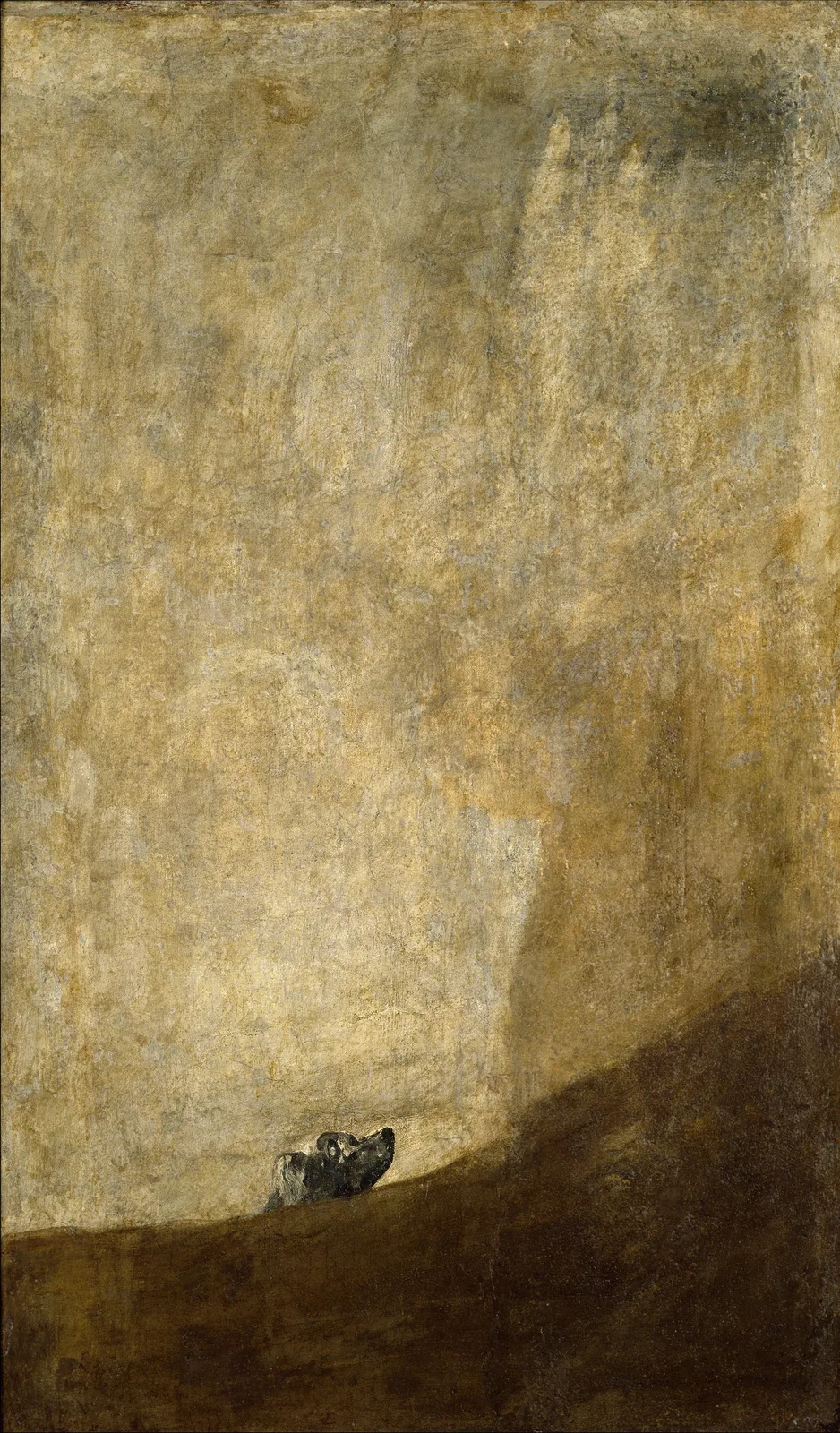
Almost the whole picture is empty. A wide, dirty ochre space fills the top, and near the bottom a dark brown slope rises toward the right. Just above that slope, very small, is the head of a dog, looking up. We cannot see its body. We cannot see what it is looking at. Francisco Goya painted it straight onto a wall of his own house outside Madrid, around 1820, and never gave it a title. Today it hangs in the Prado, and some painters have called it the most beautiful picture in the world.
What is happening to the dog?
Nobody knows, and that is the heart of it. The dog’s snout is raised, its ears are pulled back and its eyes turn up and to the right. The Prado’s own label says it appears to be in distress, apparently drowning. That is why it has been called The Half-Drowned Dog, The Half-Submerged Dog and The Buried Dog, as well as plain Head of a Dog. In Spanish it is usually El Perro.
One reading sees the dark mass as quicksand, or earth, or something else that has trapped the animal, so that all it can do is look up and hope for a rescue that never comes. In that reading the picture becomes an image of the struggle against forces we cannot fight, and the emptiness of the sky makes the dog’s isolation complete. Others see something quieter: a dog cautiously raising its head, wary of something outside the frame, or an image of loneliness and abandonment. The critic Robert Hughes said that its meaning is unknown, but that its pathos reaches us on a level below narrative. You feel it before you can explain it.
There is one more puzzle. A faint dark shape seems to loom over the dog. It has been read as damage, and as something Goya meant to be there, but it is generally thought to be a trace of an earlier painting underneath.
Look at how little Goya gives you. The upper part of the picture, by far the largest, is a dull ochre sky with nothing in it. The lower part is a smaller, curving band of dark brown that deepens toward black as it rises to the right. The dog sits right where the two meet, tiny against all that space. The emptiness is the point. It is what makes the small head feel so alone, and so alive.
The house of the deaf man
In February 1819 Goya bought a two-story house on the Manzanares River near Madrid. It was known as the Quinta del Sordo, the villa of the deaf man, after a previous owner who was deaf. By coincidence Goya was deaf too, after a serious illness decades earlier. He was in his seventies. He had survived two illnesses that nearly killed him, had lived through the Napoleonic wars and the political turmoil that followed in Spain, and was finishing his prints of the horrors of war.
He first decorated the rooms with more hopeful images. Then he painted over them. Between about 1819 and 1823 he covered the walls with fourteen pictures in oil, directly on the plaster, that are now known as the Black Paintings. Nobody commissioned them, and they were probably never meant to be seen by the public. On the ground floor were some of the darkest, among them Saturn Devouring His Son, and a portrait of a woman leaning on a fence linked to Leocadia Weiss, who lived with Goya in the house. The Dog was upstairs, on the right of the door.
From a wall to a museum
In 1823 Goya left Spain for France, and passed the house to his grandson, Mariano. He settled in Bordeaux, where he later painted The Milkmaid of Bordeaux, a gentle late picture very far from the Black Paintings.
The murals stayed on the walls for about fifty years and began to deteriorate. In 1874 a French banker, Baron Émile d’Erlanger, bought the house, and the paintings were taken off the walls and transferred to canvas under the direction of Salvador Martínez Cubells, a curator at the Prado. A photograph by J. Laurent from around that time shows The Dog still in place. The transferred paintings were shown at the Exposition Universelle in Paris in 1878, and the baron then gave them to the Spanish state. Most needed restoration, and some details may have been lost; The Dog seems to have suffered less than the others.
So the painting we know is not quite what Goya made. It was painted for a wall, in a room, to be seen by him and the few people who visited. It was never framed, never titled and never exhibited in his lifetime.
A painting painters love
The Dog has had a special hold on artists. The Spanish painter Antonio Saura called it the world’s most beautiful picture. Rafael Canogar called it a visual poem. Joan Miró, on his last visit to the Prado, asked to see two paintings: Velázquez’s Las Meninas and Goya’s dog. The Prado curator Manuela Mena has said that no contemporary painter fails to pray in front of it.
It is easy to see why. Two centuries before abstract art, Goya made a picture that is almost all empty color, with a single small sign of life in it. The French painter Pierre Bonnard put a dog that echoes Goya’s into his own cheerful The Red-Checkered Tablecloth of 1910. But nothing quite matches the original, a dog alone in the world, looking up.
Choosing a print
Size. The painting is tall and narrow, about 52 by 31 inches. Our scan is 3,051 pixels on its long side, so we keep it to a medium size: framed up to 12 × 20 in, canvas up to 12 × 20 in. Framed prints, canvas and unframed art prints all go up to 12 × 20 in. The tall shape suits a narrow wall, the side of a doorway, a stair or a reading corner.
Paper or canvas. The picture was painted on plaster, and its surface is all soft, earthy color. Canvas has a matte, painted feel that suits it; smooth paper behind glazing keeps the faint shapes in the sky clear. See our papers and canvas.
Frames and walls. A plain black or dark wood frame suits its bare, modern look. It is at home on a warm white, stone or clay-colored wall, and it gives a quiet, thoughtful note to a study. See our frames.
Questions
What does Goya’s The Dog mean?
Nobody knows. It is often read as a dog sinking or trapped, looking up for help that does not come, and so as an image of helplessness and isolation. Others see wariness or loneliness.
Is The Dog one of the Black Paintings?
Yes. It is one of the fourteen murals Goya painted on the walls of his house, the Quinta del Sordo, between about 1819 and 1823.
Did Goya give it a title?
No. All its names, including The Dog, were given after his death.
Where is it?
In the Museo del Prado, Madrid. It is 131.5 × 79.3 cm, about 52 × 31 in.
Can it be printed legally?
Yes. Goya died in 1828, and the painting is in the public domain. What public domain means.
More Goya
All Goya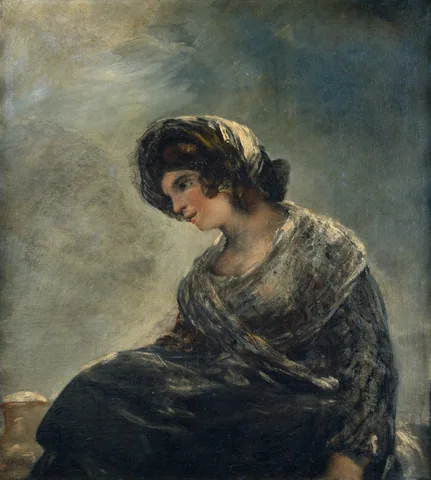
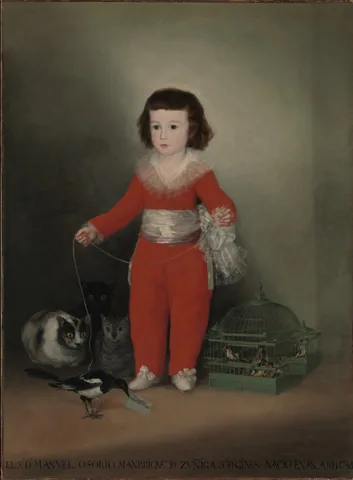
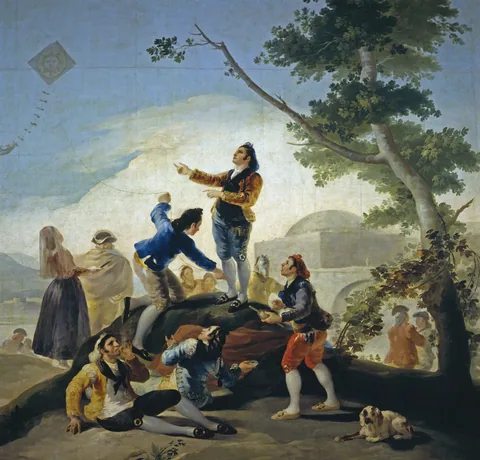
More in Birds and Animals.
Sources
More from the Journal
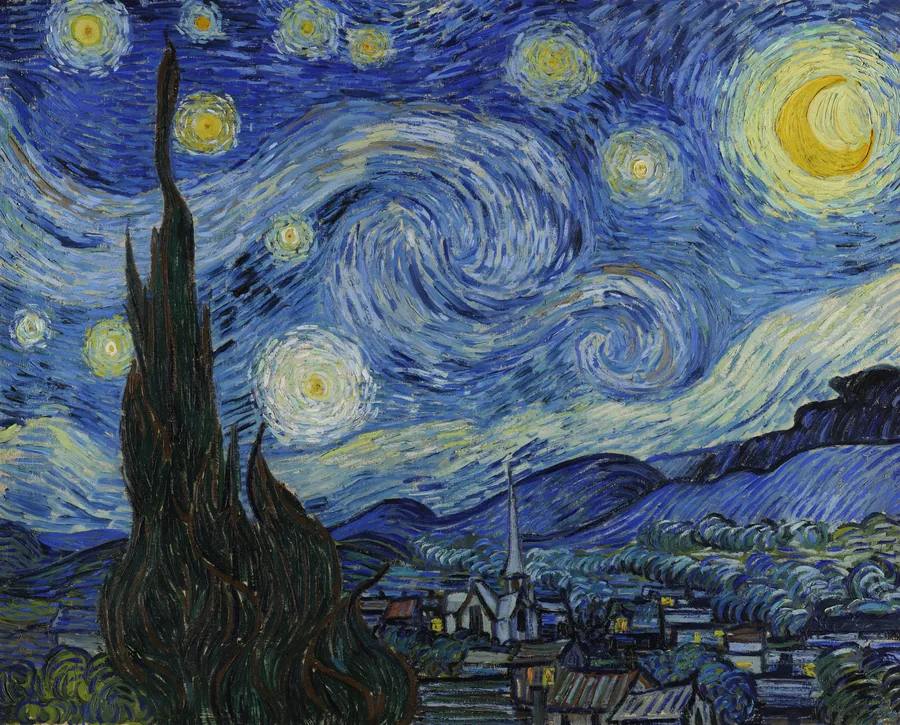 Story · 7 min
Van Gogh’s Starry Night: the facts, and choosing a print
Painted in June 1889 at an asylum in Provence: the view from his window, plus a village he made up. What is real, what it means, and which print to choose.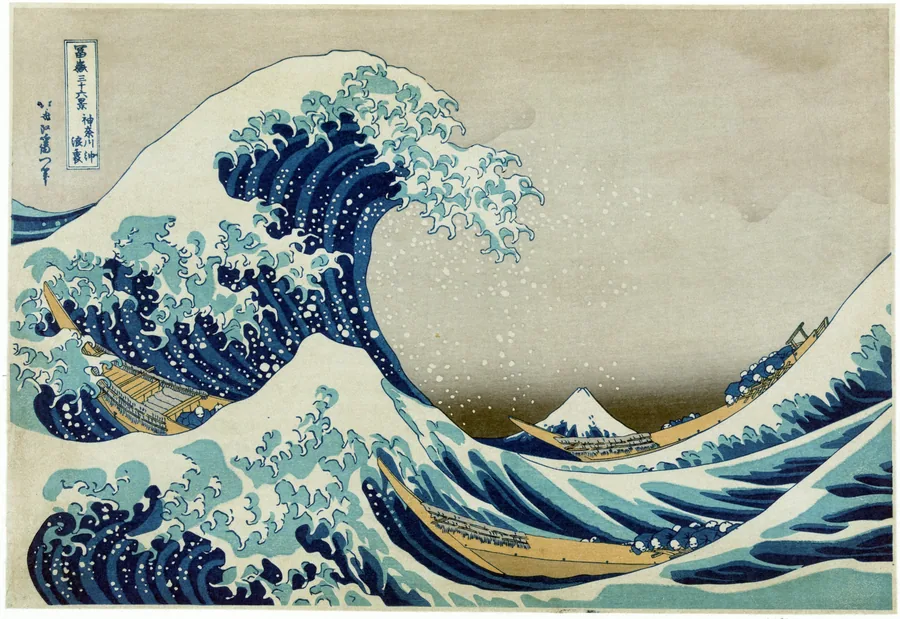 Story · 7 min
The Great Wave off Kanagawa: meaning, history and prints
A woodblock print, not a painting, and a storm wave, not a tsunami. What it shows, why no two impressions match, and how to choose a print. Story · 7 min
Klimt’s The Kiss: gold leaf, meaning and choosing a print
Real gold leaf on canvas, finished in 1909. The story of Klimt’s lovers, what a print can and can’t reproduce, and which size to choose. Story · 7 min