
Story
Hiroshige’s Sudden Shower over Shin-Ōhashi Bridge
People running across a bridge in a downpour, drawn in fine lines of rain. The story of Hiroshige’s famous print, Van Gogh’s copy, and a print.
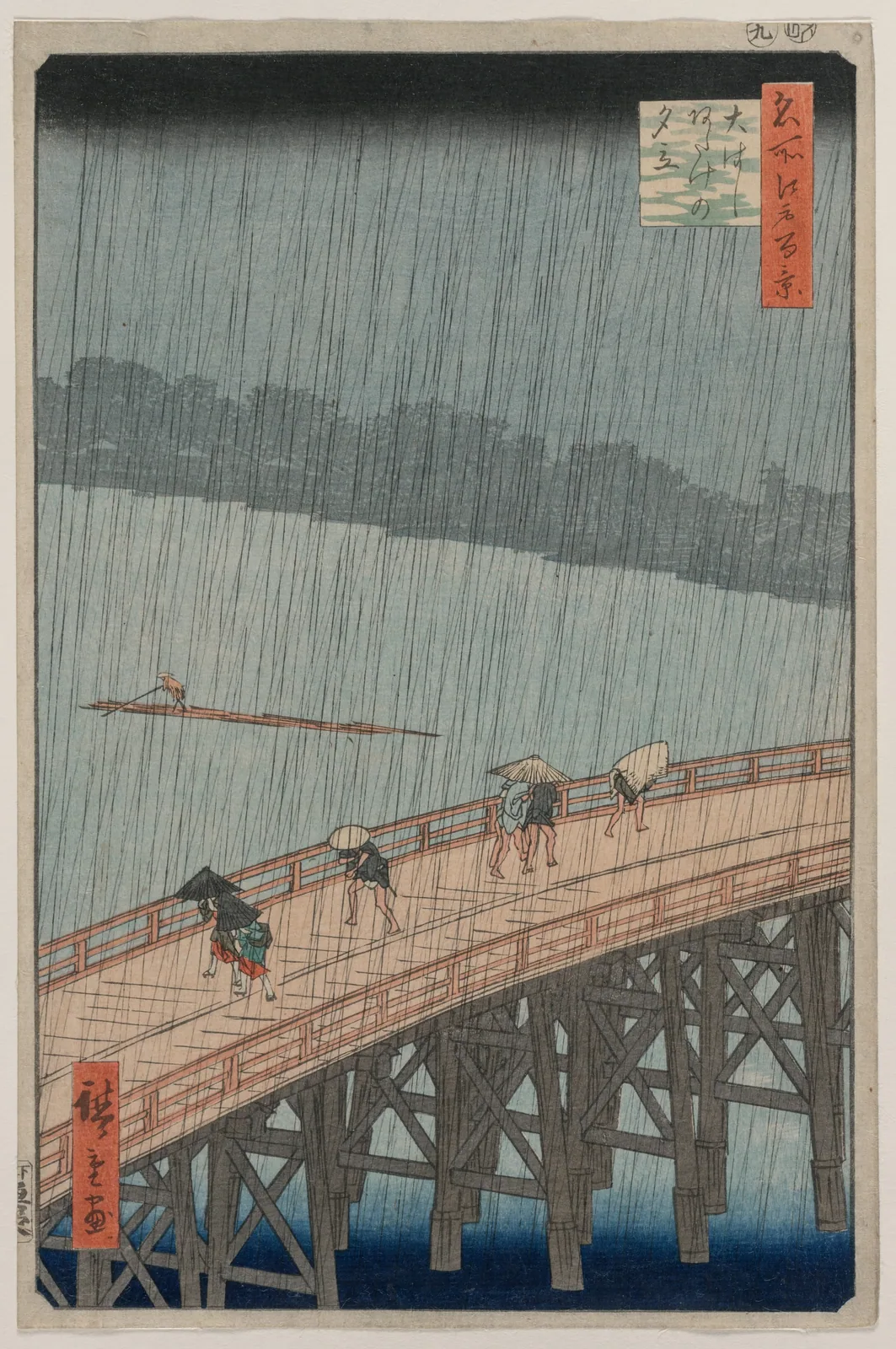
A summer storm has broken over the river. On a long wooden bridge, a handful of people hurry for shelter as best they can. The rain comes down in fine dark lines, so many and so straight that the whole sky seems hatched with them. Below, a man poles a log raft along the gray water, and the far bank is half lost in the downpour. Utagawa Hiroshige designed this print in 1857, and it has inspired painters and writers ever since.
What the print shows
The bridge is the Shin-Ōhashi, the “new great bridge,” a wooden bridge across the Sumida River in Edo, the city now called Tokyo. On it, two women and four or five men are caught out in a sudden shower. Down on the river a boatman is punting a raft of logs, toward the timber yards at Fukagawa. Across the water is Atake, an area named after the government ship Atakemaru.
The Japanese title, Ōhashi Atake no yūdachi, names a yūdachi, a sudden evening shower of the kind that sweeps in on a hot summer day. It is not a gentle rain. Everyone on the bridge is hurrying to get out of it.
Drawing rain
The rain is the triumph of the print. Hiroshige called it “white rain,” and he showed it with a great many thin, dark, parallel lines running in two slightly different directions, as if one burst of rain has crossed another. Every one of those lines had to be carved by hand into a woodblock, leaving fine ridges of wood that would print as lines, and that is very hard to do. Look closely and the rain seems to move.
Above, the dark clouds are made with bokashi, a technique of grading color on the block by hand so that it fades smoothly from dark to light. Because the printer wiped and inked the block by hand for each sheet, the bokashi varies from one impression to the next.
Looking closely
Start with the people on the bridge. They are tiny, but each is doing something: hurrying, leaning into the rain, holding on to whatever covers them. Then drop down to the raftsman, alone on his logs in the middle of the river, who has nowhere to go and must simply keep poling. Then look across to the far bank, dim behind the curtain of rain. Last, look up at the dark clouds pressing down from the top of the sheet.
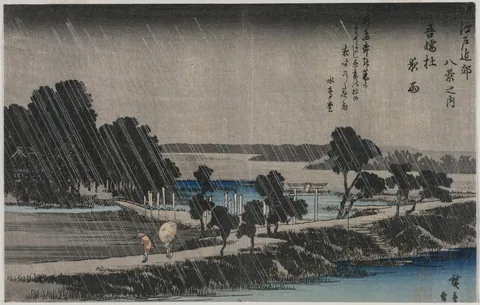
The picture is mostly empty water and sky, and that emptiness is filled by the rain. Hiroshige does not need to show puddles or splashes. The lines alone tell you how hard it is coming down, and the hunched figures tell you how it feels. Hiroshige returned to rain more than once; the store also has his Night Rain at the Azuma Shrine, from an earlier series of views around Edo.
One design, many printings
Popular prints were printed again and again, and this one changed over time. The earliest printings show two boats on the far bank that later ones leave out. A carving mistake that left a blank space in the bridge piles was corrected in later printings. Later impressions also add a deep blue gradation, a shadow under the walkway and a title cartouche in three colors. So two impressions of this print in two museums can look noticeably different. Our reproduction is made from an impression in the Cleveland Museum of Art.
One Hundred Famous Views of Edo
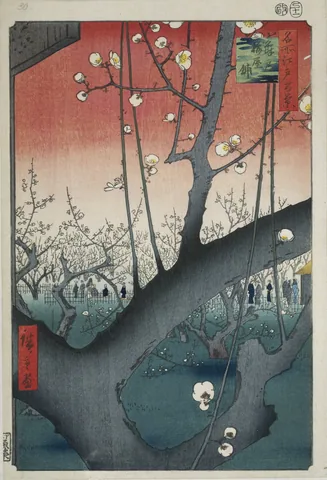
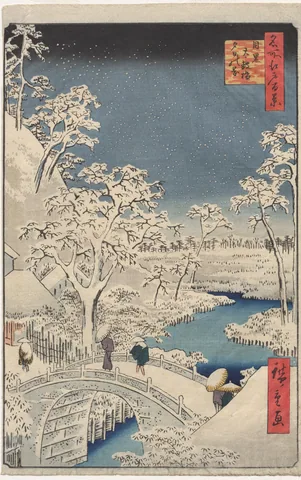
The print belongs to One Hundred Famous Views of Edo, a series of 119 prints published from 1856, arranged by the seasons. It used a tall, vertical format that Hiroshige had pioneered a few years earlier. Hiroshige died in 1858, before the series was finished, and his pupil Hiroshige II completed it. The series was hugely popular and was reprinted many times. Its best-known sheets include this one and Plum Park in Kameido; read that story in Plum Park in Kameido: Hiroshige’s print and Van Gogh.
Van Gogh’s Bridge in the Rain
Vincent van Gogh first saw this image in 1886, on the cover of the magazine Paris Illustré, prepared by the Japanese art dealer Hayashi Tadamasa. In Paris he collected Japanese prints by the hundred, and in October and November 1887 he painted Bridge in the Rain (after Hiroshige), based on this print. He put a red and green border around it, filled with Japanese characters, using the complementary colors he loved. He painted his copy of Plum Park in Kameido at the same time.
Hiroshige’s bridges reached other Western painters too. His bridge prints are said to have influenced the London bridge paintings that James McNeill Whistler made in the 1870s. And the print’s sky still speaks to people now: the critic Laura Cumming of The Observer listed it among the ten best skies in art.
About this print
What we print is a reproduction of a historical impression of Hiroshige’s design, on modern paper or canvas. It is not an original woodblock print. Read more in our guide to Japanese woodblock prints.
Size. The original sheet is about 14½ by 10 inches. Our scan is unusually detailed, 7,264 pixels on its long side, so every line of rain stays crisp even in a large print. At 11 × 16 in it is close to the original size. It holds up to 24 × 36 in framed, or 32 × 48 in on canvas. Framed prints go up to 24 × 36 in, canvas up to 32 × 48 in and unframed art prints up to 32 × 48 in.
Paper and frame. Smooth paper keeps the fine lines of rain sharp. A thin black or natural wood frame with a white mat is the classic choice. See our papers, frames and mats.
Where it works. Its tall shape suits a narrow wall, beside a window or a door, or a bathroom. It makes a natural pair with Van Gogh’s Bridge in the Rain, the Japanese original beside the Dutch homage. For a set of three, add Plum Park in Kameido, the other print from the series that Van Gogh copied the same autumn, or the Night Rain at the Azuma Shrine for a second, darker storm.
Questions
What does Sudden Shower over Shin-Ōhashi Bridge show?
People crossing the wooden Shin-Ōhashi bridge over the Sumida River in Edo (now Tokyo) in a sudden summer downpour, with a log raft on the river and the Atake district across the water.
What is Atake?
The area on the far bank of the Sumida River, named after the government ship Atakemaru. Shin-Ōhashi was the wooden bridge that crossed to it.
How did Hiroshige show the rain?
With many fine, dark, parallel lines in two directions, each carved by hand into the woodblock.
Did Van Gogh copy it?
Yes. He painted Bridge in the Rain (after Hiroshige) in Paris in 1887, with a border of Japanese characters.
Is this an original woodblock print?
No. It is a reproduction of a historical impression, printed on modern paper or canvas.
Can it be printed legally?
Yes. Hiroshige died in 1858, and the design is in the public domain. What public domain means.
More Hiroshige, and Van Gogh’s copy
All Hiroshige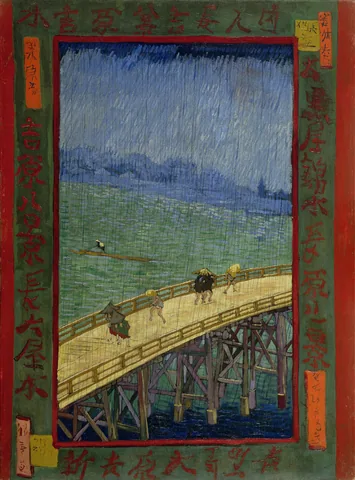
More in Japanese Woodblock.
Sources
More from the Journal
 Story · 7 min
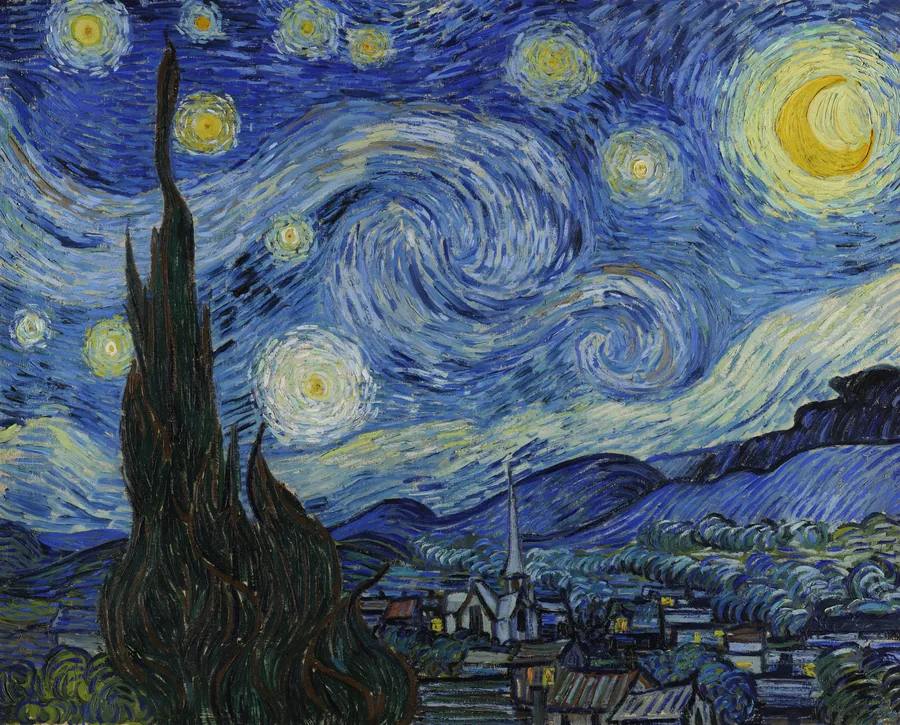
Van Gogh’s Starry Night: the facts, and choosing a print
Painted in June 1889 at an asylum in Provence: the view from his window, plus a village he made up. What is real, what it means, and which print to choose.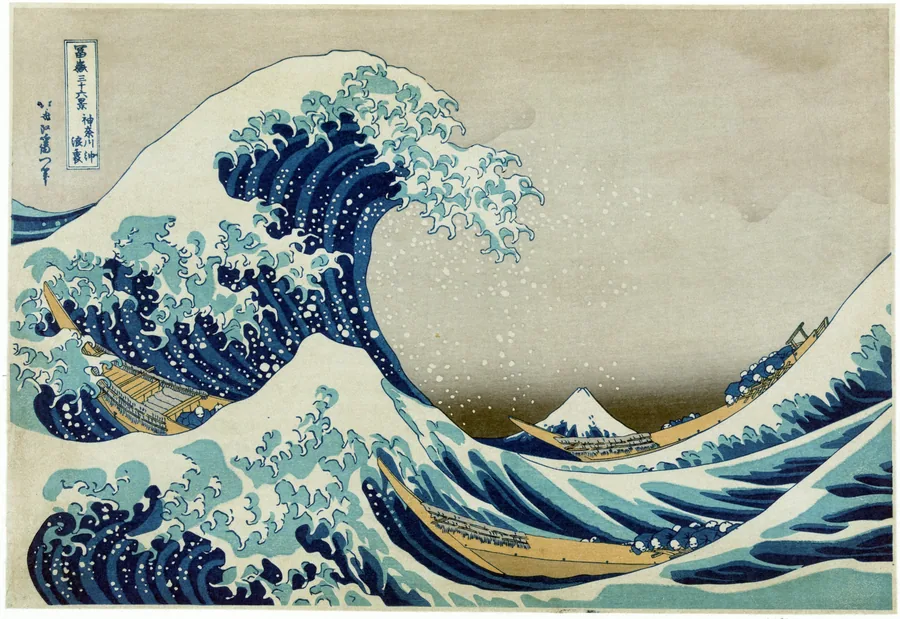 Story · 7 min
The Great Wave off Kanagawa: meaning, history and prints
A woodblock print, not a painting, and a storm wave, not a tsunami. What it shows, why no two impressions match, and how to choose a print. Story · 7 min
Klimt’s The Kiss: gold leaf, meaning and choosing a print
Real gold leaf on canvas, finished in 1909. The story of Klimt’s lovers, what a print can and can’t reproduce, and which size to choose. Story · 7 min