
Story
Takiyasha the Witch and the Skeleton Spectre: the story
A princess reads a spell and a giant skeleton bursts through the blinds. The story behind Kuniyoshi’s famous triptych, and choosing a print.
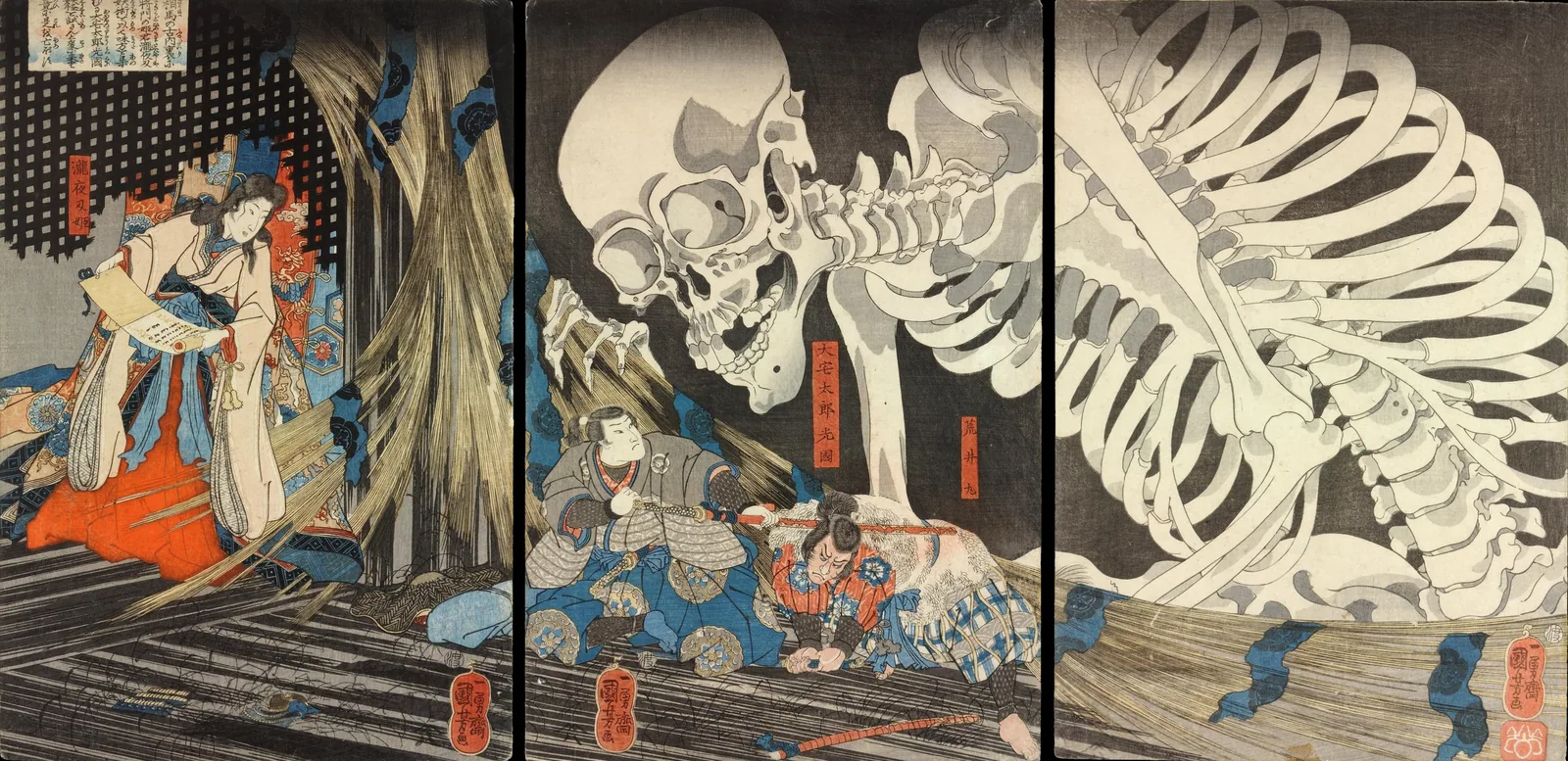
A palace at night. A princess unrolls a handscroll and recites a spell, and out of the darkness a skeleton the size of a building leans in through the palace blinds, its bony fingers tearing through them, its empty eye sockets fixed on the two warriors below. Utagawa Kuniyoshi designed this print around 1844, across three sheets of paper, and it is one of the most spectacular images in all of Japanese printmaking. It is also known as Mitsukuni Defying the Skeleton Spectre Invoked by Princess Takiyasha.
Who was Takiyasha?
The story reaches back to a real rebellion in the tenth century. Taira no Masakado was a warrior who tried to set up his own “Eastern Court” in Shimōsa Province, in defiance of the emperor. His rebellion was put down in 939, and he was defeated and beheaded.
In legend, his daughter survived him. She was Princess Takiyasha, Takiyasha-hime, and she became a sorceress who stayed on in her father’s palace. In the scene Kuniyoshi chose, an imperial official named Ōya no Mitsukuni has come looking for surviving members of the rebellion. Takiyasha summons the skeleton to frighten him off. Mitsukuni stands his ground.
One giant instead of many
Kuniyoshi made a striking choice. According to one account, the story as written told of many skeletons, of ordinary human size. Kuniyoshi replaced them with a single colossal one, so big that it cannot fit inside the palace and has to lean in from outside. The skeleton dominates the picture, and against it the people look tiny.
This is what makes the print unforgettable. A ghost story told with many small skeletons would be eerie. One huge skeleton is something else, a monster on the scale of a natural disaster, and the warriors facing it seem all the braver for it.
The skeleton that became a monster
The print has had a strange afterlife. Modern Japanese folklore has a creature called the gashadokuro, often translated as the rattling skeleton: a giant made of the bones of people who died in battle or of hunger, said to roam at night. Despite how ancient it sounds, the gashadokuro first appeared in print only in the 20th century. Kuniyoshi’s skeleton has no direct connection to it, but when artists came to draw the new monster, they based it on this print. So the popular picture of the gashadokuro, as drawn by later illustrators including Mizuki, comes from a woodblock print designed around 1844.
Takiyasha herself went on inspiring artists too. In the Meiji period, after Kuniyoshi’s time, the printmaker Toyohara Chikanobu designed his own print of the sorceress princess.
How to look at it
Take it in three steps, the way the story unfolds. First the skeleton, because you cannot help it: the huge skull, the long arm and the bony fingers pushing through the hanging blinds of the palace. Then find the princess, the cause of it all, with the handscroll from which she is reading her spell. Last, the warriors, the official Mitsukuni and his companion, facing a thing many times their size.
A triptych like this was sold as three separate sheets, each printed from its own set of carved wooden blocks, one block for each color, and the buyer laid them side by side. In many impressions you can still see the joins where one sheet meets the next. The design was planned so that the picture runs across them without a break, and the skeleton’s reach seems to carry right over the seams.
Kuniyoshi, master of warriors and ghosts
Kuniyoshi was famous above all for musha-e, prints of legendary samurai and their battles, and he liked to fill them with dreams, apparitions and omens. His breakthrough came with a series of heroes from the Chinese novel Suikoden, started in 1827. He gave the heroes elaborate tattoos, a novelty that soon influenced fashion in Edo, and the series made him popular.
He worked in a hard time for printmakers. The Tenpō Reforms of 1841 to 1843 tried to curb public displays of luxury and banned prints of courtesans and kabuki actors. Kuniyoshi got around the rules with wit, making comic prints that disguised real actors and courtesans and poked fun at the government. He also loved cats and often put them in place of people in his prints.
He was a master of the triptych, three standard sheets designed to be laid side by side as one wide picture, and from the 1820s he used the format for heroic scenes on a big scale. The shop has several of them, including the sea-dragon scene Ryūgū Tamatori-hime no zu. His pupils included Yoshitoshi, now often called the last great master of the Japanese woodblock print.
Where to see it
Many impressions of a woodblock print were made from the same blocks, so this design survives in more than one collection. The British Museum in London has one, the Honolulu Museum of Art has another, given in 1941, and the print has been shown at the Ukiyo-e museum in Kurashiki, Japan.
About this print
What we print is a reproduction of one historical impression of Kuniyoshi’s triptych, with its three sheets shown together as one picture, on modern paper or canvas. It is not an original woodblock print. Read more in our guide to Japanese woodblock prints.
Size. The picture is about twice as wide as it is tall. Our scan is 7,023 pixels on its long side, enough for a large print: up to 40 × 19 in framed, or 40 × 19 in on canvas. Framed prints, canvas and unframed art prints all go up to 40 × 19 in. The wide shape suits the wall over a sofa, a desk or a long sideboard. At 36 × 17 in the skeleton is big enough to loom.
Paper and frame. Smooth paper keeps Kuniyoshi’s fine black lines sharp. A thin black frame suits the dark night scene. See our papers and frames.
Where it works. A den, a study, a game room or a hallway, anywhere that can take a bit of drama. It is a natural pick for fans of ghost stories, manga and Japanese folklore, and it is a fine picture to hang for Halloween and leave up all year.
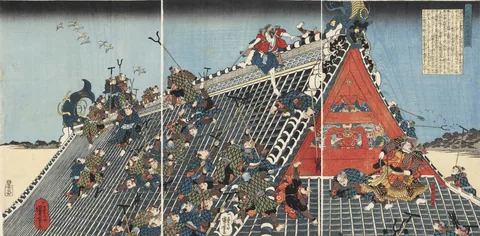
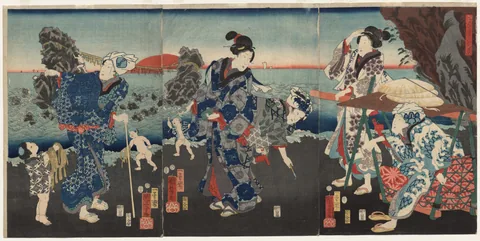
Pairing. For a pair of wide Kuniyoshi scenes, hang it with the Hōryū tower scene from the Tale of Eight Dogs, another of his wide, dramatic designs, or with the calmer sea view at Futamigaura for contrast.
Questions
What is the story of Takiyasha the Witch?
Princess Takiyasha, daughter of the rebel Taira no Masakado, summons a giant skeleton to frighten the official Ōya no Mitsukuni, who has come to hunt down the last of her father’s rebels.
Is the skeleton a gashadokuro?
Not originally. The gashadokuro is a modern folklore monster, first described in the 20th century, but its usual look is based on this print.
When was it made?
Around 1844, as a triptych of three woodblock sheets.
Is this an original woodblock print?
No. It is a reproduction of a historical impression, printed on modern paper or canvas.
Can it be printed legally?
Yes. Kuniyoshi died in 1861, and the design is in the public domain. What public domain means.
More Kuniyoshi
All Kuniyoshi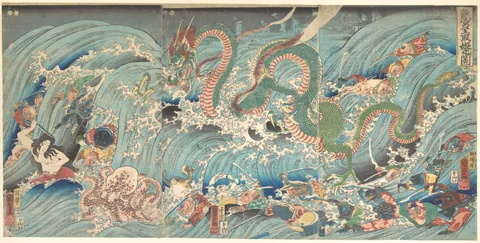
More in Japanese Woodblock.
Sources
More from the Journal
 Story · 7 min
Van Gogh’s Starry Night: the facts, and choosing a print
Painted in June 1889 at an asylum in Provence: the view from his window, plus a village he made up. What is real, what it means, and which print to choose. Story · 7 min
The Great Wave off Kanagawa: meaning, history and prints
A woodblock print, not a painting, and a storm wave, not a tsunami. What it shows, why no two impressions match, and how to choose a print. Story · 7 min
Klimt’s The Kiss: gold leaf, meaning and choosing a print
Real gold leaf on canvas, finished in 1909. The story of Klimt’s lovers, what a print can and can’t reproduce, and which size to choose. Story · 7 min