
Story
Manet’s Music in the Tuileries: who is in the crowd
A crowd of fashionable Parisians at a garden concert in 1862, including Manet, Baudelaire and Offenbach. Who is who, and how to choose a print.
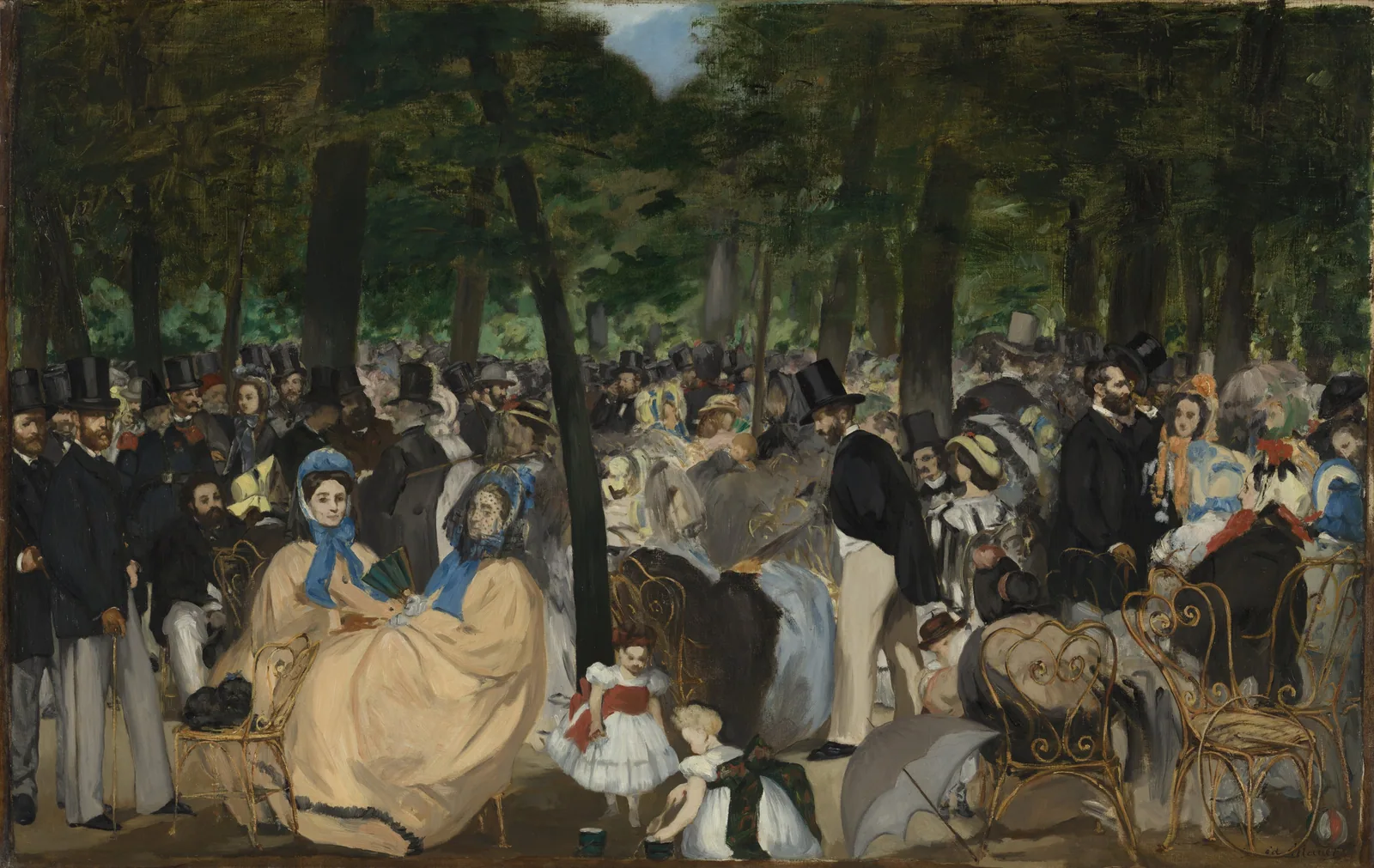
Under the chestnut trees of the Tuileries Gardens in Paris, a fashionable crowd has gathered for an open-air concert: men in black top hats, women in wide pale dresses, children playing at their feet. Édouard Manet painted it in 1862. The National Gallery in London calls it his first major painting of contemporary Paris life, and it is also a group portrait of his family and friends.
A concert you cannot see
In the 1850s and 1860s, during Napoleon III’s Second Empire, concerts were held twice a week in the Tuileries Gardens. But Manet leaves the musicians out. We cannot even tell if the music has started. Instead we stand where the band would be, looking at the audience, who are there as much to be seen as to listen.
Who is in the crowd?
Many of the faces are real people Manet knew:
- Manet himself, at the far left edge, holding a cane, half hidden by the man in front of him, the animal painter Comte Albert de Balleroy.
- Champfleury, the novelist, standing behind and between them.
- Charles Baudelaire, the poet, in profile between the critic Théophile Gautier, who leans against a tree, and the painter Henri Fantin-Latour, who looks straight at us.
- Jacques Offenbach, the composer, with glasses and a moustache, seated right of center; his wife is in the picture too.
- Eugène Manet, the painter’s brother, in a top hat and white trousers just right of center.
- Madame Lejosne, the younger of the two seated women, at whose salon Manet met Baudelaire and Bazille.
- Others include Zacharie Astruc, the painter Frédéric Bazille and Aurélien Scholl.
Putting himself at the edge of the crowd, watching, recalls Velázquez painting himself into Las Meninas, and Baudelaire’s idea of the flâneur, the stroller who observes city life.
Painted in patches
Up close, the crowd dissolves. Manet built it from dabs and touches of color, with no soft shading, and spread the figures across the canvas like a frieze with no single focus. Only a few faces are sharp, and they are flat. The writer Émile Zola said that each figure is a little patch, hardly formed.
Where is it now?
It belongs to the Sir Hugh Lane Bequest of 1917 and is shared between the National Gallery in London and the Hugh Lane Gallery in Dublin, with long loans to Dublin. Manet first showed it in March 1863 at his first solo exhibition, at Louis Martinet’s gallery in Paris.
Look closer
These details come from the scan we print from, 20,614 pixels on the long side. Pick a detail, or zoom in and drag to look around.
At the far left edge, holding a cane and partly hidden by the man in front: the painter put himself in the crowd.
Choosing a print
Wide and big. The canvas is about 30 by 46½ inches. Our largest framed print is 40 × 25 in, and unframed art prints go to 48 × 30 in. Framed prints go up to 40 × 25 in, canvas up to 48 × 30 in and unframed art prints up to 48 × 30 in. Its long shape is made for a sofa wall, a sideboard or a dining room. See what size art over a sofa. At 30 × 19 in it suits a smaller wall.
Where it works. A picture of a sociable crowd belongs where people gather: a living room, a dining room, a music room. It is a natural gift for anyone who loves Paris or music.
Which material. The picture is dark under the trees. Behind clear acrylic, dark areas reflect a facing window, so hang a framed print with side light, or choose canvas, with its matte finish and no cover. See our papers and canvas.
Frames. Gold suits Second Empire Paris; black wood echoes the top hats. See all our frames.
Manet’s Paris. Pair it with The Balcony. Open the two as a set. Read its story too.
Questions
Who is in Music in the Tuileries?
Manet himself, his brother Eugène, Baudelaire, Offenbach, Gautier, Fantin-Latour, Champfleury and others from his circle.
Where is Manet in the painting?
At the far left edge, holding a cane, half hidden by the man in front of him.
Where is the painting?
It is shared between the National Gallery in London and the Hugh Lane Gallery in Dublin.
How big is it?
76.2 × 118.1 cm, about 30 × 46½ in.
Can it be printed legally?
Yes. Manet died in 1883, and the painting is in the public domain. What public domain means.
More Paris life
All Manet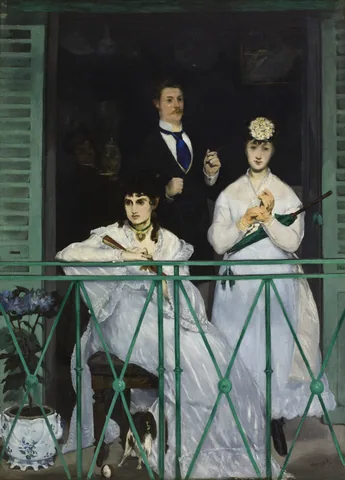
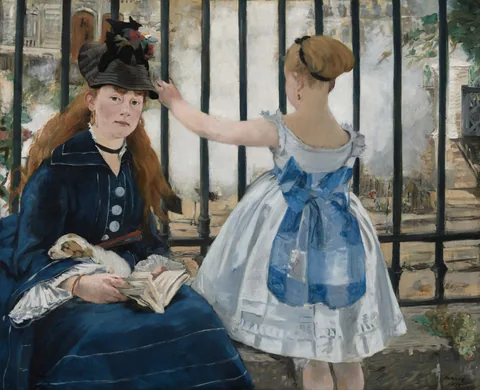
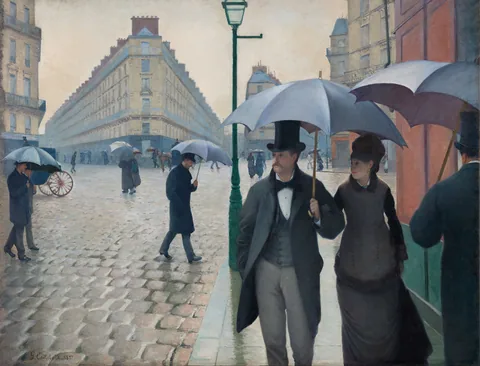
More in Impressionists and Cityscapes.
Sources
More from the Journal
 Story · 7 min
Van Gogh’s Starry Night: the facts, and choosing a print
Painted in June 1889 at an asylum in Provence: the view from his window, plus a village he made up. What is real, what it means, and which print to choose. Story · 7 min
The Great Wave off Kanagawa: meaning, history and prints
A woodblock print, not a painting, and a storm wave, not a tsunami. What it shows, why no two impressions match, and how to choose a print. Story · 7 min
Klimt’s The Kiss: gold leaf, meaning and choosing a print
Real gold leaf on canvas, finished in 1909. The story of Klimt’s lovers, what a print can and can’t reproduce, and which size to choose. Story · 7 min