
Story
The Magpie by Monet: the story of a snow painting
A black bird on a gate, white snow and blue shadows. How Monet painted The Magpie, why the Salon turned it down, and choosing a print.
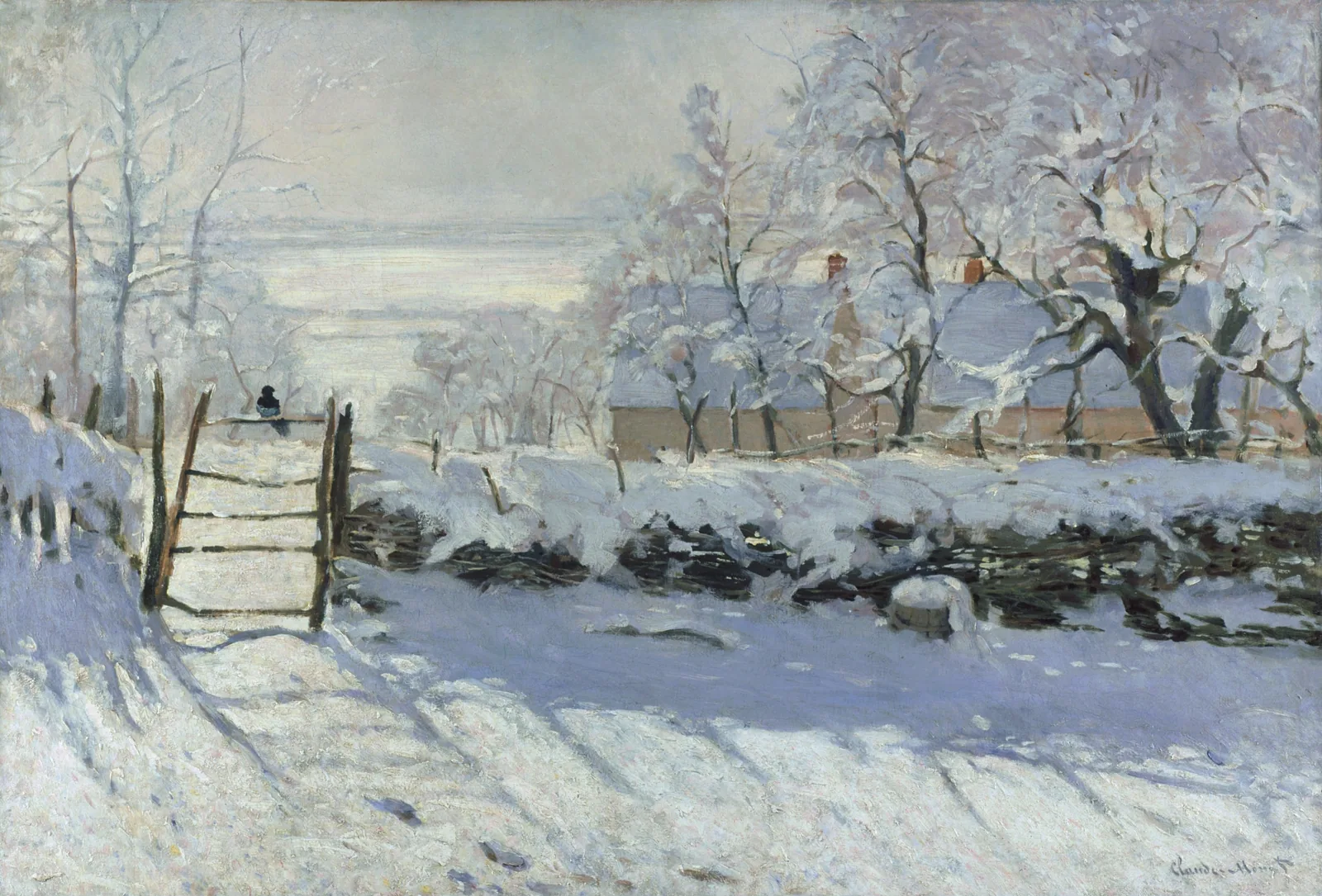
Fresh snow lies over a field and a fence made of woven branches. The sun is low, the shadows on the snow are blue, and on a wooden gate in the fence sits a single black magpie. There are no people in the picture, nothing happening at all, so the small dark bird becomes the point everything turns on. Claude Monet painted it in the winter of 1868 and 1869, in Normandy, and The Magpie, La Pie in French, is now one of the most popular paintings in the Musée d’Orsay in Paris.
Why a magpie?
There is no hidden story in the bird, no fable or symbol that Monet set out to illustrate. The magpie is there for the eye. A painting of snow is a painting of white, and white needs something to measure itself against. One small black shape, placed off center on the gate, does that job. It gives you a place to look, a sense of scale and a touch of life in a scene that would otherwise be empty. Take the bird away and you would have a fine study of snow. With it, you have a picture people remember.
Blue shadows
The real subject is light. The snow is lit by yellow sunlight, and its shadows are blue and violet, not gray or brown. That was a bold choice in the 1860s. Painters trained in the academic tradition were taught to make shadows darker, duller versions of the surface they fell on. Monet looked at what snow actually does in the sun and painted that instead: yellow light, and blue shadows that play against it as its complementary color.
The idea that colors change each other when they sit side by side was not new. The writer Johann Wolfgang von Goethe discussed colored shadows in his Theory of Colours of 1810, and the chemist Michel Eugène Chevreul published his work on color contrast in 1839. But it was painters like Monet who put such ideas on canvas, and The Magpie is one of the early examples of the colored shadows that would come to be linked with Impressionism. The historian John Rewald noted that snow scenes gave painters a way to investigate the problem of shadows, and this is one of the clearest cases.
Monet kept his palette small and his brushwork broken, laying down the snow in separate touches of cream, white, yellow and blue. The curator Lynn Orr described the way form dissolves in the color and the atmosphere, and called the painting a virtuoso study of white in snow. Michael Howard praised its evocation of the chill of a late winter afternoon, with blue shadows against creamy whites.
A winter at Étretat
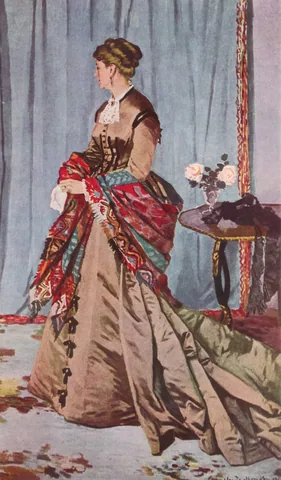
The late 1860s were hard years for Monet. In 1867 his partner, Camille Doncieux, gave birth to their first child, Jean, and his father stopped supporting him. Help came from a collector, Louis Joachim Gaudibert, who bought several of his paintings and commissioned a portrait of his wife, Madame Louis Joachim Gaudibert. Gaudibert also helped arrange a house near Étretat, on the Normandy coast, for Camille and the baby. Monet joined them there in October 1868, recovering from a low period, and by December he was in good spirits and working hard.
He liked to paint alone, outdoors, in the countryside. Painting en plein air, in the open air, was a habit he credited to his early mentor Eugène Boudin. Nobody knows exactly where he set up his easel for The Magpie. One suggestion, from the historian Ralph T. Coe, is the area around the Saint-Siméon farm above the Seine estuary near Honfleur, a place Monet had already painted in the snow.
Too common and too coarse
In 1869 Monet sent The Magpie and a picture of fishing boats to the Paris Salon, the official annual exhibition that could make an artist’s career. In April the jury rejected both. The critic Paul Richard reported that the jurors found the work too common and too coarse. The free brushwork and the unusual color probably counted against it. Monet felt the loss sharply, because a Salon showing meant buyers; he wrote that the rejection had taken the bread from his mouth.
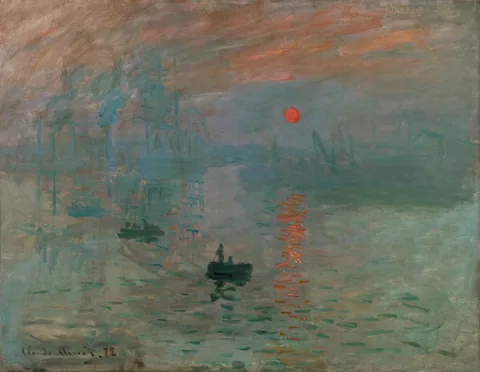
It was not an isolated case. Monet submitted to the Salon every year until 1870, and the juries accepted his work only twice. Within a few years he and his friends gave up waiting for the jury and organized their own exhibition, in 1874. A painting he showed there, Impression, Sunrise, gave the group its name.
Monet and snow
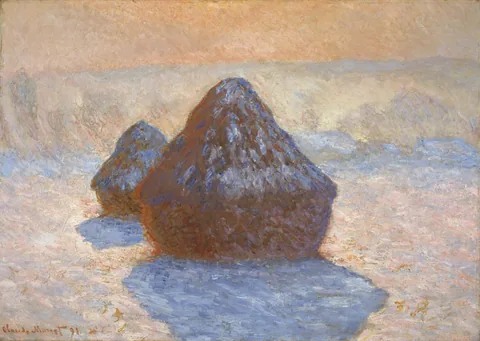
Monet painted around 140 winter scenes over his career, and The Magpie is the largest of them. His first was A Cart on the Snowy Road at Honfleur, from the mid-1860s; its exact date is still debated. The painter Gustave Courbet had been painting snow since 1856, and his example mattered to the younger artist. Monet came back to snow and colored shadows again and again, most famously in his series of grainstacks in the winter of 1890 and 1891, among them Haystacks: Snow Effect.
The painting passed through several Paris collections, including those of the dealer Durand-Ruel and the Guerlain family, before the French national museums acquired it in 1984. Art historians now count it among the finest of all his snow scenes.
Choosing a Magpie print
Size. The original is about 35 by 51 inches, wide and calm. Our scan is 4,289 pixels on its long side, and it prints sharply up to 24 × 16 in framed, or 24 × 16 in on canvas. Framed prints, canvas and unframed art prints all go up to 24 × 16 in. Its landscape shape suits the space over a sofa, a bed or a sideboard. At 24 × 16 in it fits a narrower wall or a hallway.
Paper or canvas. The picture is almost all white, cream and pale blue, and smooth paper keeps those soft differences clean. Canvas brings out the broken brushwork and has no glazing to catch reflections. See our papers and canvas.
Frames and walls. A pale wood or white frame keeps the winter light airy; a black frame picks up the magpie and the dark fence. It sits well on a white, gray or soft blue wall. See our frames.
Season. It is a winter picture without a single holiday sign, so it can stay up from the first frost to the end of March. For more ideas, see winter art prints, or read the story of another famous snow scene, Hunters in the Snow.
Questions
What does The Magpie by Monet show?
A single black magpie on a gate in a woven fence, in a field of fresh snow lit by low winter sun, with blue shadows.
Where was it painted?
In Normandy, during the winter of 1868 and 1869, when Monet was living near Étretat. The exact spot is not known; one suggestion is near Honfleur.
Why are the shadows blue?
Monet painted what he saw: snow in yellow sunlight casts blue and violet shadows. Academic painters made shadows dark and dull, so this was new.
Where is The Magpie?
In the Musée d’Orsay, Paris, since 1984. It is 89 × 130 cm, about 35 × 51 in.
Can it be printed legally?
Yes. Monet died in 1926, and the painting is in the public domain. What public domain means.
More Monet
All Monet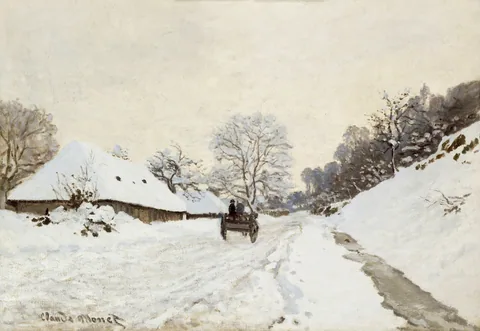
More in Birds and Animals, or read our guide to the best Monet prints.
Sources
More from the Journal
 Story · 7 min
Van Gogh’s Starry Night: the facts, and choosing a print
Painted in June 1889 at an asylum in Provence: the view from his window, plus a village he made up. What is real, what it means, and which print to choose. Story · 7 min
The Great Wave off Kanagawa: meaning, history and prints
A woodblock print, not a painting, and a storm wave, not a tsunami. What it shows, why no two impressions match, and how to choose a print. Story · 7 min
Klimt’s The Kiss: gold leaf, meaning and choosing a print
Real gold leaf on canvas, finished in 1909. The story of Klimt’s lovers, what a print can and can’t reproduce, and which size to choose. Story · 7 min