
Story
Monet’s Woman with a Parasol: the story and a print
Camille and Jean Monet on a windy summer day at Argenteuil, painted outdoors in a few hours in 1875. The story, and how to choose a print.
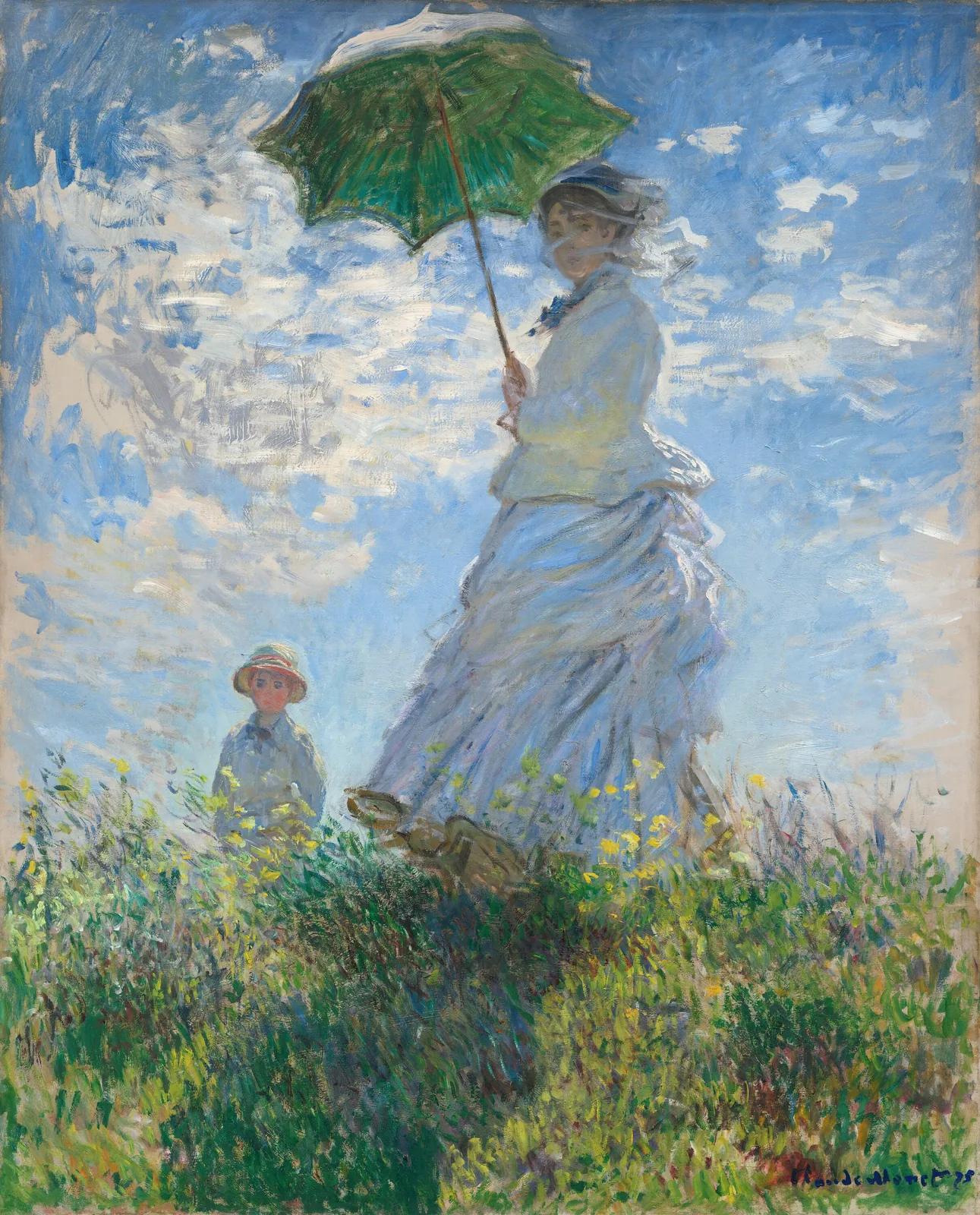
A woman stands on a grassy rise against a blue summer sky, holding a green parasol. The wind catches her veil and her white dress, and pushes the grass and flowers around her feet. A little behind, a small boy in a straw hat looks on. Claude Monet painted his wife Camille and their son Jean in 1875, probably in a single session of a few hours, and you can feel the breeze in every stroke.
Who are they?
The woman is Camille Monet, the painter’s wife, and the boy is their son Jean, then seven years old. The family lived at Argenteuil, a town on the Seine near Paris, from 1871 to 1877.
Painted in the open air
Monet painted it outdoors, en plein air, and quickly, probably in one go. That speed is why it feels like a snapshot. He looks up at Camille from below, so she stands against the sky like a monument, while Jean is further back, partly hidden by the rise of the ground.
Look at how the picture is made. The brushwork is light and spontaneous, splashes of color rather than careful outlines. Her “white” dress is painted in blues, violets and yellows, the colors of the sky and grass reflected in it. The veil and skirt blow sideways in the wind, the clouds race past, and the grass is a mass of quick dabs of green and yellow. Nothing is still.
Shown, sold, and given to the nation
In April 1876 it was one of eighteen paintings by Monet in the second Impressionist exhibition, at Paul Durand-Ruel’s gallery in Paris. That November Monet sold it to the collector Georges de Bellio. Much later, in 1965, Paul and Bunny Mellon bought it, and in 1983 Paul Mellon gave it to the National Gallery of Art in Washington, where it hangs today.
Two more women with parasols
Eleven years later, in 1886, Monet came back to the idea. At Giverny he painted his stepdaughter, Suzanne, with a parasol in a meadow, in a pair of pictures now in the Musée d’Orsay in Paris.
Look closer
These details come from the scan we print from, made by the National Gallery of Art, 15,698 pixels on the long side. Pick a detail, or zoom in and drag to follow the brushstrokes.
Camille Monet looks down at us from the top of the rise, her face half hidden by a veil blowing in the wind.
Choosing a print
Life size. The canvas is about 39 by 32 inches, and our largest framed print, 29 × 36 in, is close to it. Unframed art prints go up to 39 × 48 in. Framed prints go up to 29 × 36 in, canvas up to 32 × 40 in and unframed art prints up to 39 × 48 in.
Where it works. Anywhere you want summer: a living room, a bedroom, a sunroom or a hallway that needs light. Its blue sky lifts a dark room, and it is a lovely gift for a mother, since it is a portrait of one. At 19 × 24 in it fits a narrow wall. See our gift guide.
Which material. Canvas suits the quick, open brushwork, and its matte finish and lack of cover help in a bright room. A framed print on smooth paper keeps the sky crisp. See canvas and our papers.
Frames. A white frame keeps it fresh and airy; gold warms the yellow flowers and suits a traditional room. See all our frames and how to choose a frame color.
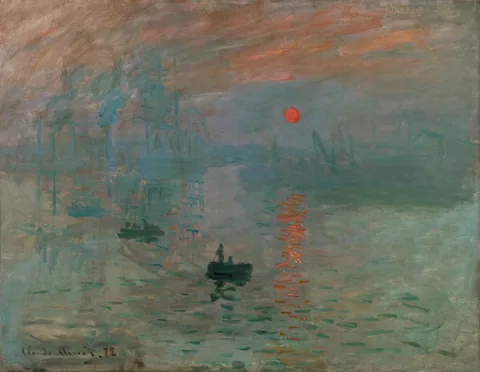
Summer at Argenteuil. Pair it with The Poppy Field near Argenteuil, painted near the same home. Open the two as a set. For Monet’s earlier breakthrough, read the story of Impression, Sunrise.
Questions
Who is the woman with the parasol?
Camille Monet, the painter’s wife. The boy is their son Jean, aged seven.
Where was it painted?
At Argenteuil, near Paris, where the Monets lived from 1871 to 1877. Monet painted it outdoors.
Where is Woman with a Parasol?
In the National Gallery of Art in Washington, a gift of Paul Mellon in 1983.
How big is it?
100 × 81 cm, about 39 × 32 in.
Can it be printed legally?
Yes. Monet died in 1926, and the painting is in the public domain, shared freely by the National Gallery of Art. What public domain means.
More Monet
All Monet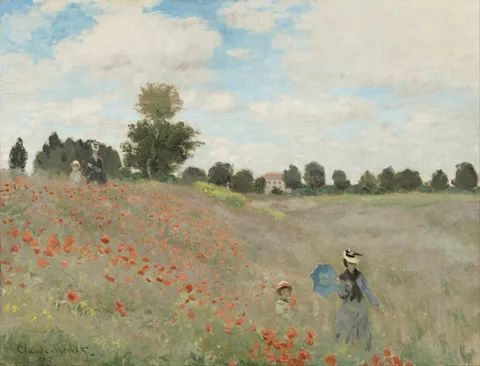
More in Impressionists.
Sources
More from the Journal
 Story · 7 min
Van Gogh’s Starry Night: the facts, and choosing a print
Painted in June 1889 at an asylum in Provence: the view from his window, plus a village he made up. What is real, what it means, and which print to choose. Story · 7 min
The Great Wave off Kanagawa: meaning, history and prints
A woodblock print, not a painting, and a storm wave, not a tsunami. What it shows, why no two impressions match, and how to choose a print. Story · 7 min
Klimt’s The Kiss: gold leaf, meaning and choosing a print
Real gold leaf on canvas, finished in 1909. The story of Klimt’s lovers, what a print can and can’t reproduce, and which size to choose. Story · 7 min