
Story
Vermeer’s View of Delft: the story and a print
Proust called it the most beautiful painting in the world. Where Vermeer stood, what he moved, the patch of yellow wall, and choosing a print.
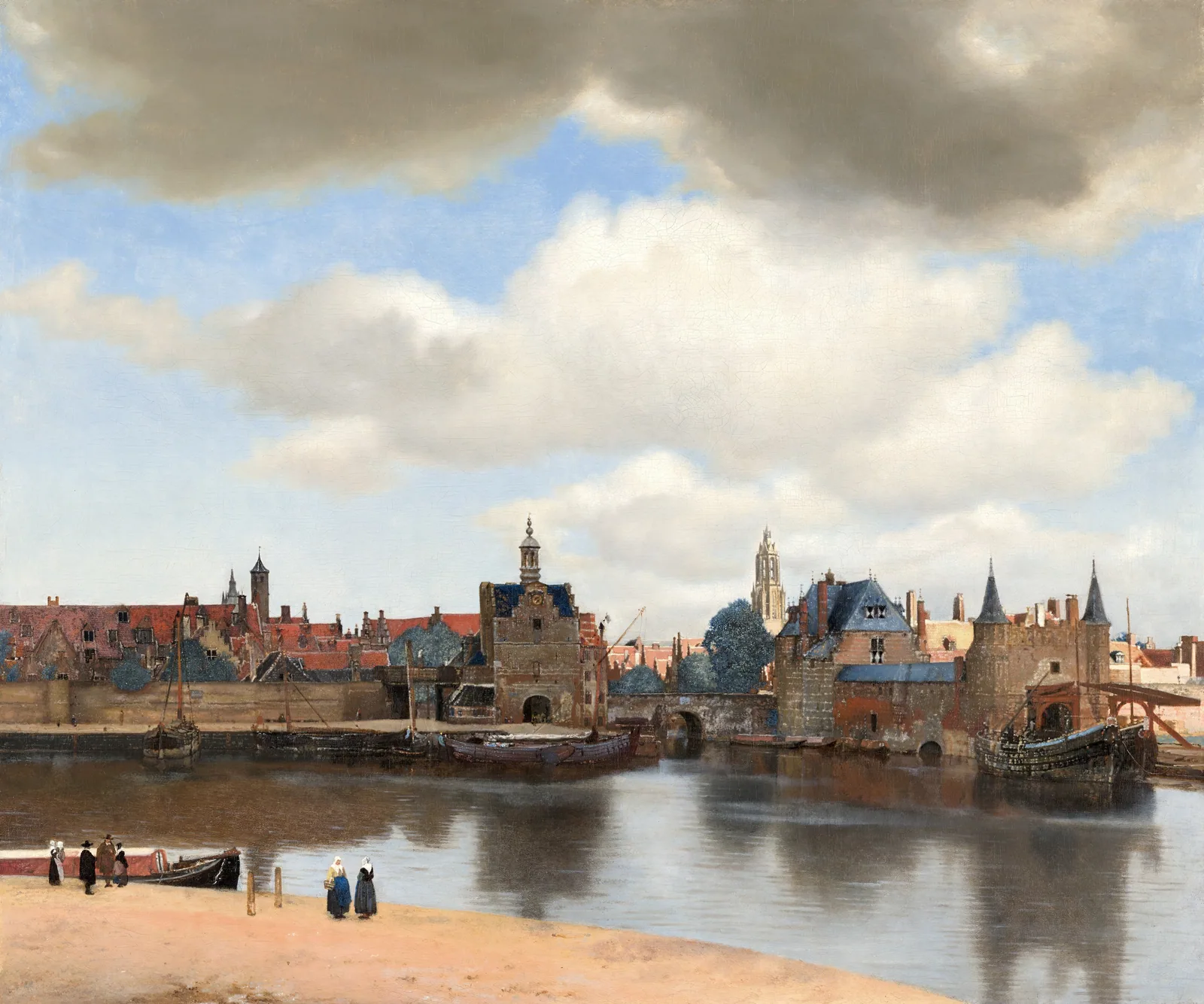
A Dutch town seen across still water under passing clouds. The near buildings are in shadow, the roofs behind them catch the sun, and half the canvas is sky. Johannes Vermeer painted his hometown around 1660, and the French novelist Marcel Proust, who first saw it in The Hague, wrote that he knew then that he had seen “the most beautiful painting in the world.”
Where did Vermeer stand?
He painted the town from the southeast, from a raised viewpoint across the harbor where the river Schie widens, a basin the locals called the Kolk, “the pond.” He may have worked from an upper floor of a building on that side. In front of him lay the city wall and two of its gates. In the middle stands the Schiedam Gate, and beside it a bridge with a clock on its roof. At the far right are the twin towers of the Rotterdam Gate, with two herring boats tied up in front. Behind the walls run the long red roofs of the town’s arsenal, and above everything rise two church towers.
What Vermeer changed
It looks like a faithful record of a real place, and mostly it is, but Vermeer arranged it. The sunlit spire of the Nieuwe Kerk, the New Church, sits closer to the center than it would from that spot, so that the brightest light in the picture falls on it. On the sandy bank in front he painted a group of people waiting to board a passenger barge, and two women talking; he first put a third figure beside them, then painted him out. And on the red inside of the barge he signed his initials.
He also chose a lucky side of town. In 1654 a gunpowder store blew up in Delft and wrecked much of the city. The south side, the one he painted, was the only part where the buildings were left untouched. So the calm, whole town in the picture is real, but it is also a careful choice.
The little patch of yellow wall
Proust loved the painting so much that he wrote it into his novel In Search of Lost Time. In the volume called The Prisoner, the writer Bergotte goes to see the View of Delft. He praises a petit pan de mur jaune, a little patch of yellow wall, and dies in front of the picture. Look at the sunlit roofs and walls behind the gates and you can see the kind of yellow he meant.
Did Vermeer use a camera obscura?
Maybe. A camera obscura is a darkened box or room that projects an image of the view through a lens. The art historian Arthur Wheelock believes Vermeer used one here, pointing to the soft, blurred highlights on the boats and buildings, the kind a lens produces. Karl Schütz insists he never did. The paint itself is known: chemical analysis found chalk, lead white, yellow ochre, natural ultramarine and madder lake.
From a Delft patron to The Hague
The painting was made for Pieter van Ruijven, a Delft patron of Vermeer. On 16 May 1696 it was auctioned with other Vermeers from the estate of Jacob Dissius and fetched 200 guilders, the top price of the sale. In 1822 the Dutch government bought it for 2,900 guilders, and it went to the Mauritshuis in The Hague, where it has been ever since.
Look closer
These details come from the scan we print from, 6,000 pixels on the long side. Pick a detail, or zoom in and drag to look around: the figures on the bank are tiny, and perfect.
The tower of the Nieuwe Kerk, lit by the sun while the gates in front stand in shadow. Vermeer moved it closer to the middle.
Choosing a print
Big, for the sky. The original is about 38 by 45½ inches, and the town is a thin band across the middle. Bigger is better here: the details on the bank and the gates need room. Our largest framed print is 30 × 25 in, and canvas goes to 40 × 33 in. Framed prints go up to 30 × 25 in, canvas up to 40 × 33 in and unframed art prints up to 40 × 33 in.
Where it works. A calm, open view suits a living room or a dining room, and anywhere you want a sense of distance on a wall without a window. At 20 × 17 in it fits over a desk or a console table.
Which material. The sky is soft and light, so reflections are less of a problem than with darker Vermeers. A framed print on smooth cotton paper keeps the tiny figures crisp. Canvas, with its matte finish, gives the clouds a painted feel. See our papers and canvas.
Frames. A wide gold frame like our Gold Plein Air picks up the sunlit roofs and gives it the look of a museum wall. Black wood is crisper and more modern. See all our frames.
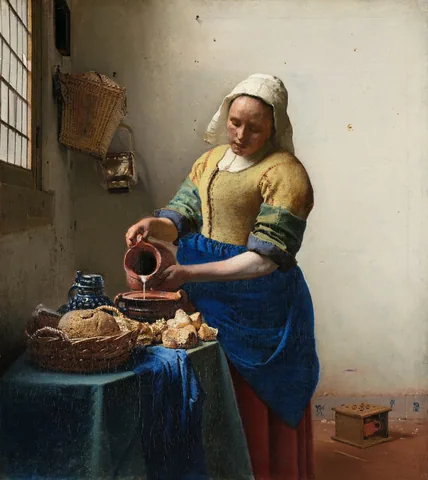
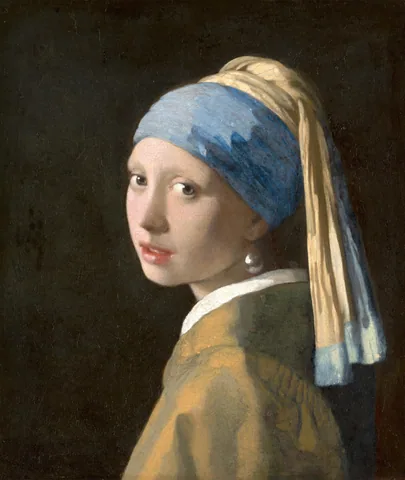
Vermeer’s Delft, twice. His other picture of the town is The Little Street, a row of houses seen up close. Open the two as a set. Read the stories of Girl with a Pearl Earring, also in the Mauritshuis, and The Milkmaid.
Questions
Where is View of Delft?
In the Mauritshuis in The Hague, in the Netherlands, since 1822.
What is the little patch of yellow wall?
A detail Proust made famous in In Search of Lost Time, where the writer Bergotte dies in front of the painting after praising it.
Is it a real view?
Yes, of Delft from the southeast across the harbor, though Vermeer moved the Nieuwe Kerk spire to give it more weight.
How big is View of Delft?
96.5 × 115.7 cm, about 38 × 45½ in.
Can it be printed legally?
Yes. It is more than 350 years old and in the public domain. What public domain means.
More Vermeer
All Vermeer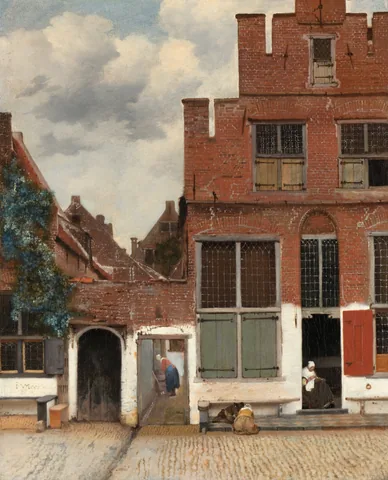
More in Cityscapes and Dutch and Flemish Masters.
Sources
More from the Journal
 Story · 7 min
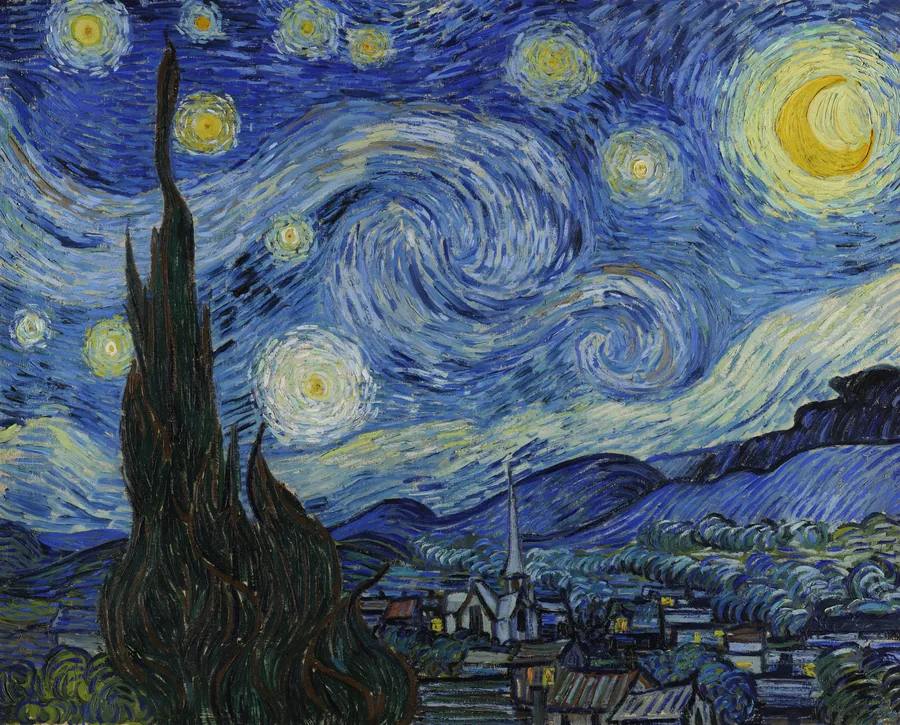
Van Gogh’s Starry Night: the facts, and choosing a print
Painted in June 1889 at an asylum in Provence: the view from his window, plus a village he made up. What is real, what it means, and which print to choose.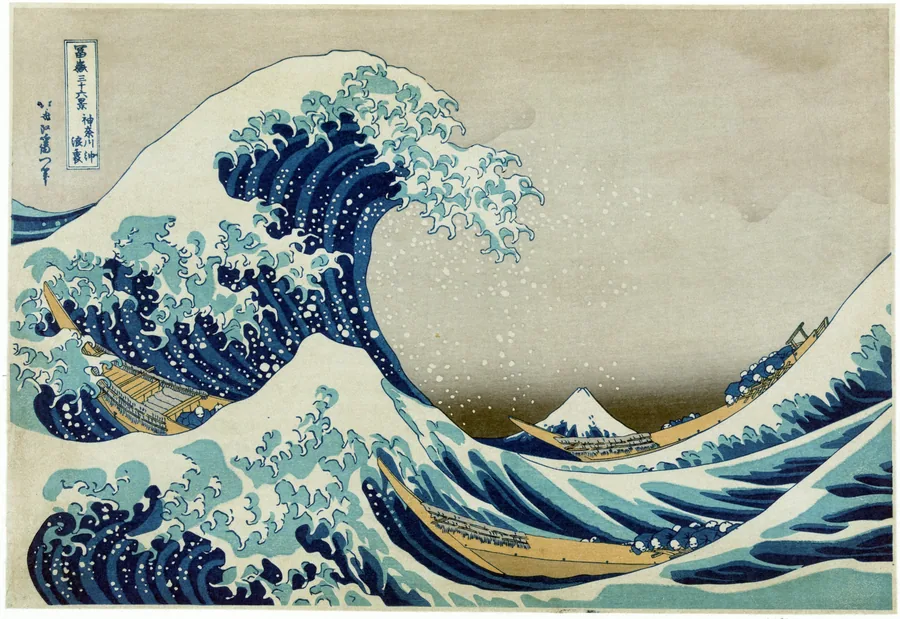 Story · 7 min
The Great Wave off Kanagawa: meaning, history and prints
A woodblock print, not a painting, and a storm wave, not a tsunami. What it shows, why no two impressions match, and how to choose a print.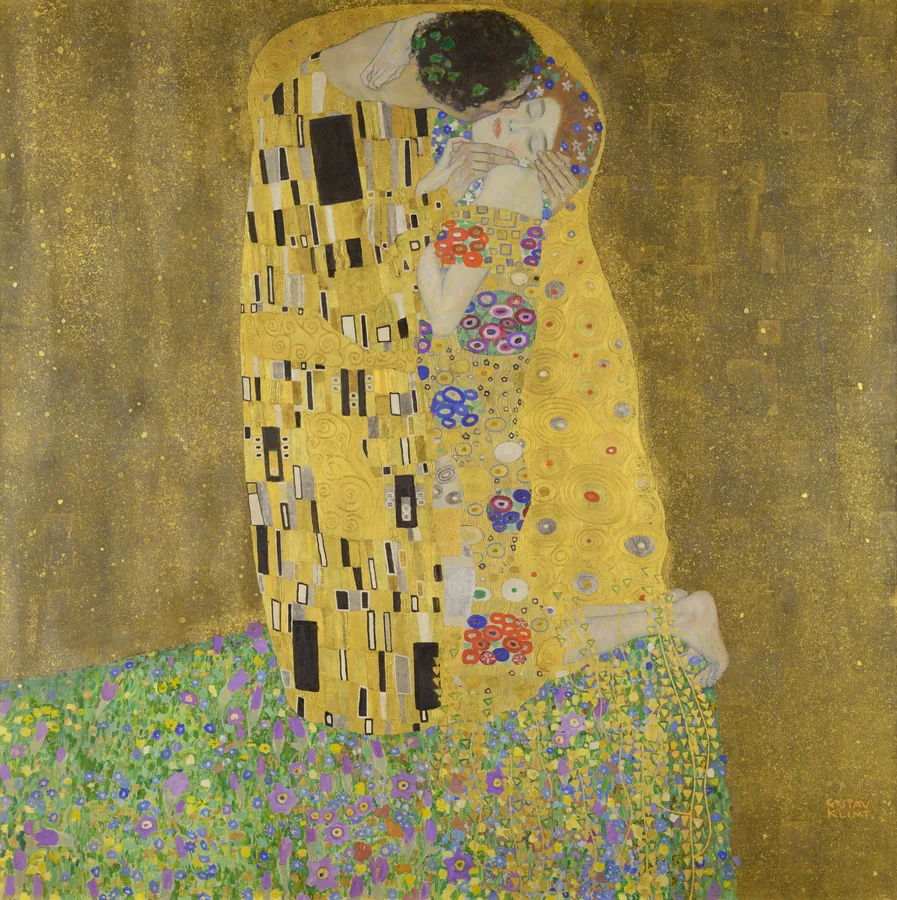 Story · 7 min
Klimt’s The Kiss: gold leaf, meaning and choosing a print
Real gold leaf on canvas, finished in 1909. The story of Klimt’s lovers, what a print can and can’t reproduce, and which size to choose. Story · 7 min