
Story
Millais’s The Blind Girl: the rainbow she cannot see
Two sisters by the road after a storm, a double rainbow and a butterfly on a shawl. What the painting means, and choosing a print.
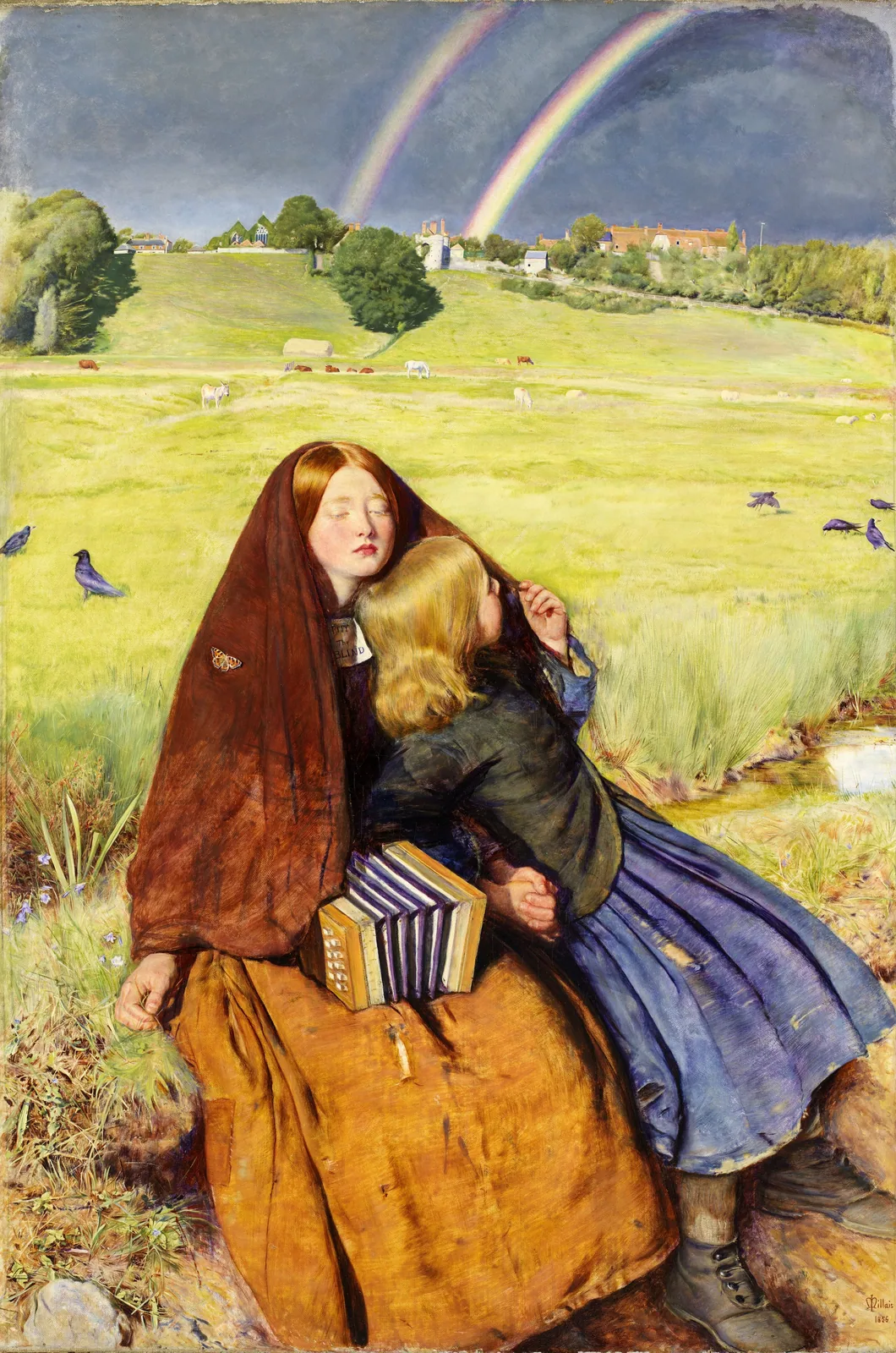
A storm has just passed. Two girls, wandering beggars and presumably sisters, rest by the roadside on their way to the town of Winchelsea, which you can see in the distance. The elder is blind, with a concertina in her lap and a card around her neck that reads “Pity the Blind.” Behind them a double rainbow has just appeared. Her little sister turns to look at it. She cannot. John Everett Millais showed the painting in 1856.
A painting about the senses
The picture is often read as an allegory of the senses. The younger girl shields her eyes and looks at the rainbow. The blind girl experiences the moment another way: she turns her face up to feel the warmth of the sun, and her fingers touch a blade of grass. The world she cannot see is still there for her to feel and hear.
A tortoiseshell butterfly has settled on her shawl. It tells us how still she is sitting, and it is one more beautiful thing she will never see. Some critics also read the rainbow as the sign of God’s promise in the Book of Genesis.
The rainbow he corrected
When the painting was first shown, in 1856, someone pointed out a mistake. In a double rainbow the colors of the outer bow run in the reverse order. Millais had painted both bows the same way. He repainted the outer one so that the science was right. Zoom in and you can check it.
Where is The Blind Girl?
In the Birmingham Museum and Art Gallery in England. It is about 33 by 24 inches.
Look closer
These details come from the scan we print from, 12,869 pixels on the long side. Pick a detail, or zoom in and drag to look around.
Eyes closed, face turned up to feel the warmth of the sun after the rain.
Choosing a print
Life size, or larger. The canvas is about 33 by 24 inches. Framed prints go up to 24 × 36 in, canvas up to 32 × 48 in and unframed art prints up to 32 × 48 in.
Where it works. A living room, a bedroom or a hallway. The tall shape suits a wall between windows or beside a door. At 13 × 20 in it fits a smaller space. See how high to hang art.
Which material. Millais painted every detail sharply. Smooth cotton paper in a frame keeps the butterfly and the rainbow crisp. See our papers and mats.
Frames. Gold suits a Victorian painting and warms the meadow; natural oak keeps it simple. See all our frames.
Millais and nature. Pair it with his Ophelia, another picture full of closely observed plants. Open the two as a set. Read its story too.
Questions
What does The Blind Girl mean?
It contrasts the senses: her sister sees the rainbow, while the blind girl feels the sun and the grass.
Why was the rainbow changed?
In a real double rainbow the outer bow’s colors are reversed. Millais first painted them the same way, then corrected it.
Where is it?
In the Birmingham Museum and Art Gallery.
How big is it?
83 × 62 cm, about 33 × 24 in.
Can it be printed legally?
Yes. It is more than 150 years old and in the public domain. What public domain means.
More Millais
All Millais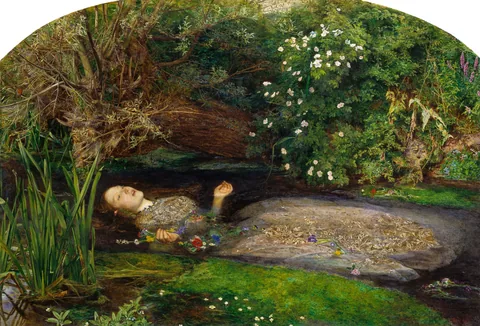
More in Landscapes.
Sources
More from the Journal
 Story · 7 min
Van Gogh’s Starry Night: the facts, and choosing a print
Painted in June 1889 at an asylum in Provence: the view from his window, plus a village he made up. What is real, what it means, and which print to choose. Story · 7 min
The Great Wave off Kanagawa: meaning, history and prints
A woodblock print, not a painting, and a storm wave, not a tsunami. What it shows, why no two impressions match, and how to choose a print. Story · 7 min
Klimt’s The Kiss: gold leaf, meaning and choosing a print
Real gold leaf on canvas, finished in 1909. The story of Klimt’s lovers, what a print can and can’t reproduce, and which size to choose. Story · 7 min